Fifteen (15) Oil & Gas in Geological Formations in NY Southern Tier:

Fifteen (15) Oil & Gas in Geological Formations in NY Southern Tier:

1) Two (2) videos to ponder:
2) Fifteen (15) Oil & Gas in Geological Formations in NY Southern Tier:
# Unit Lithology (a) Production (a) Depth (b) Thickness (a)
1 Tully Limestone Gas 2,284 0-50
2 Marcellus Shale Gas 3,483 200-600
3 Onondaga Limestone Oil & Gas 3,543 30-235
4 Oriskany Sandstone Gas 3,625 0-45
5 Akron Dolomite Gas 3,913 0-15
6 Vernon Shale Gas 4,915 450-1,850
7 Lockport Dolomite Gas 5,873 150-250
8 Rochester Shale Gas 6,136 125
9 Sodus Shale Gas 6,457 75
10 Grimsby      Shale & Sandstone Gas 6,527 75-150
11 Whirlpool Sandstone Gas 6,595 0-25
12 Queenston Shale Gas 6,837 1,100-1,500
13 Utica Shale Gas 8,952 900-1000
14 Trenton Limestone Gas 9,049 425-625
15 Black River Limestone Gas 9,637 225-550
           
(a)   NYS dSGEIS  30-Sep-209, table 4.2    
(b)  NYS DEC Searchable Data Base of 10  Van Etten wells   

Winsor Compressor Application

http://www.dec.ny.gov/enb/20110406_reg7.html#703500010600001

From: Betsy Hohenstein <brhohens@gw.dec.state.ny.us>
Subject: Dunbar Compressor Station Air Permit
To: gerriwiley@yahoo.com
Date: Monday, April 25, 2011, 3:10 PM

Hi Gerri:
Thanks for your call.  Please find attached the Draft Air permit to which the Notice refers.
The Air Permit is a Type II action under SEQR under provision 6 NYCRR Part 617 .5 (c) (35), which excludes “actions requiring a certificate of environmental compatibility and public need under articles VII, VII  or X of the Public Service Law and in the consideration of, granting or denial of any such certificate; “.
Hope this helps. Please don’t hesitate to contact me if I can be of other assistance.
Betsy

Betsy Hohenstein
Environmental Analyst
Division of Environmental Permits
NYSDEC
625 Broadway
Albany, NY   12233
phone (518) 402-9174

Regulatory Takings By Mary Jo Long, Esq.

Banning Hydrofrackingg Is Not A “Taking” of Property

By Mary Jo Long, Esq.

As the public sentiment grows for a ban on High Volume Hydrofracking (HVHF), lawyers and others who speak for corporate profit-making opportunities in natural gas say that laws banning or limiting gas drilling is a “taking” of property.  Even some who seem to be on our side make the same claim.  This claim is groundless and misguided.  It is a scare tactic to prevent public pressure on our elected officials against HVHF.

What is the Legal Status of These Claims?

  1. All property in this country is held under the implied obligation that the owner’s use of it shall not be injurious to the community.   There is no compensation for limiting that type of use of property, and
  2. A “taking” claim does not apply if the property can be used for other purposes even if those uses are not as profitable.

Consider the Source

The claim that the government (fed, state or local) will be sued to recover the value of lost property is made by attorneys and others supporting HVHHF as a method of gas drilling.  They say that we, the taxpayers, will have to pay for the lost profits due to the government’s taking of their property.  Always bear in mind that lawyers are advocates for their clients.  When a Landowners’ Coalition lawyer claims that a ban will be a taking, that lawyer is making an argument in support of his client’s position.  Making a claim (I’m going to sue you) doesn’t mean that a lawsuit will really happen nor that a Court will agree with the argument if an actual lawsuit is filed.

What Is the Law on Taking Property  by the Government

The Fifth Amendment to the U.S. Constitution provides certain protections to persons.  Included in the protections is the phrase “nor shall private property be taken for public use without just compensation.”[i]  This is the “taking” referred to by the anti-ban people.  This obligation to compensate for taking private property only applied to the federal government until the 14th Amendment to the Constitution expanded the application to state governments as well.  Eminent domain is the term most frequently used when a government takes a piece of property: land for a public park, a public road, a public school, etc.  The owner of the land is entitled to be paid for the value of the land taken from her.   Historical evidence suggests that the original intent of the takings clause did not include mere restrictions on use.

But what if the government, say through a town zoning law or a state law, BANS gas drilling without taking over title to the property where gas companies and gas leaseholders expect to drill for gas?  Are governmental laws that restrict the use of the land by restricting a profit making opportunity a “taking” when actual ownership does not change?

The notion that one can do anything he wants on his property is not the law of the land.   The US Supreme Court has said  “all property in this country is held under the implied obligation that the owner’s use of it shall not be injurious to the community.” Mugler v. Kansas, 123 U.S. 623, 665 (1887)  This principle still remains the law of the land even as Court rulings on “takings” have muddied the waters.[ii]

A town government can use its police power[iii] and zoning/land use power to restrict and prohibit uses that it considers to be detrimental to the community.  The exercise of these powers does not constitute a “taking.”  For example, the Town of Hempstead passed a law prohibiting gravel pit from excavating below the town’s water table.  This law was upheld in Goldblatt v. Hempstead, 369 U.S. 590 (1962) as a valid use of the town’s police power.  The Supreme Court conceded that the law completely prohibited a prior use by Mr. Goldblatt who had operated a gravel pit for 30 years.  But the Court held that depriving the property of its most profitable use does not make the law unconstitutional, nor a taking.

The present case must be governed by principles that do not involve the power of eminent domain, in the exercise of which property may not be taken for public use without compensation.  A prohibition simply upon the use of property for purposes that are declared, by valid legislation, to be injurious to the health, morals, or safety of the community, cannot, in any just sense, be deemed a taking or an appropriation of property for the public benefit.  Such legislation does not disturb the owner in the control or use of his property for lawful purposes, nor restrict his right to dispose of it, but is only a declaration by the State that its use by any one, for certain forbidden purposes, is prejudicial to the public interests.” Goldblatt at p.593 quoting Mugler v. Kansas.

In 1992 the Supreme Court carved out an exception to this concept in Lucas v. S.C. Coastal Council, 505 U.S. 1003.  The Supreme Court expanded the right to be compensated when new laws deprived land of all economically beneficial use.  Although Lucas still owned the land, a lower court at trial had found that the property was rendered of zero value by the law which prohibited residential construction beyond a baseline on the beachfront.  While the Supreme Court described these as “relatively rare situations”[iv], it has encouraged litigation.  At the same time as Lucas slightly expanded the takings doctrine it also reaffirmed the principle that government does not have to pay compensation when it limits “harmful or noxious uses” of property.

It is correct that many of our prior opinions have suggested that ‘harmful or noxious uses’ of property may be proscribed by government regulation without the requirement of compensation. . . .[G]overnment may, consistent with the Takings Clause, affect property values by regulation without incurring an obligation to compensate – a reality we nowadays acknowledge explicitly with respect to the full scope of the State’s police power”[v]

The Court further acknowledged that Lucas would not be entitled to compensation even though he was deprived of all economically beneficial use if his “bundle of rights” did not include the prohibited use to begin with.[vi]  Some uses of land are not a part of the land title to begin with.  When someone owns property the owner does not have the property right to have a common law nuisance.  Government actions that abate common law nuisances are per se not takings.  The Court acknowledged there are inherent limits on landowner rights, imposed under background principles of the State’s law of property and nuisance.  Thus government can still forbid deleterious uses even to the point of total takings.

Justice Scalia, who wrote the majority opinion in Lucas, says that a “total taking” of personal property would be subject to a lower standard “by reason of the State’s traditionally high degree of control over commercial dealings”[vii]   This means that there is no claim of a taking based on a gas lease, which is personal property rather than real property, i.e. land.

Those opposing a ban on hydrofracking base their claims of a “taking” on Lucas but subsequent cases have confirmed the narrowness of the ruling in Lucas.

  • Tahoe-Sierra Preservation Council, Inc. v. Tahoe Regional Planning Agency, 535 U.S. 302 (2002) (Court said moratorium was not a regulatory taking);
  • Palazzolo v. Rhode Island, 533 U.S. 606 (2001) (part of parcel was worth $200,00, so was not a total taking);
  • Lingle v. Chevron U.S.A. 125 S. Ct. 2655 (2005) (recognized that Takings cases were inconsistent.  Tried to clarify by saying the inquiry is whether the regulation is “so onerous that its effect is tantamount to a direct appropriation or ouster” i.e. functionally equivalent to the classic taking in which government directly appropriates private property or outs the owner from his property.);
  • Gazza v. NYSDEC 89 NY 2d 603 (1999),  cert. denied. (Mere diminution in value of property, however serious, is insufficient to demonstrate a taking.)

Conclusion

  1. To make a takings argument, the following conditions apply:
    1.   A taking claim cannot be based on an interest the owner never had, e.g. the right to create a nuisance.
    2.  A taking claim does not apply if the property can be used for other purposes. i.e. the economic value has not been totally extinguished.  Just because the value of the property has been reduced does not mean the owner gets to claim his “expected” profits if he were allowed to fully exploit the property.
    3. Personal property, such as a gas lease, has even less recognition as a taking, even if it is a total taking.
  1. Property rights, as well as other rights, are limited by the neighborhood of other public interests.  The highest court in NYS said in Gernatt Asphalt Products v. Town of Sardinia, 87 N.Y.2d 668 (1996):

A municipality is not obliged to permit the exploitation of any and all natural resources within the town as a permitted use if limiting that use is a reasonable exercise of its police power to prevent damage to the rights of others and to promote the interests of the community as a whole. (at page 684)

  1. The police power of the state is the power to regulate persons and property for the purpose of securing the public health, safety, welfare, comfort, peace and prosperity of the municipality and its inhabitants.

[i] “No person shall be held to answer for a capital, or otherwise infamous crime, unless on a presentment or indictment of a grand jury, except in cases arising in the land or naval forces, or in the militia, when in actual service in time of war or public danger; nor shall any person be subject for the same offense to be twice put in jeopardy of life or limb; nor shall be compelled in any criminal case to be a witness against himself, nor be deprived of life, liberty, or property, without due process of law; nor shall private property be taken for public use, without just compensation.”

[ii] In 1922 the Supreme Court ruled that the Pennsylvania legislature had overstepped the line by enacting a law forbidding people from removing coal from under other people’s houses and was held to effect a taking.  The Court said, “While property may be regulated to a certain extent, if regulation goes too far it will be recognized as a taking.” Penn. Coal Co. v. Mahon, 260 U.S. 393, 415.  In 1987 the Supreme Court in Keystone Bituminous Coal Association v. DeBenedictis, 480 U.S. 470 held that a nearly identical law was not a taking.  Property is held under the implied obligation that the owner’s use of it shall not be injurious to the community.  That principle, the court held, does not require compensation whenever the state asserts its power to enforce a prohibition that is injurious to the community.  It is a question that “necessarily requires a weighing of private and public interests.” (pp. 491-492)

[iii] Police power is the power to regulated persons and property for the purpose of securing the public health, safety, welfare, comfort, peace and prosperity of the municipality and its inhabitants.  This include prevention, suppression and abatement of public nuisances, including street nuisances and air pollution, preservation of the public peace and tranquility, protection of the public health through sanitation and disposal of waste and from the harmful effects of industrial and commercial development and proper growth of the municipality through zoning.  Article IX of the NY State Constitution; Section 10 of the Municipal Home Rule Law; Section 130 of the Town Law; Section 20 of the General City Law and Section 4-412 of the Village Law.

[iv] Lucas v. South Carolina Coastal Council, at p. 1018

[v]Lucas at p. 1022-1023 citing  Penn Central Transportation Co. v. New York City,  438 U.S. 104, 125 (1978)

[vi] Lucas at p. 1027.

[vii] Lucas at 1027.

Water station could help Painted Post cash in on fracking – Corning, NY – The Corning Leader

Water station could help Painted Post cash in on fracking – Corning, NY – The Corning Leader.

Local group warns Auburn on gas well water Apr. 18, 2011

AuburnPub.com

Local group warns Auburn on gas well water

Christopher Caskey / The Citizen | Posted: Monday, April 18, 2011 3:05 am

A group of local citizens concerned about natural gas drilling is calling on the city of Auburn to tighten regulations related to gas well water at its sewage treatment plant.

A letter signed by 75 people questioned how the city can trust that the companies currently dumping well water at the plant to follow the rules. They specifically pointed to a recent public notice that announced citations against six natural gas drilling companies for failing to file proper monitoring reports in 2010.

The group, which calls itself the Cayuga Anti-Fracking Alliance, wants the city to do one of two things. Either charge an “exorbitant price” to take the water and require all drilling firms to accept any future liability related to environmental or health impacts from the water, or refuse to take natural gas well water altogether.

City and state regulations currently ban any water from the controversial Marcellus shale formation and from wells that use a process known as high-volume, horizontal hydraulic fracturing (or fracking, for short) from going into the city’s wastewater plant.

The firms cited in March for the reporting violations were also forced to produce certification that no water from the Marcellus Shale was discharged into the local plant.

“How do we know that this is the case apart from taking natural gas companies at their word?” the group asks in their letter to the Auburn City Council.

“Bluntly put, the natural gas industry has no incentive to tell the truth,” the letter later states.

Members of the city council say they are intrigued by the group’s concerns. Auburn Mayor Michael Quill said on Thursday that the council will hold a work session in the coming weeks to try and answer some questions and discuss issues related to processing well water at the city plant.

Quill said he is interested in studying legislation in other municipalities about processing well water and see if the city should change its own regulations. A work session on the issue would be a way to “get everyone in a room together talking to each other” about the issue, he said.

“None of us want anything (processed at the plant) that’s detrimental to the environment,” Quill said.

Councilor Gilda Brower said she’s also watching the issue closely. She said on Thursday that the city may have to do more testing of the water that comes through. Though Brower said she’s in favor of going even further, at this point.

“I would support a ban, for sure,” Brower said.

The city’s wastewater plant has accepted natural gas well water for more than a decade. But that water, and natural gas drilling, has become the focus of controversy in recent years.

The horizontal hydrofracking process is used to pull large amounts of natural gas from the Marcellus Shale, a large underground formation that runs through parts of New York’s Southern Tier and Pennsylvania.

The natural gas well water processed at the Auburn plant mostly comes from wells in the Trenton Black River, Queenston, Oriskany and Oneida formations in New York state and is hauled by a handful of companies. The water is considered industrial waste, and the city must include all sources in an industrial pretreatment program filed with the federal Environmental Protection Agency.

Each hauler must report the wells and formations from which the water comes.

The wastewater from the Marcellus wells contains higher levels of contaminants, radioactive materials, chlorides and dissolved solids than water from a typical gas well that uses a conventional, vertical drilling process. The water coming into the Auburn site contains lower concentrations of contaminants, according to city officials.

The state is currently in the process of finishing an environmental review for horizontal drilling in the Marcellus formation. And as that process continues, the members of the Cayuga Anti-Fracking Alliance are one of dozens of environmental groups looking to ban horizontal drilling in New York state.

Auburn resident Beth Cuddy, who helped bring the local group together, said she started focusing on the issue recently when she saw in a national media report that said Auburn accepts well water.

She described the organization as an “informal group,” though she said they plan to organize local rallies and events to raise awareness about the hydrofracking issue. This weekend they held private screenings of a documentary on the issue, and Cuddy said they are looking for other times and places to hold similar screenings.

They also plan to continue lobbying local officials and raise awareness about environmental issues surrounding hydrofracking.

“I don’t see any way it (hydrofracking) can be done where it doesn’t affect the water,” Cuddy said. “I don’t understand why anyone would want to destroy the one resource we need to survive as a human race.”

Staff writer Christopher Caskey can be reached at 282-2282 orchristopher.caskey@lee.net. Follow him on Twitter at CitizenCaskey.

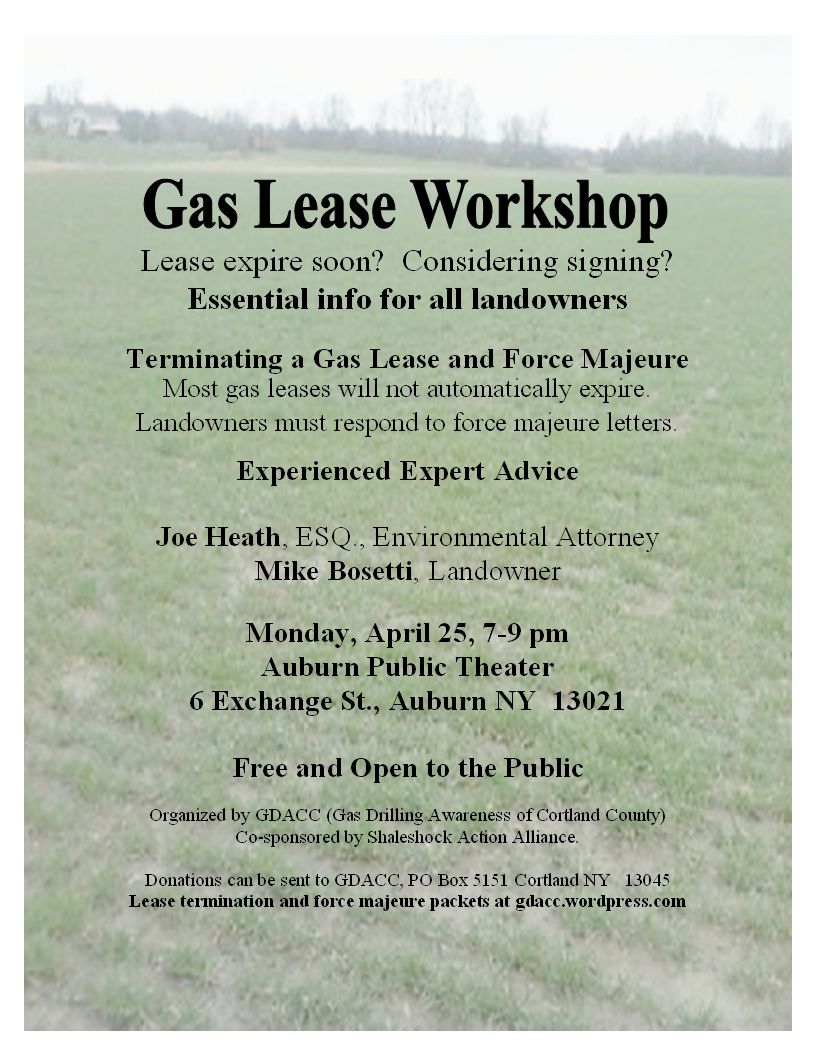
Gas Lease Workshop Apr. 25th Auburn Public Theatre

The rime of the upstate anti-fracker Daily Star 4/9/11

April 9, 2011

The rime of the upstate anti-fracker

Anonymous By Art Siegel The Daily Star Sat Apr 09, 2011, 03:24 AM EDT

In Samuel Coleridge’s oft-quoted late 18th-century poem of the violation of nature and Christian redemption, “The Rime of the Ancient Mariner,” the title character laments, “water, water, everywhere, Nor any a drop to drink.”

An albatross, a good luck omen to sailors, had been pursuing the mariner’s ship for days. The mariner thoughtlessly kills the great seabird, invoking the wrath of the spirits of the sea.

The ship is tossed into the windless doldrums, where it remains until the ship’s water supply is exhausted and the crew severely dehydrated. The vengeful crew wrapped the seabird around the mariner’s neck as a kind of “Scarlet Letter.”

While the fantasy of this faraway mariner’s life-threatening dehydration may seem irrelevant to the risks posed by rural life in upstate New York or urban life in New York City, this fantasy may be a far more imminent possibility than most New York state residents can yet imagine.

Why?

Some of the nation’s richest reserves of natural gas are trapped in the tight, difficult-to-access shales of the Marcellus Formation, some of which lie several thousands of feet below the surface in a broad, 18,000-square-mile swath across New York state’s Southern Tier. The formation covers 95,000 square miles across several states, including Pennsylvania and West Virginia.

The oil and gas drilling industries have already leased tens of thousands of acres in the watersheds that supply 27 million consumers in five states _ New York, New Jersey, Pennsylvania, Delaware and Maryland _ with clean, potable and mostly unfiltered and affordable water.

Using a relatively new, aggressively intrusive method _ horizontal hydraulic fracturing _ well drillers penetrate the earth vertically to reach the tight shales, then extend horizontally for up to a mile.

The 3 to 8 million gallons of water for each individual well are drawn from local aquifers, streams and rivers to facilitate the drilling process. Eighty to 300 tons of “proprietary” chemicals, the identities of which are unknown to the public, are used with the drilling water.

The Federal Energy Policy Act of 2005 exempts the oil and gas industries from disclosing chemical drilling recipes, and exempts them from regulation under the Environmental Protection Agency’s Clean Water and Clean Drinking Water acts.

However, the EPA labels oil and gas drilling by-products as the most hazardous industrial wastes in the nation.

Approximately 1 million gallons of drilling wastewater laden with toxic chemicals, normally occurring radioactive materials (NORMS) and total dissolved solids (TDS) will be recovered from the well bore and stored on site until they can be removed and processed at an appropriate wastewater processing facility _ the type of which only exists in a few locations in the entire country.

After drilling, the gas is released from the shale by water and sand under explosively high pressures. Some of the recovered methane, a greenhouse gas 25 times more potent than carbon dioxide, along with a miasma of volatile organic compounds, will be “flared off” at the wellhead before the useable gas can be contained.

With an economy of scale throughout the full range of the Marcellus’ 95,000 square miles _ 6 to 10 wells per square mile _ the gas drilling industry claims it can provide enough gas to

See Frack on Page D2

meet the nation’s current gas consumption needs for 100 years. Yet the U.S. population of 310 million will reach 450 million by 2050, according to the U.S. Census Bureau. That implied increased consumption would considerably shorten that projected supply period, even if current per capita use remained stable.

Moreover, subsidizing the gas industry with costly tax exemptions and EPA exemptions that threaten public health and safety are tantamount to feeding the world’s most consumptive society’s insatiable fossil fuel addiction, instead of treating it with heavier subsidies for genuinely renewable energy sources such as wind and solar. The Rocky Mountain Institute asserts that if the 40 least electrically efficient states in the U.S. were to achieve the electrical efficiency of the 10 most efficient ones, national electricity use would be cut by one-third _ the equivalent of shutting down 372, or 62 percent, of the nation’s 600 coal-fired power plants.

Exclusive use of LED (light-emitting diode) lighting in the U.S. would reduce electrical energy use for lighting by 75 percent. Worldwide exclusive use would reduce global electrical energy consumption by 12 percent. And that’s only the beginning.

The New York City Department of Environmental Protection’s Final Impact Assessment Report (released in December 2009 by a hydrological civil engineering company) details a host of additional risks posed by hydraulic fracturing to the purity of the 1 million-acre New York City watershed in the Catskill region.

Many thousands of trucks laden with toxic wastewater would be simultaneously plying town, county and state roads adjacent to streams, rivers and reservoirs. Naturally occurring and hydraulic-fracturing-related fissures and fractures in rock formations would provide pathways through which highly toxic drilling chemicals and NORMS could migrate under pressure to aquifers and aqueducts.

The “ancient mariner” in Coleridge’s fantastical poem was ultimately redeemed by his own contrition and the forgiveness of Christ, even though all his crewmates perished by dehydration because he had violated the natural law of the sea. Our elected state officials may not benefit from that same kind of redemption and may be compelled to wear an albatross of shame if they fail to act at this decisive moment.

While the DEP report has been available since 2009, two governors, the state Legislature and the state Department of Environmental Conservation still have not acted decisively to ban hydraulic fracturing in New York state. They produce only moratoriums, fatally flawed drafts, and hearings in public auditoriums where concerned citizens speak to DEC stenographers who mechanically record their eloquent remonstrations on an otherwise vacant, unresponsive public platform.

When I interviewed state Assemblyman James Brennan of the 44th Assembly District, he characterized the proposed hydraulic fracturing in the New York City watershed as “the industrialization of the region.” Brennan courageously sponsored a bill in the Assembly that would cut the Gordian knot of disparate opposition and effectively ban hydraulic fracturing in anyone’s watershed. A similar bill, SO 1234, was sponsored by Sen. Tom Duane in January. The bill is now with the Senate’s Environmental Conservation Committee, with little or no support.

This is no time for quibbling over an industrial process that is inherently dangerous, regardless of the most restrictive regulations or oversight, which no state agency has the staff to implement. Budgeted to the bone, the DEC has 19 staff to supervise what could become tens of thousands of hydrofracking wells in the state. Let’s get real.

All that glitters may not be gold or oil or gas, but the sparkling surface of a pristine river or reservoir.

Art Siegel is a certified tree farmer with The National Tree Farm System and an independent filmmaker. His film “Parcelizing the Catskills and the Boiled Frog Syndrome,” which features interviews with local, New York City and state elected and agency officials on environmental issues affecting the Catskill Region, is being screened at the Frank W. Cyr Center in Stamford on Saturday.
Deep Drilling, Deep Pockets Expenditures of the Natural Gas Industry in New York to Influence Public Policy Part II – Lobbying Expenditures A Report by Common Cause/New York April 2011

CC_REPORT_FINAL.PDF (application/pdf Object).

Common Cause/NY Releases Report Reflecting Large Infusion of Money to Influence Policy Decisions on HydrofrackingPro Industry Lobby Groups Outspend Those Opposing

Gas Drilling by 4-1


Susan Lerner, executive director of Common Cause/NY:  “New York State’s policies regarding hydrofracking will have a profound impact on the future of our state.  It is imperative that those policies are not unduly influenced by large infusions of special interest dollars. The fact that natural gas special interests outspent environmental groups 4-1 last year underscores the need for the public to monitor the state’s decision-making process and raises serious questions about our elected officials’ ability to remain independent and impartial.”

The proposed use of hydraulic fracturing technology, also called hydro-fracturing or, more commonly, hydrofracking, to drill for natural gas in New York State remains highly controversial.  Industry and some upstate landowners continue to press to be permitted to use hydrofracking, particularly to unlock the natural gas found in the Marcellus Shale, citing job creation and the need for new energy sources, while environmental groups and others urge caution, pointing to potential risks to New York’s water, air and natural resources. To assist the public in monitoring this difficult decision and how it is made, Common Cause/New York has continued and expanded its analysis of lobbying expenditures by those who seek to influence this critical decision.

Today, Common Cause/NY released the results of that analysis in their report, Deep Drilling, Deep Pockets, Lobbying Expenditures of the Natural Gas Industry to Influence Public Policy, Part II, which provides a detailed analysis of the presence of a large money push to influence New York State’s public policy decision-making process in regards to natural gas extraction policies.

The report’s analysis of lobbying disclosures shows that it is not only the natural gas industry that is seeking to influence the state’s policies regarding natural gas exploration.  A powerful consortium of business groups has allied itself with the natural gas industry to oppose the moratorium on hydrofracking.  That consortium, made up of energy companies, business and professional associations in addition to natural gas companies, spent a total of $2,869,907 lobbying last year, grossly outspending those that lobbied in support of the bills by $2,143,525 or four to one.

Much of this was due to substantial amounts spent for advertising by Chesapeake Appalachia, the nation’s second largest producer of natural gas and the biggest spender among industry advocates of hydrofracking. In the first half of 2010, Chesapeake spent an astounding $836,386 on advertising to the public via billboard signage, television advertisements focused on the benefits of natural gas, and even a short film production.

New York State’s policies on hydrofracking will have a profound impact on the future of our state. It is imperative that those policies are not unduly influenced by large infusions of natural gas industry dollars. The uneven balance in spending on lobbying and advertising by pro- and anti-moratorium groups  reflects the massive resources at the disposal of natural gas interests and is indicative of  the growing need for special interest money to be countered by the grassroots involvement of an informed public.

To prepare Deep Drilling, Deep Pockets, Lobbying Expenditures of the Natural Gas Industry to Influence Public Policy, Part II, Common Cause/NY accessed and obtained copies of the bi-monthly lobbying reports filed by the companies we had previously identified in our July, 2010 lobbying report. In that report, we analyzed the lobbyist expenditures of three natural gas companies from the year 2005 through the first half of 2010, as well as expenditures by five environmental groups. This report brings earlier data up to date with full year 2010 figures and expands our analysis to look more fully at lobbying expenditures spent lobbying in favor or opposition to two moratorium bills introduced last year. We examined the bi-monthly lobbying reports available for 2010 on the NY Commission for Public Integrity website in detail to compile the lobbying data for each company and entity identified as having lobbied on the moratorium bills introduced in the previous legislative session, S7592/ A10490 and S8129B/A1143B.

SEE FOLLOWING SAMPLE CHARTS FROM REPORT BELOW


###

_________________________________

For more information about Common Cause New York, go to:

http://www.commoncause.org/site/pp.asp?c=dkLNK1MQIwG&b=4847595

Sign up to receive news updates from Common Cause/NY


Follow us on Twitter @commoncauseny

Like us on Facebook at:http://www.facebook.com/CommonCauseNewYork

Groups Warn Governor Cuomo About Gas Extraction Plan

An excellent demonstration of the power of letter-writing and media attention!

Groups warn Cuomo about gas extraction plan

Posted on March 30, 2011 at 1:02 pm by James M. Odato in General

About 40 groups, ranging from Neighbors of the Onondaga Nation to Trout Unlimited, wrote to Gov. Andrew Cuomo Tuesday advising him to put the brakes on allowing hydraulic fracturing that they said would pose risks as currently planned. Companies are eager to drill into the deep shale deposits below New York’s surface to extract natural gas.

“We are writing to you on an issue of urgent importance to all New Yorkers – assuring that New York State does not rush to allow risky new drilling techniques in the Marcellus and Utica Shale formations unless the protection of the State’s drinking water supplies and other irreplaceable resources can be demonstrated,” the groups, including Common Cause and the Natural Resources Defense Council, wrote.

“Specifically, we ask that you clearly confirm that the New York State Department of Environmental Conservation (DEC) will be allowed both adequate time and resources to fully and properly evaluate the full range of potential risks associated with new natural gas development utilizing hydraulic fracturing, or “fracking,” before issuing a revised draft Supplemental Generic Environmental Impacts (DSGEIS) pursuant to Executive Order 41 (EO 41). Simply put, the arbitrary June 1, 2011 target date established by former Governor David Paterson in EO 41 is wholly inadequate to allow for the development of an appropriately comprehensive or legally sufficient revised DSGEIS.”

The letter was copied to Department of Environmental Conservation Commissioner Joe Martens.


AP Interview: New York drilling regs may take all summer

Published: Thursday, March 31, 2011, 9:36 AM     Updated: Thursday, March 31, 2011, 9:41 AM
The Associated Press By The Associated Press The Post-Standard

ALBANY, N.Y. (AP) — Joe Martens, the new head of New York’s Department of Environmental Conservation, says gas drilling in the massive Marcellus Shale formation is the most daunting environmental issue the agency has faced in its 40-year history, but he’s hopeful rules will be in place by summer’s end to address all the potential impacts.

In an interview with The Associated Press Wednesday, Martens said DEC staff will meet twice a week starting in early April and through the summer to complete a new environmental impact statement for gas drilling that addresses issues raised in the 13,000 comments received on the first draft completed in September 2009.

New York has had a moratorium on gas drilling in the Marcellus Shale since 2008 while new rules are being developed.


MIT WellWatch

MIT WellWatch