Considerations for Surface Use Agreements — Natural Gas — Penn State Cooperative Extension

Considerations for Surface Use Agreements — Natural Gas — Penn State Cooperative Extension.

Considerations for Surface Use Agreements

Posted: April 10, 2011

Many landowners are being approached to lease land for surface use for infrastructure. What should a landowner be aware of? Here are some items to consider

Landowners across many areas of Pennsylvania are being approached by natural gas companies for surface use agreements.  These agreements cover various surface activities such as the placement of access roads, compressor stations, water impoundments, pipeline activity, or gas storage infrastructure on the landowner’s property.  The terms and conditions of surface use agreements depend largely on the type of infrastructure proposed.  However below are some important items to consider when approached about any type of surface use agreement. These items are provided to illustrate the range of items to consider and are not meant to be a comprehensive list of surface use addenda:
1. Who has access to the site and where is the access point/route?
2. How much traffic will the site receive on a daily basis? How frequently do workers need to visit the site?
3. It may be wise to limit the agreement to only the stated use and not open to unrelated uses (for instance an agreement for a pipe valve should not let the company install a metering station, compressor or other structure).
4. Consider further limiting the agreement to the current structure and not allow additional structures to be built without negotiating terms with the landowner.
5. Define all products allowed to be transported through the infrastructure. For pipeline infrastructure it could be limited to natural gas (not oil, not waste water, not hazardous waste). For water infrastructure, you may want to limit it to fresh water (not brines or waste water).
6. Map in advance the exact location and area used for the structure. Any changes to the location of the structure or access routes need to be approved by the landowner.
7. The landowner should have a map showing pre-defined areas for the activity, both during construction and after.
8. Consider site security issues. Is the site fenced and locked? Will there be gates on access roads? Will the landowner have a key to gates?
9. Define the length of the agreement and include specific terms for ending the contract and removal of the equipment.
10. Include terms for restoring the site after construction and final restoration after the agreement has ended.
11. Terms for damage payments and site restoration for any repairs or upgrades to the structure.
12. Consider what the site will look like when completed. Can it be landscaped or fenced to screen the structure from view?  Is the structure open or enclosed (in a building)? Can it be disguised through building design or landscaping to blend into the landscape or community?
13. If it’s a pipeline related piece, are nearby homes outside of the ‘impact area’ should there be a leak or explosion? (the operator can provide these distances based on gas pressure, etc).
14. A landowner could request drinking water monitoring if water-related infrastructure is being proposed, or sound and air emissions monitoring for compressors or other pipeline related structures.
15. Does the surface use agreement violate any conditions of an existing gas lease or right-of-way agreement on the property?

In addition to the above list, standard items such as landowner liability, dispute resolution and transferability of the agreement should be considered. All of these items should be in writing and part of the agreement or contract rather than a verbal agreement with the landman. As with any contract or agreement, it’s important to have an experienced attorney, with knowledge of the oil and gas industry, review any contracts before you sign. An attorney can also be helpful in negotiating terms with a landman on your behalf.

~Dave Messersmith, Wayne County Extension Educator
Neighborhood vs. neighbor: In towns 1,500 miles apart, gas rush causing a ruckus | Star-Gazette | stargazette.com

Neighborhood vs. neighbor: In towns 1,500 miles apart, gas rush causing a ruckus | Star-Gazette | stargazette.com.  Apr. 16, 2011

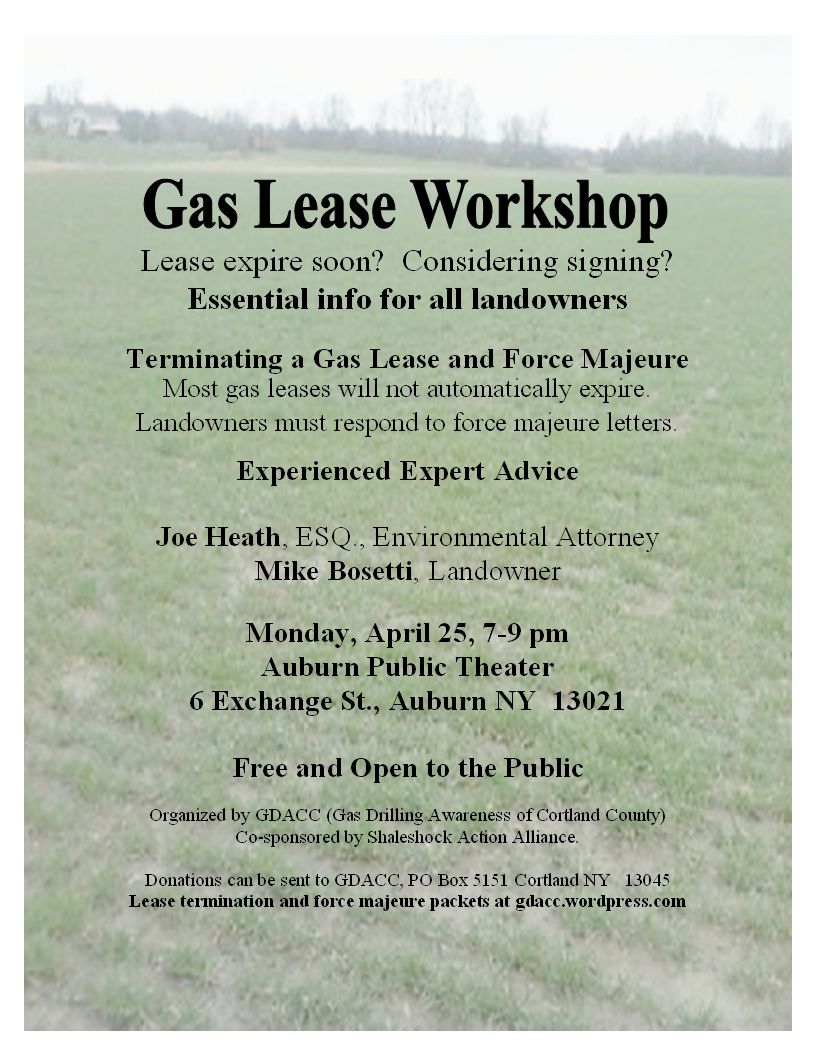
Gas Lease Workshop Apr. 25th Auburn Public Theatre

United States, Energy & Natural Resources, Superior Court Interprets Oil and Gas Lease in Favor of Landowners – Schnader Harrison Segal & Lewis LLP – 03/03/2011, Energy Law, Oil, Gas & Electricity

United States, Energy & Natural Resources, Superior Court Interprets Oil and Gas Lease in Favor of Landowners – Schnader Harrison Segal & Lewis LLP – 03/03/2011, Energy Law, Oil, Gas & Electricity.

United States: Superior Court Interprets Oil and Gas Lease in Favor of Landowners

03 March 2011

With the recent increase in activity in the oil and gas industry in Pennsylvania, disputes between developers and landowners over the interpretation of oil and gas leases are inevitable. In its most recent opinion on the subject, the Pennsylvania Superior Court held that landowners properly terminated leases where the developer had not commenced drilling by the end of the primary term of the lease. In so holding, the Court concluded that continued delay rental payments after expiration of the primary term did not extend the term of the lease.

In Hite v. Falcon Partners, et al., 2011 WL 9632 (January 4, 2011), the landowners had entered leases with a developer in December 2002 and October 2003. The leases contained the following provision, which identified a primary term and also incorporated a traditional habendum clause (providing that lease term continues “so long thereafter” as oil or gas is produced) and a delay rental clause:

3. Term. Lessee has the right to enter upon the Property to drill for oil and gas at any time withinone [sic] (1) year from the date hereof and as long thereafter as oil or gas or either of them is produced from the Property, or as operations continue for the production of oil or gas, or as Lessee shall continue to pay Lessors two ($2.00) dollars per acre as delayed rentals, or until all oil and gas has been removed from the Property, whichever shall last occur.

Drilling never commenced on the property; instead, the developer (and its assignees) continued to pay delay rentals to the landowners for a period of five years. After obtaining offers from other developers and complying with the right of renewal clauses in the leases, the landowners declared that the leases were terminated.

The Court first reviewed the history of oil and gas lease interpretation in Pennsylvania stretching back to the 19th century. In reviewing this history, the Court concluded that delay rental provisions “have a well settled meaning” — that is, to provide something to the landowner in lieu of royalties from production. The Court further found that these clauses “typically” are concerned with the primary term of the lease only, and it reviewed all of the reasons why such clauses typically are restricted to a lease’s primary term. Historically, the delay rentals clause was developed not only to provide some compensation to the landowner, but also to limit the period in which drilling may be delayed. If delay rentals could be used to extend a lease indefinitely, the lease essentially would be a “no term” lease and may unreasonably restrict the landowner’s ability to use or transfer the land.

Based on this history, the Court concluded, “[t]o find as Falcon urges, that it may pay delay rental indefinitely, thereby denying Plaintiffs the opportunity to reap the financial benefits of actual production, would be contrary to the decisions of our Courts, at odds with the presumed intention of the parties in executing the leases in the first place, and in stark contrast to the clear opinion of the courts of Pennsylvania that the obligation to pay delay rentals is intended to ‘spur the lessee toward development.'”

Although the Court based its decision on a long line of cases interpreting oil and gas leases, the clause at issue in this case was not a typical clause. The standard oil and gas lease has been modified many times over the years, but most modern leases include habendum and delay rental clauses that are separate and apart from the clause which defines the primary term of the lease. In this case, all these clauses were combined into one “term” clause. As a result of this structure, the lease could have been interpreted in a different manner. In particular, the Court could have found that, because the delay rental clause was included in the same clause that defined the primary term, the parties intended for the delay rentals to extend the primary term.

Interestingly, the Court stated that the unusual lease language compelled its decision: “Specifically, the language pertaining to the one year primary term and the delay rental due on an annual basis, used in conjunction, is not typical, and, as we will explain, require us to affirm the lower court’s summary judgment in Plaintiffs’ favor.” To the contrary, however, the Court’s decision appears to be based not on the specific language of the lease, but on the historical interpretation of oil and gas leases generally. Even if the Court focused on the specific language at issue, it would have been very reluctant to issue a ruling that would allow a developer to extend the primary term indefinitely, at least absent the clear intent of the parties.

This decision suggests that the courts may focus less on the specific language of a particular lease and more on the principles underlying the development of modern oil and gas leases. While this may provide more consistency for landowners and the oil and gas industry, it may make it more difficult to deviate from standard lease constructions unless the parties’ intentions are spelled out clearly in the lease.

www.schnader.com

The content of this article is intended to provide a general guide to the subject matter. Specialist advice should be sought about your specific circumstances.

Energy companies insist they can extend gas leases; landowners take them to court | syracuse.com

Energy companies insist they can extend gas leases; landowners take them to court | syracuse.com.

Energy companies insist they can extend gas leases; landowners take them to court

Published: Sunday, February 27, 2011, 10:10 AM     Updated: Sunday, February 27, 2011, 11:43 AM

2011-02-17-db-Hydrofracking.JPGMark Petitte crossed out a clause on his gas drilling lease with Chesapeake Energy that would have allowed the company to automatically renew the lease when it expired Feb. 11. The company says it is extending the lease on his Otisco property anyway.

Residents With Expiring Leases Fight Extensions

Residents With Expiring Leases Fight Extensions–Cortland Standard Feb. 22, 2011

The Marcellus Effect: NY Landowners Fed Up with Unfair Lease Extensions

The Marcellus Effect: NY Landowners Fed Up with Unfair Lease Extensions.

Marcellus Shale: The Real Price of Compulsory Integration In New York

Marcellus Shale: The Real Price of Compulsory Integration In New York.

NY Gas Development and Leasing Issues-Cortland SWCD Feb. 28 7pm

Cortland SWCD – Home Page.

New York Gas Development Update & Leasing Considerations (2/28/2011, Grange Auditorium, Free and Open to Public)

An educational seminar on natural gas exploration is scheduled for Monday February 28th, from 7pm to 9pm at the New York State Grange Headquarters in Cortland, NY.  The seminar will focus on future leasing considerations, how to ensure an expired lease is released by gas companies along with an update on gas development in NY.

As policy makers and stakeholders continue to debate the risks and benefits of natural gas development in New York, the outlook is still unclear.  Much of upstate New York contains significant natural gas reserves that will continue to attract the gas industry.  Therefore, rural landowners will still be faced with complicated decisions regarding drilling and related activities such as pipelines, compressor stations, water storage and access roads.

Brett Chedzoy, an expert from Cornell Cooperative Extension will be providing an update on the current status of gas development in NY and highlight key leasing recommendations for landowners.  Joe Heath, Esq. will be on hand explaining the process of getting an expired lease released by a gas company.   He will also share some of the tactics gas companies are using to attempt to extend existing leases, some of which are preventable.  The seminar will also take a glimpse at our neighbors in Pennsylvania, painting a picture of what our landscape may look like when exploration activities commence in NY.

This seminar is sponsored by the Cortland County Soil and Water Conservation District (SWCD) and is free and open to the public.  If you have any questions about the seminar or any of the services or programs provided by the SWCD please call 607-756-5991