Community Meeting on I-81 Proposed Pipeline
September 6, 2013
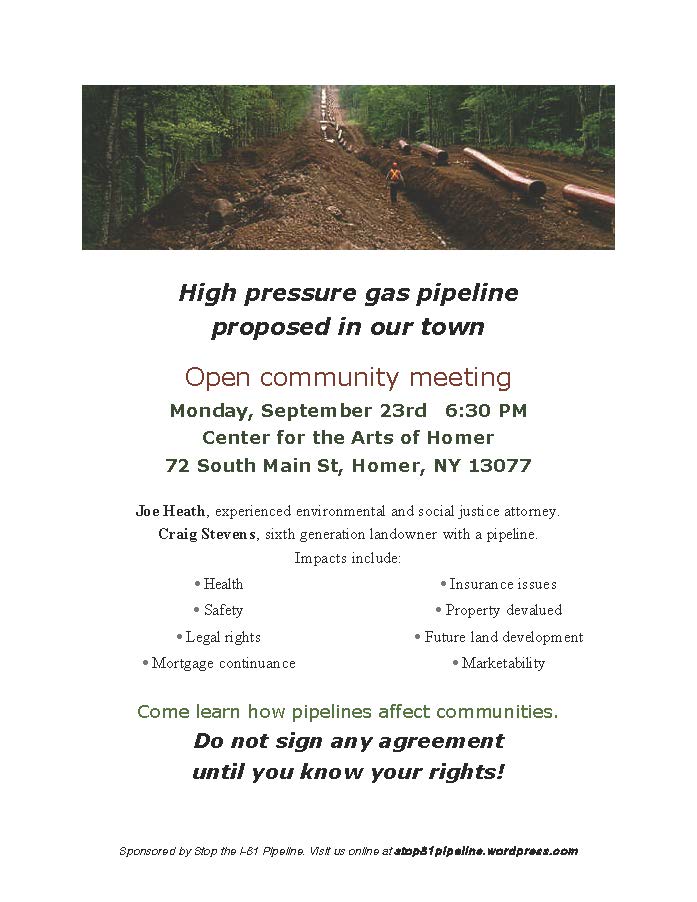
Sept. 23 Public Meeting Homer
Gas Drilling Awareness for Cortland County
July 22, 2013
MORE IN NEW YORK »By
- WILL JAMES
A proposal to build a natural-gas facility off Long Island and New Jersey has turned into a proxy for the debate about hydraulic fracturing, the gas-drilling technique that remains banned in New York state.
Liberty Natural Gas LLC is asking the federal government for permission to build a facility where ships carrying liquefied natural gas would dock, vaporize the gas and pump it into the New York City area.
The company says it will never use the $300 million terminal in the Atlantic Ocean to export the gas overseas. But opponents are skeptical, saying the facility to be called Port Ambrose could drive a hydraulic-fracturing boom in the Northeast as the U.S. natural-gas industry appears poised to pivot from importing to exporting.
Federal agencies are reviewing the application, but environmental groups from the Catskills to the Jersey Shore are lobbying Gov. Andrew Cuomo, a New York Democrat, and Gov. Chris Christie, a New Jersey Republican, both of whom have the power to stop the proposal.
“Fracking in New York state will be made possible because of this facility that is being proposed off of our shores,” said Jeremy Samuelson, the executive director of Concerned Citizens of Montauk, an environmental group in eastern Long Island.
A spokesman for Mr. Cuomo said: “We are monitoring the federal process.” A Christie spokesman didn’t respond to requests for comment. In 2011 and 2012, Mr. Christie vetoed two proposals by Liberty to build offshore terminals, citing environmental and security concerns.
Liberty, based in Manhattan, said it wanted only to exploit a niche market in the New York City area, where winter prices rise because pipeline capacity falls short of demand.
“We’ve identified New York City as a particularly attractive seasonal peak market during the winter months,” said Liberty Chief Executive Roger Whelan.
Industry experts backed the Liberty business plan’s logic. “It’s not totally crazy, because of the constraints to deliver to the New York City area,” said Kenneth Medlock, senior director of the Center for Energy Studies at Rice University, in Houston. “It’s a way around pipeline constraints.”
Hydraulic fracturing—widely known as fracking—involves the injection of millions of gallons of water, sand and chemicals into the earth to break up shale rock and release natural gas. Critics cite concerns about groundwater pollution, hazardous byproducts and the release of methane, a potent greenhouse gas.
Parts of New York state sit on the Marcellus Shale, a rock formation rich in untapped natural gas. A moratorium on widespread, high-volume fracking has been in place since 2008 as New York state government officials weigh whether to allow it. It is legal in other states, such as Pennsylvania, Ohio and West Virginia, that also sit atop the formation.
The U.S. Coast Guard and the Maritime Administration are conducting an environmental review of the Port Ambrose proposal, which would be 20 miles southeast of Jones Beach on Long Island and 28 miles east of Long Branch, N.J.
Port Ambrose would consist of two submerged buoys—each 33 feet tall and 24 feet in diameter—moored to the sea floor where ships could stop and turn liquefied natural gas into its gas form. The gas would travel through underwater pipelines into an existing pipeline serving New York City and Long Island.
The Maritime Administration ultimately will rule on the application, but it must deny it if Mr. Cuomo or Mr. Christie expresses opposition.
The proposal comes at a dynamic time for the gas industry. U.S. prices have been dropping for years as new production methods such as fracking have driven a domestic boom.
As U.S. natural gas production has hit record heights in recent years, more companies have been seeking to ship it overseas. Port Ambrose is one of four pending import terminals, while there are 20 seeking to export, according to the Federal Energy Regulatory Commission.
A representative for Neptune LNG Deepwater Port, an offshore terminal in Massachusetts Bay near Boston designed to exploit a niche similar to the one eyed by Liberty in New York, said last week that low natural-gas prices have rendered the facility inactive for years and it planned to suspend operations.
Neptune was one of only two operational offshore ports designed to import liquefied natural gas—like Port Ambrose.
Even though Neptune is shutting down, Mr. Whelan said the Boston area still relies on liquefied natural gas from other facilities in the winter, due to pipeline constraints. “It really is an apples and oranges comparison,” he said. “We still believe there’s a very strong market in the winter months for this kind of supply into New York City.”
Some of the contention over Port Ambrose hinges on whether it would be legal or technically feasible to switch an import facility to an export facility.
Mr. Whelan said he wouldn’t seek to export gas from Port Ambrose because it wouldn’t be legal under the federal license he seeks. Liberty’s opponents say federal law allows the Maritime Administration to easily amend licenses without having to solicit public input, and they want the federal government to take the impacts of exporting the gas and fracking into consideration.
The Maritime Administration said if Liberty sought to export liquefied natural gas from Port Ambrose, it would be required to file a new application and restart a lengthy review process. The current application is being considered exclusively for importing, a spokeswoman said.
Emerging technology will allow exporters to liquefy natural gas on vessels and ship it from offshore terminals like Port Ambrose, but Mr. Whelan said that technology was prohibitively expensive, costing billions of dollars. “It would be insanity to install an export facility,” he said.
A version of this article appeared July 22, 2013, on page A19 in the U.S. edition of The Wall Street Journal, with the headline: Offshore Plan Spurs Debate On Fracking.
July 5, 2013


I will try to add this legend to the map itself.
BH
July 5, 2013
June 29, 2013
By Joe Mahoney Staff WriterThe Daily Star
December 3, 2012
US oil and gas pipeline safety and risk assessment developments.
Pipeline and Hazardous Materials Safety Administration (PHMSA
This is a good synoptic statement about Federal pipelines; there are also many that are within state and they are built and operated under state authority.
November 8, 2012
PA DEP Oil & Gas Reporting Website – Statewide Data Downloads By Reporting Period.
This database shows that much PA unconventional drilling waste is coming to NY for disposal
Spreadsheet showing waste transported to NY from PA Chesapeake wells from Jan to June, 2012. Most is drill cuttings deposited in Painted Post and Niagara Falls landfills.
 GDACC
GDACC 

