Conrad Dan Volz at the DEP’s Advisory Commission Meeting – mary.beilby@gmail.com

 Conrad Dan Volz at the DEP’s Advisory Commission Meeting –

http://www.youtube.com/watch?v=YepP7139Q0k

Protesters and concerned citizens spoke out against the Marcellus Shale fracking during the DEP’s Advisory Commission Meeting in Harrisburg.  Apr. 27, 2011

Chesapeake Energy – Frack Spill in Leroy, PA on Vimeo

Chesapeake Energy – Frack Spill in Leroy, PA on Vimeo on Vimeo

via Chesapeake Energy – Frack Spill in Leroy, PA on Vimeo.

Madison County lawmakers urge Albany to adopt tough oversight role, strong ‘fracking’ rules | syracuse.com

Madison County lawmakers urge Albany to adopt tough oversight role, strong ‘fracking’ rules | syracuse.com.

State geologists mapping deep aquifers – News – Daily Review

State geologists mapping deep aquifers – News – Daily Review.

State geologists mapping deep aquifers

by robert swift (Harrisburg Bureau Chief)
Published: April 26, 2011
Article Tools

| Font size: [A] [A] [A]

Sign Up newsletter

State geologists are mapping the location of the deepest water aquifers in response to the upsurge in natural gas drilling in the Marcellus Shale formation.

With Marcellus wells reaching several thousand feet deeper than traditional shallow gas wells, locating the deep aquifers will tell geologists where potable water supplies that could be affected by drilling operations can be found.

The Pennsylvania Topographic and Geologic Survey, one of state government’s oldest offices dating to 1836, is taking on new work as a result of Marcellus development, survey director George Love told the citizens’ advisory council for the Department of Conservation and Natural Resources.

Geologists are also consulting an extensive water well inventory as part of this effort. Under state law, drillers of water wells are required to submit a public record after completing a new well.

In addition to locating aquifers, the survey is starting to examine the impact of hydrofracking operations on groundwater supplies, he added.

Love said the survey’s aim is to provide unbiased information.

The survey’s geologists routinely provide information about groundwater supplies, geologic formations and hazards and the location and extent of mineral deposits to state and local officials, commercial firms and the public as well.

The survey’s regional studies are of particular use to local and regional planning commissions, said Love.

Long before the Marcellus drilling became a phenomenon, the survey’s oil and gas division conducted extensive studies of Pennsylvania’s oil-and-gas producing areas to show where future prospecting would pay off.

By studying geologic data from oil and gas wells, the survey produces maps and cross-section diagrams as well annual production reports for minerals.

The roots of the survey lie in the development of the coal and iron industries in the early 19th century. The anthracite fields of Northeast Pennsylvania were among the first areas surveyed. The early surveys also identified potential routes for roads and railroads serving the new industries.

In the modern area, the survey provides information about sinkholes in the limestone-bearing regions of southern Pennsylvania and likely underground storage sites for any future program to sequester carbon emissions from coal-fired power plants.

The survey is perhaps best known for its series of quadrangle and county topographic maps that are the basis of planning, land development, agriculture and recreation projects.

Contact the writer: rswift@timesshamrock.com

Add New Comment

Required: Please login below to comment.

Showing 3 comments

Real-time updating is enabled. (Pause)
  • tea_for_sanity 2 days ago
    Pennsylvania playing catch up yet again. Fracking is not new. Our government had ample time to examine the havoc wreaked in other states and been forewarned. Any studies such as this and action plans derived from them should have been in place long before the first well permit was issued.
  • CamptownGal 2 days ago
    Better late than never, but it does seem that they mapped the assets that they could extract long before they paid any attention to the irreplaceable water aquifer that the extraction may affect.
    A bit like taking inventory AFTER the fire when taking it before the fire may have spurred the thought to take better care of it in the first place.

  • ConcernedBC 1 hour ago
    Such a stupid state (politicians) to jump into this without basic studies.

comments powered by Disqus

Lease Termination Workshop May 17, Cortland

LANDOWNER’S  GAS LEASE WORKSHOP


EXPERT ADVICE


TERMINATING A GAS LEASE

Most gas leases will not terminate automatically at expiration date unless the landowner takes action.


RESPONDING TO FORCE MAJEURE

Landowners need to respond to Force Majeure letters being received from gas companies.


JOE HEATH, ESQ.

ENVIRONMENTAL ATTORNEY


MIKE BOSETTI

LANDOWNER

(TERMINATED LEASE SUCCESSFULLY)


Betsy Larkin

Cortland County Clerk

Tuesday  May 17, 2011  7 – 9 pm


Cortland County Office Building Auditorium

60 Central Ave., Cortland, NY

Organized by GDACC

(GAS DRILLING AWARENESS FOR CORTLAND COUNTY)

P.O. BOX 5151, CORTLAND, NY 13045

SEE  GDACC’S WEBSITE FOR LEASE TERMINATION AND FORCE MAJEURE PACKETS:

http://www.gdacc.wordpress.com


Co-sponsored by:

Office of the Cortland County Clerk

Cortland County Legislature’s Ag Planning & Environment Committee

Cortland County Farm Bureau

Interactive Map: Fossil Fuel Accidents

Interactive Map: Fossil Fuel Accidents.

Alternative Radio : Vandana Shiva : War on the Earth

Alternative Radio : Vandana Shiva : War on the Earth.

War on the Earth
Vandana Shiva
Available Formats
CD: SHIV016aC $16.00
MP3: SHIV016aM $5.00
Transcript: SHIV016aD $7.00
Where recorded: New Dehli, India
Date recorded: 11 Feb 2011

The predatory practices of corporations are increasingly turning our fragile garden into a junkyard. Citizens are told by their political masters and the corporados who pay them that there is no alternative. That’s true if one’s only concern is profits. That approach is fast turning our planet into a toxic waste dump. The landscape of environmental devastation extends from radiation leaks in Japan to drilling in the Alberta tar sands to hydofracking in Pennsylvania and New York to leveling mountains in West Virginia to more drilling in the Gulf of Mexico. However in India, the site of some of the worst corporate abuses, there is tremendous popular resistance. Some of the poorest people anywhere are saying, Stop the plunder. No to the war on earth.

Vandana Shiva
Vandana Shiva is an internationally-renowned voice for sustainable development and social justice. She’s a physicist, scholar, social activist and feminist. She is Director of the Research Foundation for Science, Technology and Natural Resource Policy in New Delhi. She’s the recipient of the Right Livelihood Award, the alternative Nobel Prize. She is the author of many books, including “Water Wars,” “Earth Democracy,” and “Soil Not Oil.”

Ernst v. EnCana Corporation | Landowner Jessica Ernst sues EnCana and Alberta government regulators over water contamination

Ernst v. EnCana Corporation | Landowner Jessica Ernst sues EnCana and Alberta government regulators over water contamination.

Fracking Spill Response In Pennsylvania Took 13 Hours Despite State’s Quick-Action Plan

Fracking Spill Response In Pennsylvania Took 13 Hours Despite State’s Quick-Action Plan.

The Marcellus Effect: An Economic Perspective

The Marcellus Effect: An Economic Perspective.

Tuesday, April 26, 2011

An Economic Perspective

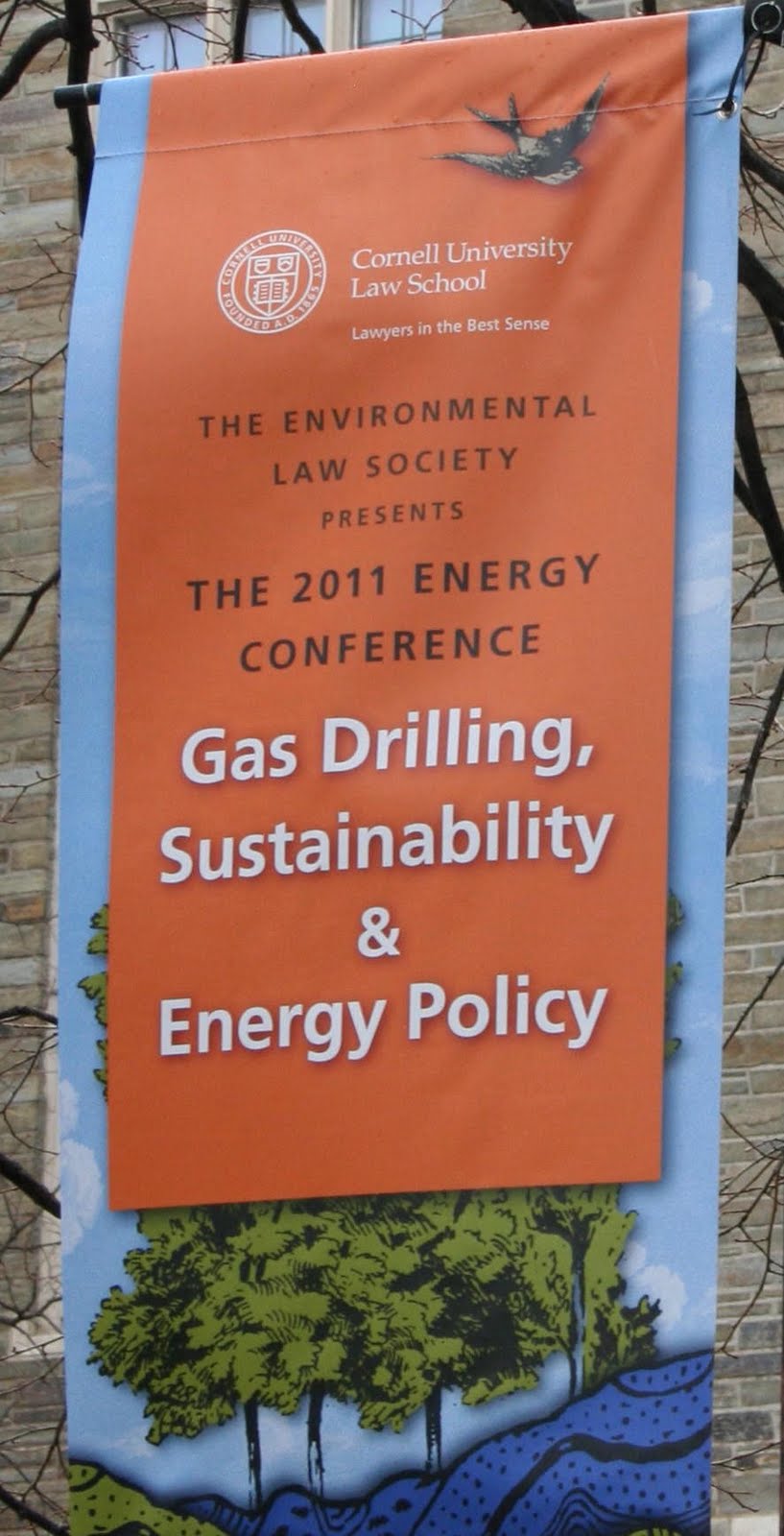
During the April 1-2 Environmental Law Conference up at Cornell, professor of city and regional planning Susan Christopherson provided some economic perspective to the Marcellus Shale discussion. “Drilling affects everything in a community,” she said, listing topics from traffic to housing to community health.
“There are so many uncertainties,” Christopherson said. “We don’t know what all the risks are, or who will bear them.” What we do know is that the roads will be heavily impacted by the increased traffic.
Shale drilling is driven by the market. The industry is debt-driven and looking for commercially viable wells and that will determine where they drill and how long they remain in a locality. Like the financial services, shale drilling is “a speculative bubble,” Christopherson said, “but one with serious environmental consequences.”
Drilling impacts are driven by the pace and scale of development. “We should plan for a short-term intensive boom/bust cycle, as well as the impact of building an infrastructure to get their [gas] product to market,” Christopherson said. She said municipal and state officials need to think beyond the well pad and consider cumulative impacts of industrialized drilling activity.
“There will be increased public safety costs,” Christopherson said, pointing to the correlation between the need for more police and shale gas drilling. Other community impacts include increased costs for health and education services, and increased demand on public administrative services such as permitting and zoning officers, and an increased need for environmental remediation and monitoring.
Communities that don’t experience drilling may still feel the impacts. Ithaca will see increased truck traffic, and Watkins Glen is already seeing development of an industrial site for storing liquefied gas and petroleum products. There will be more, she said: pipelines, man camps, water withdrawal sites, compressor stations, truck depots, rail spurs and “trucks, trucks, trucks!”
The big question: are we prepared for the bust? “It will surely come,” Christopherson warned, “because once the gas is gone, it is gone.” And the rural areas will be the ones hardest hit by the boom/bust cycle. The increased housing costs will push out traditional residents; the demand for truck drivers will push the cost of milk production higher as farmers compete with gas companies for drivers.
Resource extraction works against diversity in local economies, driving out small businesses that do not cater to the gas industry. Tourism, in particular, depends on availability of lodging and restaurants. There will be increased economic inequality, Christopherson said.
But communities can take steps to minimize these cumulative impacts. The most important thing, Christopherson said, is to slow the pace of development. That will allow communities to absorb and spread out the impacts. Communities also need to cooperate with each other. Christopherson also challenged the state to take the lead by establishing policy that regulates and monitors the gas industry. The state needs more transparency, too, regarding where drilling happens and when and where spills and incidents occur.