American Rivers CEO Is Nominated for Interior Assistant Secretary Post – NYTimes.com

American Rivers CEO Is Nominated for Interior Assistant Secretary Post – NYTimes.com.

American Rivers CEO Is Nominated for Interior Assistant Secretary Post

President Obama has nominated the leader of a conservation group to be the Interior Department’s next assistant secretary for fish, wildlife and parks, a position that oversees national parks and the Fish and Wildlife Service.

Rebecca Wodder, who since 1995 has served as CEO of American Rivers, a national river conservation group, was picked to replace Tom Strickland, who left Interior for the private sector in early January.

Wodder’s selection is seen as a nod to environmental groups and could draw opposition from some in the Senate over her group’s positions on hydroelectric power and river restoration, particularly in the West.

If confirmed, Wodder would replace Rachel Jacobson, Interior’s principal deputy solicitor, who is serving as acting assistant secretary in Strickland’s absence.

At American Rivers, Wodder helped dozens of communities restore river health through conservation projects including river trails, the removal of obsolete and dangerous dams, and the implementation of green infrastructure to safeguard clean water, Interior said.

“Rebecca’s extensive experience and notable accomplishments in natural resource management make her an outstanding choice for this key position on our departmental leadership team,” Interior Secretary Ken Salazar said in a statement. “Her lifelong work to conserve and restore America’s lands and waters will be invaluable in carrying out Interior’s strategic vision for our wildlife and park conservation programs and initiatives.”

From 1981 to 1994, Wodder worked for the Wilderness Society, a national environmental group dedicated to protecting public lands, where her roles included vice president for organizational development and vice president for membership, marketing and development.

Prior to working with the Wilderness Society, Wodder served as legislative assistant for environmental and energy issues to Sen. Gaylord Nelson (D-Wis.), who is known as the principal founder of Earth Day.

Wodder was named a “Top 25 Outstanding Conservationist” by Outdoor Life magazine in 2010, and was named Woman of the Year by the American Sportfishing Association in 1998.

At American Rivers, Wodder is credited with leading collaborative efforts among federal, state, tribal and local governments; business and industry; and grass-roots groups to reach agreements on rivers and freshwater resources.

But her group has taken controversial positions in advocating for the removal of dams on the Lower Snake River and criticizing an Obama administration salmon restoration plan (pdf) for the Columbia River that carries the support of states, tribes, the federal government and lawmakers from both sides of the aisle.

“This is a disappointing decision from the administration,” Wodder said of the Obama plan in May 2010 (Greenwire, May 21, 2010). “We can recover salmon and restore the Snake River in a way that works for local communities and the region’s economy, and we should embrace that path, not shy away from it.”

Wodder at the time said President Obama had taken no action to specifically address climate change in the document. She said the White House had “lowered the bar” for protection of species.

Difficult transition?

Her transition from an environmental group to the office of the Interior secretary won’t be easy, according to an Interior source who asked not to be identified by name because she is not authorized to speak to media on the matter.

“She was highly regarded at American Rivers, but the challenge is really about how well she makes that switch from the environmental world to the world of the executive,” the Interior source said. “It’s a different world.”

Some also question whether Wodder will be confirmed by a deeply partisan Senate where lawmakers have recently blocked Interior nominees to force the agency’s hand on energy development and draw negative attention to its conservation policies.

Confirmation of Dan Ashe, Obama’s nominee to lead FWS, is still held up by Utah Sen. Mike Lee (R), who demanded access to documents regarding the development of the Bureau of Land Management “wild lands” order, which Congress blocked as part of an April funding resolution.

Lee’s office is reviewing an initial installment of documents Interior provided late last week, a spokeswoman for the senator said.

Wodder could face similar challenges from Western senators whose states rely on hydroelectric dams to provide carbon-free electricity, water supplies for farming and flood control, among other things.

American Rivers argues that removing the lower four Snake River dams would be the “surest way to restore self-sustaining, harvestable wild salmon and steelhead populations to the lower Snake River and its tributaries.”

But it emphasizes that before the dams are removed, the area must find carbon-free energy to replace lost power, upgrade its railroads, highways and the Columbia River barge system and retrofit irrigation pumps.

American Rivers, which publishes a yearly report of the 10 most endangered rivers, last month named the Susquehanna River in New York, Pennsylvania and Maryland at the top of the list, citing a rush to drill and use hydraulic fracturing to access natural gas reserves, which it warned is a risk to clean water and public health.

The group also included the Hoback River in Wyoming and the Bristol Bay in Alaska, which are threatened by oil and gas drilling and hardrock mining, the group said.

“Is she going to be confirmed?” the Interior source speculated. “I think that’s an open question.”

Some observers have said they believe Ashe, if confirmed, would be the last Interior nominee to be confirmed during this session of Congress (E&E Daily, May 11).

A Nebraska native, Wodder holds a bachelor’s degree in biology and a bachelor’s in environmental studies from the University of Kansas. She also holds an master’s in landscape architecture and a master’s in water resources management from the University of Wisconsin, Madison.


Copyright 2011 E&E Publishing. All Rights Reserved.

For more news on energy and the environment, visit www.greenwire.com.
Greenwire is published by Environment & Energy Publishing. Read More »

Buy NY Times Gifts, Photos, Reprints, Collectibles and mor

Tompkins town drilling regulations | The Ithaca Journal | theithacajournal.com


Tompkins town drilling regulations | The Ithaca Journal | theithacajournal.com.

Tompkins town drilling regulations


Town drilling regulations

Here’s a look at the actions related to gas exploration adopted and under review by Tompkins County towns.

Ithaca: Adopted Road Excavation Law; Studying Road Use Preservation Law; Considering Critical Environmental Areas Legislation; Considering a zoning law to ban gas drilling in the town.

Dryden: Added industrial noise ordinance to new zoning code: Considering a zoning law to ban gas drilling in the tow:; Considered Critical Environmental Areas Legislation; Considering a zoning law to ban gas drilling in the town: Considering Aquifer Protection Ordinance; Contract with engineering firm to conduct Road Use Assessments for possible Road Use Preservation Law.

Lansing: Conducting Road Assessments with highway staff for Road Use Preservation Law.

Ulysses: Considering a zoning law to ban gas drilling in the town: Created a Citizen’s Advisory Board on Gas Drilling: Contract with engineering firm to conduct Road Use Assessments for possible Road Use Preservation Law: Funding stream monitoring by the Community Science Institute for water quality data: Passed legislation prohibiting town water from being used for gas drilling purposes.

Enfield: Adopted Road Excavation Law: Conducting citizen survey on attitudes toward gas drilling: Considering contract with engineering firm to conduct Road Use Assessments for possible Road Use Preservation Law.

Groton: The town is considering a road use assessment, and citizens are forming a landowners’ consortium to negotiate with drilling companies regarding leasing.

Newfield: Adopted Road Excavation Law: Contract with engineering firm to conduct Road Use Assessments for possible Road Use Preservation Law;

Danby: Adopted Stormwater Management Law: Adopted Road Excavation Law: Contract with engineering firm to conduct Road Use Assessments for possible Road Use Preservation Law: Working with first-responders to prepare for gas drilling accidents/emergencies: Researching possible noise/light protection ordinances: Considering Critical Environmental Areas Legislation: Citizens preparing petition for gas drilling ban.

Caroline: Adopted Road Excavation Law: Considering conducting Road Use Assessments for Road Use Preservation Law.

Two Caroline Town Board members, Linda Adams and Peter Hoyt have placed a resolution on the agenda of the June 14 board meeting that would prevent the town from taking any action to prohibit high-volume hydraulic fracturing.

“Don’t Smoke in Your Shower,” Ridge Jokes on Colbert (With Video) | PoliticsPA

“Don’t Smoke in Your Shower,” Ridge Jokes on Colbert (With Video) | PoliticsPA.

With Video)

By Keegan Gibson, Managing Editor

Former Pennsylvania Governor Tom Ridge got the Colbert treatment last night when he appeared on the Comedy Central news program to discuss Marcellus shale natural gas.

The interview focused largely on allegations that hydraulic fracturing, aka “fracking,” is responsible for methane contamination in well waters. Colbert showed the now famous footage of a man lighting his water faucet from the film ‘Gasland.’

“In September of 2010, the EPA warned residents of a Wyoming town where fracking was taking place to use fans while showering to avoid the risk of explosions,” Colbert noted. “So that proves there’s a work-around. Just install a fan in your showers and…”

“Don’t smoke,” Ridge interjected. “Don’t smoke in your shower.”

The former Governor went on to explain that while methane has turned up in well water, there has been no conclusive evidence to suggest that hydraulic fracturing is to blame.

“Yes it is happening to some water supplies, and it has absolutely nothing to do with hydraulic fracturing,” Ridge said. “Methane gas is naturally occurring. They’ve had methane gas, speaking as a Governor, in some of our water wells in Pennsylvania long before any frack wells were located next to them.”

The Governor also disputed that he was a lobbyist for the gas industry, clarifying that he was an consultant to the Marcellus Shale Coalition.

“Since it’s my first time on your show, I hate to correct your first question, but I’m not a lobbyist,” said Ridge. “Pennsylvania is sitting on top of something I think could lead a Renaissance in America with regard to energy, not only in terms of creating jobs, but making us more secure and less dependent on foreign sources.”

“I actually understand what you’re saying, and I now agree with everything you’re saying, and I would say you did a very good job of lobbying me just now,” Colbert replied.

Share

3 Responses to ““Don’t Smoke in Your Shower,” Ridge Jokes on Colbert (With Video)”

  1. David Meiser says:

    Slickwater horizontal hydrofracturing has only been used for the past couple of years is still considered an expermetnal technology. when he states that hydrofracking has been used for 50 years this also includes fracking of water wells and not gas. Also this is all vertical drilling and not what is being used in shale gas.

    ‎”there has never been a documented case of water being affected by fracking.”
    and smoking does not have a direct link to cancer!

    I guess these cases don’t count?
    http://switchboard.nrdc.org/blogs/amall/incidents_where_hydraulic_frac.html

    Also one needs to understand the difference between biogenic and thermogenic methane. thermogenic is from shale and biogenic is naturally occurring. There have been numerous accounts showing the gas migration is from THERMOGENIC methane this is proved by isotope analysis and is undisputed fact!

  2. Carol says:

    Governor Ridge knowingly nominated and allowed a (non indicted)perjurer to serve in his cabinet.* No one can believe a word Mr. Ridge says. He is bought and paid for by the gas companies, at least Marcrellus Shale as he acknowledged.
    The doctor was a “name” in Pa. and the nomination came 3 weeks after the forced settlement of a malpractice case against the nominee, for negligible amount, after 14 years in the court system.
    Ridge then went with what was against public interest and has no trouble doing so now as well.

    * “We have little difficulty in concluding that Dr. Jannetta’s testimony at deposition was different than, or inconsistent with, the testimony at trial.” Levy v Jannetta, CCP Allegheny County, GD 81-7689; appeal -J. A370017/92 Levy v Jannetta et al, No. 00150 Pittsburgh, 1992. settled, 1995

    Peter J. Jannetta, secretary of health, Pa. 1995-1996

  3. Julieann Wozniak says:

    I have two words for our former governor: Dunkard Creek. Flowback water illegally injected into a borehole at Consol Energy’s abandoned Blacksville, West Virginia mine exterminated all aquatic life in Dunkard Creek, at least in the section upstream of Bobtown that Big Coal hadn’t already killed. Dunkard Creek is still dead. Whitely Creek and the Monongahela River (the drinking water supply for Southwestern Pennsylvania) are endangered by the same practice. Water haulers contracted to gas drillers have been known to pump tributary streams dry.

Leave a Reply

Methodists call for new drilling moratorium – News – The Times-Tribune

Methodists call for new drilling moratorium – News – The Times-Tribune.

Methodists call for new drilling moratorium


GRANTHAM – United Methodists representing 950 churches across central and Northeast Pennsylvania passed a resolution calling for a temporary halt in gas well drilling in the Marcellus Shale as well as an impact tax on those places where drilling already has taken hold.

The issue dominated about an hour of discussion Thursday at the Susquehanna Annual Conference meeting, which runs through today at Messiah College near Harrisburg.

Karen Weiss, a lay member from St. Paul’s Church in State College, who is also an environmental engineer, said she had a hand in being part of a design team for a pair of wastewater treatment plants that took fracked water.

She said she was surprised that what chemical compounds some companies said they used in fracking often understated what was actually used.

“We were discovering that the water at the end of the treatment plant’s recycling process wasn’t as clean as it should have been because other things had been added we weren’t prepared for,” Ms. Weiss said. “That’s just not acceptable.”

The Rev. Wayne Bender of Shope’s Church in Hummels­town said he was disappointed that the Susquehanna Conference was not addressing what he considered more important issues that the Marcellus Shale activity had wrought on the region – particularly an influx of new workers coming into the region and what he called the “new homelessness” created because rents were being driven up in certain communities.

But, Joan Carey, a lay member from Clarks Summit, said she has a doctorate in biology, and “the bottom line was that if we don’t have clean water, we’re done.”

During the four-day conference attended by as many as 1,500 United Methodists about evenly divided between clergy and laity, the body also supported mental health ministries, envisioned an AIDS-free world by 2020 and openly discussed sexual ethics and reinforced the church’s mechanisms for accountability.

Celebrations also occurred in honor of retiring clergy and in memory of those deceased.

Bishop Jane Middleton presided over the body, and in her opening remarks Wednesday said those gathered needed “to stand in the water and choose life.”

She said individuals needed to be willing to give up anything that is not essential to their survival and challenged the conference to give up everything that is not essential to its mission “so we may go where God leads.”

On Friday, the body voted to cut back on its number of geographical districts from 11 to seven effective July 1, 2012, and reallocate resources that could better be directed at training and deploying transformational leaders.

The body also elected seven laity and seven clergy to represent the Susquehanna Conference at next year’s quadrennial meeting of the worldwide United Methodist Church, which would be meeting next spring in Tampa, Fla. Among the clergy elected was Scranton District Superintendent the Rev. Beth Jones.

The Susquehanna Conference includes 160 United Methodist churches in Northeast Pennsylvania that until a year ago were in the former Wyoming conference.

Contact the writer: bbaker@wcexaminer.com

Environmental Outlook: America’s Wilderness | The Diane Rehm Show from WAMU and NPR

Environmental Outlook: America’s Wilderness | The Diane Rehm Show from WAMU and NPR.

Ted Danson: “Oceana” | The Diane Rehm Show from WAMU and NPR

Ted Danson: “Oceana” | The Diane Rehm Show from WAMU and NPR.

Tom Ridge on Colbert Report June 9, 2011

http://www.colbertnation.com/the-colbert-report-videos/389134/june-09-2011/tom-ridge

Tom Ridge on the Colbert Report re: FRACKING!

YouTube – A link between climate change and Joplin tornadoes? Never.

YouTube – A link between climate change and Joplin tornadoes? Never..

http://www.youtube.com/watch?feature=player_embedded&v=xhCY-3XnqS0

State health agency doesn’t keep Marcellus database – News – The Times-Tribune

State health agency doesn’t keep Marcellus database – News – The Times-Tribune.


Article Tools

| Font size: [A] [A] [A]

Our Social Networks

Facebook Twitter

Facebook

ALLENTOWN, Pa. (AP) — The Pennsylvania Department of Health says it does not formally keep track of citizens’ health complaints about gas drilling and has not, as a result, linked drilling to any health consequences.

Agency spokeswoman Brandi Hunter-Davenport said Friday in response to an Associated Press inquiry that the department takes citizen complaints about drilling seriously. But she said the agency does not keep a complaint database, and she could not say how many complaints the agency has received and investigated.

The AP asked for the data after a northern Pennsylvania hairdresser named Crystal Stroud told an anti-drilling rally in Harrisburg this week that a gas well drilled near her home poisoned her well water and made her sick. A drilling firm denies her claims.

The Marcellus Effect: Frack Democracy! Full Speed Ahead

The Marcellus Effect: Frack Democracy! Full Speed Ahead.

Friday, June 10, 2011

Frack Democracy! Full Speed Ahead

Town of Caroline, Tompkins County NY
Drive south of Ithaca just a few miles and you come to the Town of Caroline. It’s a lovely mix of rolling hills, farms and several small communities. People move here to raise their vegetables and children in a quiet rural environment. They stay because of the community.
But that sense of community may be fracturing. About 55% of the land in the Town of Caroline is leased to gas companies and some residents worry that a minority will rake in economic benefits at the expense of the majority. They are concerned that industrialized drilling could contaminate their water, pollute their air, affect soil and food production, drastically change land use and damage publicly-funded infrastructure.
So over the past few weeks a few of these folks have been walking through their neighborhoods carrying a petition. It’s a simple petition, only 55 words long: We, the undersigned residents of the Town of Caroline, urge the Town Board to ban gas extraction using high-volume, slickwater, hydraulic fracturing in the Town of Caroline. The methods used and the intensity of industrial development threaten our clean air, clean water, soil, rural landscapes, and health, as well as our social and economic well-being.
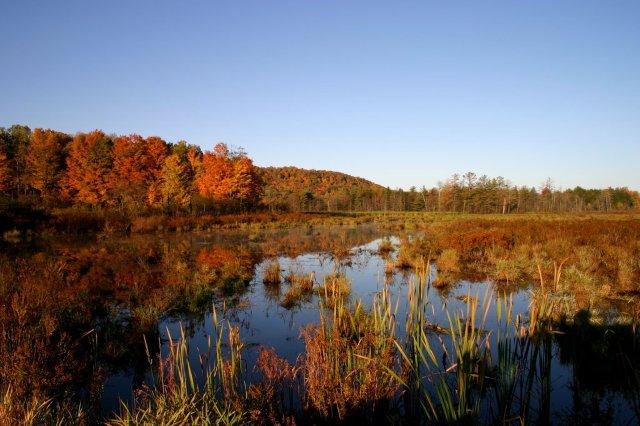
Caroline in the fall
More than 900 Caroline residents have already signed the petition – more than three times as many signatures as any other petition drive in the Town has ever gathered, says Bill Podulka. He coordinates the local activist group ROUSE (Residents Opposing Unsafe Shale-Gas Extraction) which is spearheading the petition.
“Momentum to ban gas drilling by local rule has been building across Tompkins County,” says Podulka. “This week the city of Oneonta voted to ban all forms of gas drilling within city limits, and Buffalo has already enacted a similar ban.” Even closer to home both Dryden and Ulysses boards are exploring legal options to draft a fracking ban. 
And that has some Caroline town officials running scared. Two town council members have decided to take preemptive action – they’ve submitted a resolution that would preclude the board from taking any action to consider drafting a local ban.
“Before the petition is presented and before necessary legal research is done,” says Podulka.
Council members Linda Adams and Peter Hoyt co-authored the legislation, and Toby McDonald supports it. Should gas wells be drilled in town, all stand to benefit: Hoyt and McDonald have leased their property to gas companies, and Adams directs the Tompkins Landowner’s Coalition, a group whose sole purpose is to help landowners obtain the best lease possible.
Adams and Hoyt don’t see a problem with their proposed law. They contend that local drilling bans are not permitted because New York State statute preempts local regulation of natural resource mining activities.
But many legal experts dispute this interpretation of the statute. They say that although local regulation of the day-to-day operations of resource extraction is indeed prohibited, there is ample case law to show that outright banning, which falls under local land use determination, is permissible.
Residents are outraged.  “Given that these elected officials all have ties to gas leasing, their action strikes me as a brazen abuse of power to benefit their own self-interests,” says Irene Weiser.
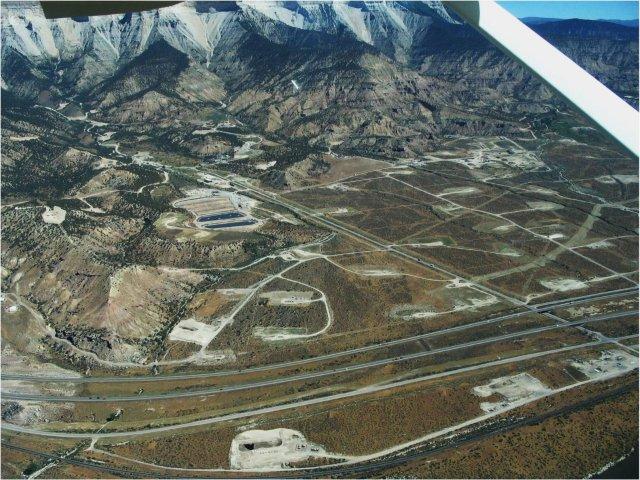
Aerial view of drilling in Colorado
Another explained that this resolution, if passed, “… would severely limit the town’s options in the face of massive industrialized hydraulic fracturing. If this type of industry is encouraged in the rural corners of Caroline,” he says, “the quiet, sweet rolling hills of green with thrushes, peepers, crickets and wild flowers could quickly be replaced with thousands of thundering trucks and hundreds of massively noisy industrial drilling rigs that will destroy the countryside for years to come — all for the short term financial benefit of only a few. These drilling rigs are massive and industrial; this is not your grand-dad’s little gas well sitting quietly out on the back forty.”
Earlier today town supervisor Don Barber commented on the attempt to short-circuit the democratic process. The resolution may be an attempt to stop debate about a frack ban. “But the town board will have that debate,” Barber said. “ The town needs to hear from all its residents before taking a position.”
The Caroline Town Board will hold its public business meeting on Tuesday, June 14, at 7 pm.  Public comments regarding the proposed resolution will begin at 8:15 pm, after the Board considers other matters.


Text Of The Proposed Resolution
Resolution Clarifying the Town of Caroline’s Role Regarding Gas Development Based on Current Environmental Conservation Law
Whereas Ecl 23-0303, section 2 states,  “The provisions of this article shall supersede all  local  laws or ordinances  relating  to  the  regulation of  the oil, gas and solution  mining industries; but shall not supersede local government jurisdiction over local roads or the rights  of  local  governments  under  the  real property tax law”; and
Whereas it is the opinion of our municipal attorney that the State clearly, with intent and purpose, set this scope; therefore be it
Resolved that the Town will not attempt to either encourage or limit gas drilling in the Town of Caroline; and further
Resolved that the Town will exercise its fiduciary responsibility to protect its investments in local roads, primarily through road use agreements; and further
Resolved that the Town through its authority under the Stormwater Law will protect local water supplies from any damaging effects of surface runoff due to gas drilling or any other large scale industrial activity.