Robert F. Kennedy, Jr. – The Colbert Report – 6/1/11 – Video Clip | Comedy Central
June 2, 2011
Robert F. Kennedy, Jr. – The Colbert Report – 6/1/11 – Video Clip | Comedy Central.
Gas Drilling Awareness for Cortland County
June 2, 2011
Robert F. Kennedy, Jr. – The Colbert Report – 6/1/11 – Video Clip | Comedy Central.
May 31, 2011
https://acrobat.com/#d=RF- gWpS33h7fE1A5ic0iwg.
May 30, 2011
May 29, 2011
This was a combined public hearing of the NYS Assembly Standing Committee on Environmental Conservation chaired by Robert K. Sweeney and Assembly Standing Committee on Health, chaired by Richard N. Gottfried. The panel includes (left to right) Assembly Members Thomas J. Abinanti (Environment); Richard N. Gottfried (chair, Health); Robert K. Sweeney (chair, Environment); Steve Englebright (Energy); and Michelle Schimel (Environment).
DVDs of the complete hearings are available from: Public Information, 202 L.O.B, Albany, NY 12248. Refer to: “Assembly Public Hearing on Health Impacts of Hydraulic Fracturing Techniques from Thursday, May 26” and Include a check for . A transcript of the hearing will also be available from the Assembly Public Information Office.
“NY Assembly Hearing on Fracking & Health Impacts” (05-14-11, The Marcellus Effect)- http://marcelluseffect.blogspot.com/2011/05/ny-assembly-hearing-on-fracking-health.html
1-Sandra Steingrabber- http://www.youtube.com/watch?v=1mhDFYUQdq0 & http://blip.tv/shaleshock-media/1-sandra-steingrabber-5217824
2-Sandra Steingrabber responds to panel- http://www.youtube.com/watch?v=H3ZvOFSpyss & http://blip.tv/shaleshock-media/2-sandra-steingrabber-responds-to-panel-5217543
3-Adam Law– http://www.youtube.com/watch?v=UBgmeGiCXvU & http://blip.tv/shaleshock-media/3-adam-law-5216851
4-Adam Law responds to panel– http://www.youtube.com/watch?v=FRVeeJ7wPgg & http://blip.tv/shaleshock-media/4-adam-law-responds-to-panel-5216662
5-Kevin Chatham-Stephens– http://www.youtube.com/watch?v=KN_1zZbMwVE & http://blip.tv/shaleshock-media/5-kevin-chatham-stephens-5215959
6-Kevin Chatham-Stephens responds to panel– http://www.youtube.com/watch?v=GzYCC8BZxJU & http://blip.tv/shaleshock-media/6-kevin-chatham-stephens-responds-to-panel-5215816
7-Uni Blake– http://www.youtube.com/watch?v=2KzqBDYuZ-c & http://blip.tv/shaleshock-media/7-uni-blake-5215662
8-IOGA Scott Kline– http://www.youtube.com/watch?v=IZl9Dp_m-1k & http://blip.tv/shaleshock-media/8-scott-kline-5215468
9-IOGA Scott Kline Uni Blake respond to panel– http://www.youtube.com/watch?v=9933iLt-k1c & http://blip.tv/shaleshock-media/9-ioga-scott-kline-uni-blake-respond-to-panel-5215366
10-IOGA Scott Kline Uni Blake respond to panel (con’d)– http://www.youtube.com/watch?v=kly5pcgif1M & http://blip.tv/shaleshock-media/10-ioga-scott-kline-uni-blake-respond-to-panel-con-d-5214831
Scott Kline Testimony–Comment/Questions
The notion of an hermetically sealed layer by virtue of capillary blockage is also one that I heard made by a proponent of propane fracking in answer to my question, what about old gas wells or vertical faults near the fracking operation?
Theoretical knowlege has a place. Without it, we’d have no progress. But it can be wrong, and in this case the consequences are so bad, the precautionary principle needs to be operative.
In any case, Kline’s explanations did not pass muster with Richard Gottfried, chair of the Assembly Health Committee.
As I was recording the exchange, I got a sense of how difficult it must be for politicians, at least good ones, to deal with technical testimony.
Has this issue of ‘capillary blocking’ been adequately addressed in a scientific debate or exchange?
We keep talking about the risk of old gas wells and vertical faults. The industry’s experts keep talking about how safe and sequestered it is in the shale layer.
We continue to make the point that the industry narrowly focuses on the fracking operation at depth when it makes the claim, repeated I believe by Kline, that no drinking water aquifer has been contaminated by hydro-fracking.
I know that I am not alone in being concerned with the long term consequences –long after the gas has been extracted. The integrity of the well casing is often cited. But when I here from Kline that the fracturing actually does extends above and below the shale layer, I am concerned.
As is Richard Gottfried, chair of the Assembly Health Committee, who responds to Kline’s assertion of capillary blockage with a question of capillary action transporting the liquid. To which Kline responds, it all would go toward the well bore regardless, because of the pressure gradient.
That is the problem the theoretical knowledge. There are coherent views, but we really don’t know what processes may unfold over time.
Though maybe it is not productive for activists to get involve with this sort of question over all else we need to focus on, certainly, some more expert scientific opinion countering the industry claims articulated by Kline would help those who in the legislature who support, or are leaning toward, and extended moratorium.
Some might say this is already out there, but I have no as yet read anything that directly addresses the industry/technical assertion that capillary blockage makes everything safe and contained.
It was a long exchange between Kline and the panel. The assertion that the thermogenic methane that has contaminated water wells near drilling operations comes from shallow layers apparently is disputed by the Duke study.
Early, Sandra Steingrabber made the point that there are really only two studies –the ecent Duke study and the Ingraffea/Howarth/Santoro study.
On 5/27/11 9:13 PM, KatyaBelousBoyle@aol.com wrote:
No doubt now that Scott Cline holds a BS in geological science. His statements about fracking are pure BS. RHB
Visit the Sustainable Otsego website:
http://sustainableotsego.org/—
|
Reply
|
Reply to all
|
Forward
|
|
show details 1:11 PM (11 hours ago)
|
The telling point is highlighted below –
– Show quoted text –Visit the Sustainable Otsego website:
http://sustainableotsego.org/
May 27, 2011
The Potential Health Impacts of Hydraulic Fracturing
Testimony before the New York State Assembly Standing Committees
on Environmental Conservation and Health
May 26, 2011
Sandra Steingraber, Ph.D.
Distinguished Scholar in Residence
Department of Environmental Studies
Ithaca College
Ithaca, New York 14850
Chairman Sweeney, Chairman Gottfried, and distinguished members of the committees:
Thank you for convening this hearing on a topic that is of urgent concern to all New Yorkers. Hydraulic fracturing relies on pressure, water, and high volumes of inherently toxic chemicals to shatter the bedrock beneath our feet and beneath our drinking water aquifers. Once shattered, the bedrock releases more than just bubbles of natural gas. The rock itself releases inherently toxic materials that have been bound together with the shale for 400 million of years. As we, in New York, consider whether to permit or prohibit this form of energy extraction, it is essential that we understand the possible consequences to public health as a prerequisite for making that decision. Once shale is shattered, it cannot be unshattered, nor groundwater unpoisoned.
Some of the chemicals used in hydraulic fracturing—or liberated by it—are carcinogens. Some are neurological poisons with suspected links to learning deficits in children. Some are asthma triggers. Some, especially the radioactive ones, are known to bioaccumulate in milk. Others are reproductive toxicants that can contribute to pregnancy loss. Cancer, miscarriage, learning disabilities, and asthma are not only devastating disorders, they are expensive. They add rocks to the pockets of our health care system and cripple productivity.[1] A recent analysis published in our nation’s preeminent public health journal, Health Affairs, estimates that we now spend $76.6 billion each year on health care for children exposed to toxic chemicals and air pollution.[2]
So it is right that we ask if hydraulic fracturing brings with it involuntary environmental exposures that may increase our disease burden here in New York. I applaud you for initiating this conversation. It feels like an historic moment.
My name is Sandra Steingraber. I’m a distinguished scholar in residence at Ithaca College, and my Ph.D. is in biology from the University of Michigan. More specifically, my training is in systems ecology, which means I’m interested in understanding how a dynamic web of direct and indirect interactions—from pollination to groundwater flow—helps shape the natural world.
Early on in my career as a biologist, I had a profound personal experience that led me to the work I do now, which is focused on understanding how the cumulative impacts of multiple environmental exposures to toxic chemicals create risks for human health.
At the age of 20, I was diagnosed with bladder cancer, a quintessential environmental cancer with well-established links to particular classes of chemicals. Questions about my possible chemical exposures posed to me by my own diagnosing physician led me, years later, to return to my hometown in Illinois and investigate an alleged cancer cluster there. Among other things, I discovered the presence of dry-cleaning fluid in the drinking water wells. That was a surprise because the underlying geology of the area should not have allowed toxic contamination to happen. But there it was. I came to appreciate how little we really know about the unmapped, subterranean landscape below our feet, which has intimate, unseen connections to the world above ground. It’s not just an inert lump of rock down there.
My investigation of the environmental links to cancer became the topic of my book Living Downstream, which was released last year as a documentary film. I’ve also published two books on pediatric environmental health, the most recent of which is Raising Elijah: Protecting Children in an Age of Environmental Crisis. The book’s final chapter addresses the potential health threats of hydraulic fracturing, and I’m pleased to share the results of my research with you.
I’ll begin by saying that a comprehensive study of the long-term, cumulative, public health impacts of fracking has not been done. However, we do know quite a lot about the risks to human health posed by some of the chemicals used in the process or released by it.
Health Effects from Air Pollution
Because breathing is our most ecological act—we inhale a pint of atmosphere with every breath—I’ll begin with air.
Air pollution is an inevitable consequence of horizontal hydrofracturing. It is not the outcome of a catastrophic accident. It is not a hypothetical risk. Compromised air quality is a certainty. Because four to nine million gallons of fresh water are required to frack a single well and because wells must cover the landscape for Marcellus shale development to be profitable, fracking is a shock and awe operation. 77,000 wells are envisioned for upstate New York alone.[3] Each well requires 1,000 truck trips. 77,000 times 1,000 equals a number with six zeroes after it. This represents a prodigious amount of diesel exhaust. And, of course, in addition to endless fleets of 18-wheelers, gas production requires generators, pumps, drill rigs, condensers and compressors, which also run on diesel. At the same time, the wellheads themselves vent volatile organic chemicals—such as benzene and toluene—that are themselves highly toxic and can combine with combustion byproducts to create smog.[4]
This kind of air pollution is lethal. It contains large amounts of ultrafine particles, soot, ozone, and the carcinogen benzo-a-pyrene. In adults, these pollutants are variously linked to bladder, lung, and breast cancer, stroke, diabetes, and premature death. In children, they are linked to premature birth, asthma, cognitive deficits, and stunted lung development.[5]
Again, this harm comes with economic costs. Premature birth, which is the leading cause of disability in the United States, carries $26 billion a year price tag. The direct and indirect costs of childhood asthma are $18 billion a year.[6]
What’s more, the airborne contaminants from gas drilling travel long distances, up to 200 miles.[7] That is to say, the health costs of drilling will be borne by children living in areas where no one is benefiting financially from land leases. Albany will be affected. So will New York City.
In the gas-producing areas of Utah and Wyoming, formerly pristine air now contains more ozone than downtown Los Angeles.[8] As the mother of a child with a history of asthma, this concerns me deeply. New York is not Wyoming. Our starting point here is not pristine, and our population density is much greater. The cumulative impact of the air pollution that would be generated by hydraulic fracturing and the air pollution already here in our state is a question that, I submit, requires investigation before any permits are issued.
Health Effects from Water Pollution
We are each of us in this room 65 percent water by weight. As such, we enjoy an exquisite communion not only with the atmosphere but with the water cycle, too.
Fracking turns millions of gallons of fresh water into poisonous flowback fluid that requires permanent disposal. The technology does not exist to turn this waste into drinkable water nor remove the radioactive isotopes. You cannot filter radioactivity. This much we know with certainty. The unfolding nuclear disaster in Japan illustrates the point.
We also know that there are many documented cases of surface and ground water contamination with compounds associated with gas extraction, including the carcinogen benzene.[9] However, because hydraulic fracturing has been granted the environmental equivalent of diplomatic immunity—and enjoys special exemptions from both the Clean Water Act and the Clean Drinking Water Act—it is difficult for those of us in the research community to quantify the public health consequences. Researchers lack knowledge about the behavior of groundwater, and, because of trade secrets, they also don’t know what chemicals to test for.[10]
We do know, from a study released earlier this month, that drinking water wells near gas extraction sites in Pennsylvania and New York have, on average, 17 times higher methane levels than wells located farther away.[11]
Other than possible explosions, what are the health consequences of drinking and inhaling methane? For pregnant women? For children? For anybody? We don’t know. Those studies have never been done. The federal government does not regulate methane in drinking water.
We do know that disinfection byproducts are created when water containing carbon-based contaminants is chlorinated. These include trihalomethanes, such as chloroform, which are, in fact, linked to both bladder and colon and cancers.[12] Can methane serve as a raw material for the creation of carcinogenic compounds during the disinfection of public drinking water? To my knowledge, we in the scientific community don’t have an answer to that question.
I have brought with me a jar of water from my kitchen tap in the village of Trumansburg, which comes from a municipal well sunk into a groundwater aquifer next to Cayuga Lake, where fracking fluid from Pennsylvania has been dumped. Every day, I pour this water into glasses and hand them to my children. Every day, this water becomes their blood plasma. It becomes their tears. It becomes their cerebral spinal fluid. According to the most recent annual Drinking Water Quality Report for my village, this water contains 29.2 parts per billion trihalomethanes. That’s not in violation of regulatory limits, but it’s worrisome as there is no documented safe threshold level of exposure. This water also contains nitrates, probably as the result of agricultural run-off. Their presence in this jar is, all by itself, not a call for alarm. But it is a sign that our municipal water, which draws from an unconfined aquifer, is vulnerable to chemical contamination. It shows that there exist hidden connections between the surface of the earth and the watery vaults of groundwater deep beneath our feet.
What would happen to this water if the fields that surround my village—many of which are already leased to gas industry—become a staging ground for fossil fuel extraction?
This is not a hydrological experiment that I am interested in running.
Impact on Food
I have also brought with me a loaf of bread and a bag of flour. Both are made from organic heirloom wheat and rye that is grown in my home county and milled right in my village. You can find similar loaves of artisanal bread—made from this same flour—in Brooklyn bakeries. This particular loaf was created by Stefan Senders of the Wide Awake Bakery in Mecklenburg, New York. Baker Senders asked me to submit this loaf as his personal testimony to the Assembly today. And it comes with a message:
“Please tell the committees that bread is mostly water. The flour and the yeast are just a matrix to make water stand up. I can’t bake bread without a source of clean water.”
He also told me that the farmers who grew the organic wheat to make his flour are surrounded by leased land. He believes whole farm-to-table enterprise is threatened by fracking.
Baker Stefan and his suppliers have reason to feel concern. Organic farmers who raise food near fracking operations are facing potential boycotts and will lose their certification if their crops and animals are chemically contaminated.
Upstate New York was recently identified by the New York Times as a national hotspot for organic agriculture, which itself is the most rapidly expanding sector of the food production system that has continued to grow even during the economic downturn.[13] Cows, wheat fields, vineyards, maple syrup, and apple orchards: they are all part of a healthy human food chain. They all require clean water, and they are all affected badly by exposure to air pollution.
Of course, public health is also served by employment opportunities in the form of non-toxic jobs. The above-mentioned mill and bakery are currently hiring. They both have plans to grow their businesses as demand for locally produced, organic bread is rising. The grain farmers, too, are seeking additional land. However, as baker Stefan Senders informs me, concern about the area gas leases and the possible end of the current state moratorium on horizontal drilling have negatively affected plans for locally expanding organic wheat agriculture and artisanal bread baking. This raises a question: is the human health of New York best served by jobs that involve organic bread production or fossil fuel extraction?
Conclusions
I fervently hope that these hearings are the beginning, not the end, of an essential conversation. In its current incarnation, the New York State Department of Environmental Conservation’s draft Supplemental Environmental Impact Statement—on which the future of hydraulic fracturing hangs—considers neither human health consequences nor the cumulative impacts of the numerous hazards that gas drilling has brought to our doors.
The human health impacts of fracking cannot be understood by looking at one chemical exposure by itself, one river at a time, one well pad in isolation. We all know that it is not just the last straw that breaks the backs of camels. I urge the Assembly to look at the all straws, employing the new tools of cumulative impacts assessment to do so.[14] Until that work is complete, benefit of the doubt goes to New York’s children, water, cows, and wheat fields, not to things that threaten them.
[1] President’s Cancer Panel, Reducing Environmental Cancer Risk: What We Can Do Now, 2008-2009 Annual Report (National Cancer Institute, May 2010)
[2] L. Trasande and Y. Lui, “Reducing the Staggering Costs of Environmental Disease in Children, Estimated at $76.6 Billion in 2008,” Health Affairs 30 (5): 863-70, 5 May 2011.
[3] This estimate is based on assumptions about how much of the shale will be tapped over what period of time. 77,000 wells assumes that 17 New York State counties are drilled and that the shale is 70 percent developed over 50 years at a density of eight wells per square mile. T. Engelder, “Marcellus 2008 Report Card on the Breakout Year for Gas Production in the Appalachian Basin,” Forth Worth Basin Oil and Gas Magazine, Aug. 2009, pp. 18-22, and Anthony Ingraffea, Ph.D., personal communication.
[4] C.D. Volz et al., “Potential Shale Gas Extraction Air Pollution Impacts,” FracTracker—Marcellus Shale Data Tracking, Foundation for Pennsylvania Watersheds, 24 Aug. 2010.
[5] American Lung Association, “Health Effects of Ozone and Particle Pollution,” State of the Air, 2011; President’s Cancer Panel, Reducing Environmental Cancer Risk: What We Can Do Now, 2008-2009 Annual Report (National Cancer Institute, May 2010).
[6] American Lung Association, Asthma and Children Fact Sheet, Feb. 2010; J.M. Perrin et al., “The Increase of Childhood Chronic Conditions in the United States,” Journal of the American Medical Association 297 (2007); U.S. Centers for Disease Control, Summary Health Statistics for U.S. Children: National Health Interview Survey, 2006 and “Premature Birth,” 2010.
[7] S. Kemball-Cook et al., “Ozone Impacts of Natural Gas Development in the Haynseville Shale,” Environmental Science and Technology 15 (2010): 9357-63.
[8] M. Bernard, “Air Pollution Becoming a Basin Concern,” Vernal Express, 5 Oct. 2010; D.M. Kargbo et al., “Natural Gas Plays in the Marcellus Shale: Challenges and Potential Opportunities,” Environmental Science & Technology 44 (2010): 5679-84.
[9] A. Lustgarten and ProPublica, “Drill for Gas, Pollute the Water,” Scientific American, 17 Nov. 2008.
[10] For example, U.S. Agency for Toxics Substances and Disease Registry, Evaluation of Contaminants in Private Residential Well Water, Pavillion, Wyoming, Fremont County, August 2010.
[11] S.G. Osborne et al., “Methane Contamination of Drinking Water Accompanying Gas-Well Drilling and Hydraulic Fracturing,” Proceedings of the National Academy of Sciences, May 2011, epub before print.
[12] R.D. Morris et al., “Chlorination, Chlorination By-products and Cancer: A Meta-analysis,” American Journal of Public Health 82 (1992); H.W. Weinberg et al., “Disinfection By-Products (DBPs) of Health Concern in Drinking Water: Results of a Nationwide DBP Occurrence Study (Athens, GA: EPA National Exposure Research Laboratory, 2002).
[13] H. Fairfield, “The Hot Spots for Organic Food,” New York Times, 3 May 2009.
[14] “Cumulative impacts” refers to the combined effect of numerous adverse impacts on public health or ecosystems from environmental hazards. The Science and Environmental Health Network has launched a new website that describes the latest science on cumulative impacts assessment: www.cumulativeimpacts.org.
May 23, 2011 1 Comment
NO landfill expansion – The Petition Site.
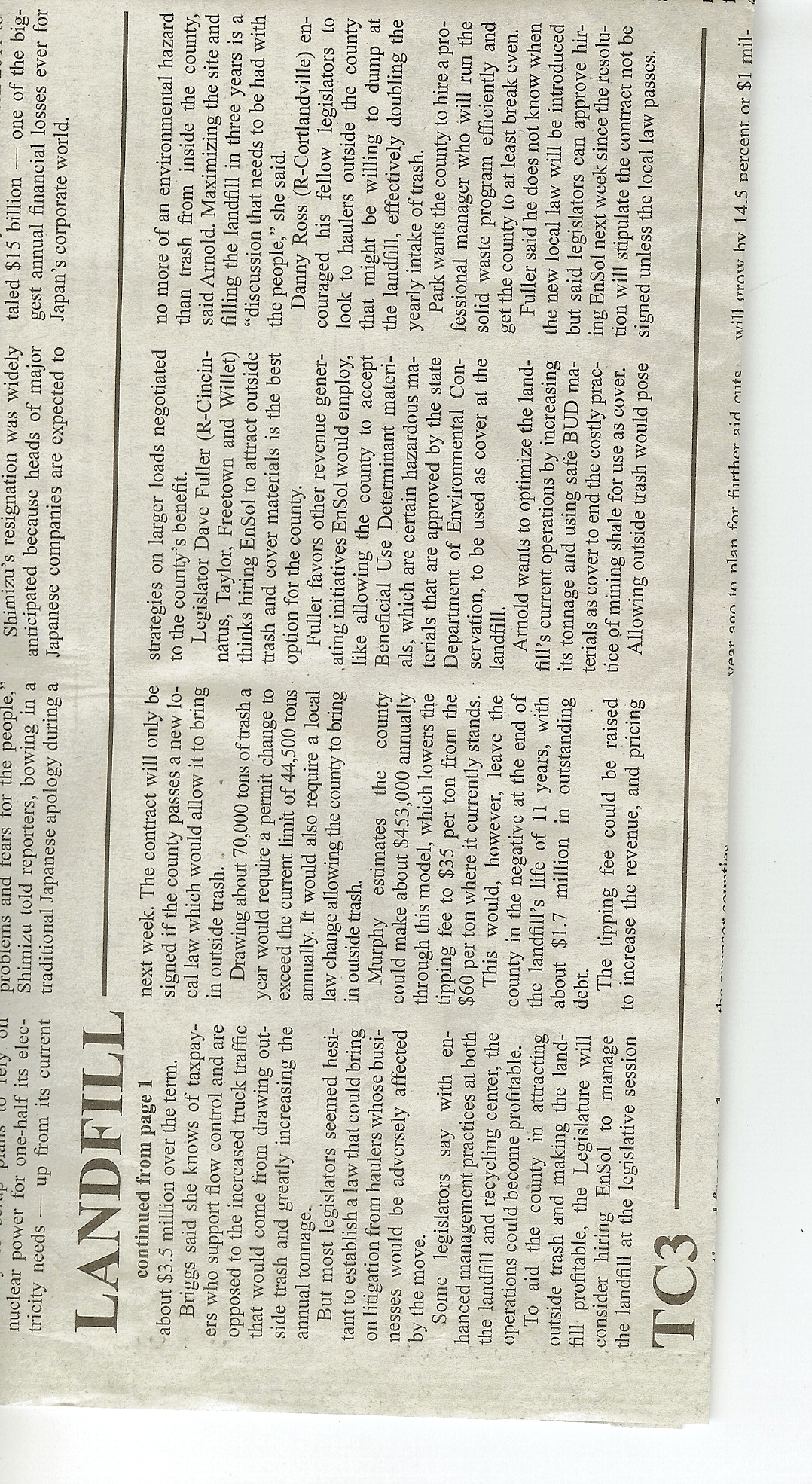
The EPA designated the upper 2/3 of Cortland County, NY, as a critical, sole-source aquifer. If our water is contaminated, we have NO OTHER water source. Our legislature is considering expanding the landfill to receive 1 MILLION tons of New York City garbage each year. Their filth will be trucked in on nearly 200 tractor trailer loads each day – creating noise and additional pollution. The DEC wants us to accept BUD waste: oil-laced soil and hydrofracking waste. Other BUD waste includes PCB-laced soil – will we get that next? If any of this gets into the water system in McGraw-Solon, it will flow west to Cortland-Homer. Our drinking water, health, welfare, quality of life, and property values are at stake. We will be known as the garbage capital of New York. The stench at Seneca Meadows, a similar landfill, is said to pollute the air with sickening odors 2-3 miles away. Sign this petition and VOTE NO TO ANY LANDFILL EXPANSION, and call for the immediate removal of any legislator who votes yes. less
May 19, 2011
Here is her email:
Sorry about taking so long to get back to you.
My class that does all the talking is only 6 students. One of them is the wife of a man who supervises the well completion– which is what we’re told went wrong at Canton – the well head. (personally I suspect that they ran into a vein of gas that was much stronger than the well cap could handle but they’re not going to say this to the public. That’s the only reason I can see that they would stop all “wellhead completion actions” until they figured out what went wrong. As far as I know, they haven’t returned to the “well head” completions yet). She’s the one that told us they were stuffing paper products from the local minimart down the wellhead to get the gusher to slow down — thus my tweak that they didn’t have a back up plan for such a situation. And I wonder if they have any back up plans at all? She also said that her spouse has worked for years with the drilling going on in Texas and was transferred up to PA because of his know-how; however, he can’t move up the supervisory ladder because he doesn’t have a degree! Instead he is working under some newcomer who has a degree in HISTORY (!) that they hired as supervisor and her spouse is training him. She also said that most of the rig workers don’t know what they’re doing and are guessing at how to go about the drilling. One well, she said, was put in backwards – as in the hole was to grow smaller as it went deeper but they were drilling so it widened instead. Nice, huh. She said men are being injured all the time at the well sites because it is such physically demanding work. She also said that she has 3 children and her spouse insists that they use only bought water! She has the most to tell but I’m guessing that her spouse won’t allow her to talk publicly. I was surprised she shared this much.
Another student (an older man who is retraining since his company closed down) said that in his area where there’s lots of wells going in, he & his friends (hunters who have lived there for all their lives) noticed that there was absolutely no wildlife around last fall. He said at some point, he could hear an audible grrrrrr that felt like the sound of an earthquake deep in the ground under his house. We figured the animals felt that too and took to higher ground. (this is part of my theory about my pond fish dying from the impact of the drilling sounds within the ground – we’re talking 24/7 for at least 6 weeks for just one drilling session – there’s no escape from it while it’s happening and the sounds go right through the walls of your home. I live 2000 feet away from the drilling & there’s a woods between us and the pad yet our house resounded with the sounds for the entire time even with the windows closed.)This is no small production as they’d like you to believe. It’s the greed of military-like industry backed by outlandish amounts of money.
A student from fall semester scared me (another older man) by saying that when they frack near your home, the house will shake from the explosions so strongly that things will fall off the walls.
One girl mentioned that she had been stalked by a Mexican who figured out that she was the last one to close up at her job in the evening — she quit her job.
Another one said that they were building “man camps” near her (Sayre area) just to house the workers who will be coming. I don’t think they’ve even seriously begun yet and the rains are slowing them down for which I’m grateful. She also said that her home is surrounded by drilling pads and lately she’s noticed that their water smells – which she’s never noticed before. She was getting pretty scared about it. There are already people in Wyalusing with class action suits because their water has been destroyed.
I’m noting that as they re-create the roads around here so that it can handle the impending increase in truck traffic (I can now hear the trucks on 87 which I could never hear before), they are building them up so high that the shoulders are incredibly steep. One swerve to get away from an oncoming truck (& these trucks are driven by newly licensed CDL drivers which they are churning out like flies on shit), and my car will be irreparably damaged – if not rolled over – because the inclines are so steep and the sides of our mountain roads are all about steep hills (and curves). I’ve never been cautious of the sides of the roads before and now, even having the road to myself, I’m hypervigilant. The railings that are in place were sufficient for the minor traffic but there’s no where near enough for the heightened roads, lack of shoulders and steep hillsides. They haven’t even repaired the railing that was taken out last fall when a water truck couldn’t make the S curve and went down over the bank.
My neighbor came home one day and called the police because he and his wife were driving around a serious curve on 87 and witnessed 2 water trucks (these are massively long) driving by them in the opposite direction at breakneck speed which almost tipped over on them! My neighbor has been driving trucks for years (not affiliated with this gas industry), and he knows when they are driving too fast and what they look like when they’re about to tip. He was really seriously pissed.
It’s so disgusting on so many levels, I can only absorb so much at a time. They’re polluting our air and our water, tearing down mountains to erect gas compressor stations (NOISE – coming soon), flattening trees to make way for their 4 acre pads, scattering holding ponds for toxic wastes (?) throughout the back woods (what happens to the wildlife that drinks from them?) — destroying the peace with constant sounds (thunderous rigs, planes & helicopters), chasing the wildlife out of their homes & hitting them on the roads (deer all the time), chewing away at the earth to get gravel for their pads, gashing through the mountains for their pipelines, making driving anywhere a concern for one’s life, destroying the normal roads and constantly we are held up in traffic due to construction. Getting in and out of Towanda (due to the bridge bottleneck) during peak hours is a long wait. Just to get in and out of town yesterday, I had to take back roads all around the light. I imagine once the rains settle down, the gray dust covering the sides of the roads – from the continuous Mac trucks taking gravel to the pads – will be nauseating to view. So much for the by-the-road wildflowers that were so gorgeous to view throughout the season.
Oh, and this too — the influx of newcomers is changing the entire essence of community. Everywhere I go when I’m in Towanda, I’m seeing these tough-looking young guys with tatoos. I’m sure they’re the workers brought here from Texas and other states. They look to me like the type that could do some violence under the influence… oh and there’s drugs coming through with them. Of course. I’ve already seen several young people at public places who looked like they were near death’s door literally. It’s the inner city come to the country.
All this for economic growth? ! Then why are there men near retirement age enrolled at Lackawanna because they lost their jobs and can’t get anything without a freakin degree! And every time I hear someone spout “responsible well drilling” as the answer, I want to throttle them. It doesn’t exist at this pace — no way.
It’s so indescribable that the “natural” gas companies get away with it – singing their songs of wealth – because no one who hasn’t been there can consciously grasp the complete devastation until they are in it. This is why I’m sending out everything that’s happening around here — I really want people to have their eyes open when it sets its sights on your area. I’ve never in my life witnessed something so all-encompassingly evil though I know this kind of selfish consumptive razing been going on all over the world and now it’s literally reached my back yard. It certainly has opened my heart to the pain in our world in ways that I wouldn’t have been able to feel otherwise BUT I’ve always known the world is getting weakened by our doings and that’s exactly why I hid myself in the mountains. Now, I too, like the wildlife, am being pushed out, killed off, and dehumanized. It’s very hard to be joyful about life or to respect us as Americans right now. I have to hold my fire of fierce opposition within me just to get through the days (and distract myself with animal rescue). This is how bad it is now – just a little over a year into this travesty – and they haven’t dug in yet. They’re just getting warmed up! Think about that.
May 9, 2011
May 7, 2011
Unconventional gas drilling is emerging as one of the most controversial energy & environmental issues in the United States and around the world today.
Advancements in extraction technologies, particularly horizontal drilling and high volume hydraulic fracturing (fracking), have enabled drillers to reach previously inaccessible gas in geological formations underlying several areas of the U.S.
Increasing public awareness of the threats posed by America’s dependence on foreign oil and dirty coal to public health and the global climate have led many – including some environmental organizations and progressive politicians – to embrace gas as a “bridge fuel” to help America kick its dirty energy addiction.
54 page report at: http://www.desmogblog.com/fracking-the-future/desmog-fracking-the-future.pdf
But recent revelations about the dangers that unconventional gas drilling poses to drinking water supplies, public health and the global climate are raising important questions about how “clean” this gas really is.
Scientists studying the impacts of unconventional gas drilling warn that gas is likely to have a greater influence on water, air and climate than previously understood. Major scientific bodies have cautioned against a national commitment to gas as a bridge fuel, citing the need for further research into the potential consequences of continued reliance on this fossil fuel.
A growing number of land owners, former gas industry executives and elected officials are also challenging the notion that gas is as clean as its proponents argue, and questioning whether unconventional gas drilling can be done without threatening drinking water supplies, air quality and the global climate.
Yet the gas industry continues to benefit from lax oversight and several exemptions from existing public health protections, such as the Safe Drinking Water Act and parts of the Clean Water Act that apply to other fossil fuel extraction industries. Recent attempts by federal agencies and lawmakers to improve oversight of gas operations have been met with strong resistance from the gas industry and its alliance of front groups and defenders in the media.
The gas industry’s influence in Washington has grown tremendously thanks, in large part, to the rapid consolidation of the gas industry into the hands of the largest oil companies in the past few years. Not long ago, the industry was made up primarily of what its proponents call “mom and pop” companies—small operators that drilled chiefly for conventional gas.
But with recoverable deposits of that relatively ‘easy’ conventional gas dwindling in the Lower 48, larger drillers have turned their focus to the more difficult and expensive unconventional gas plays.
Oil giants such as BP, ExxonMobil, Shell and Chevron now dominate the gas industry. The industry’s chief front group, Energy In Depth (EID), goes to great lengths to maintain the “mom and pop” image of the industry, claiming it represents small and independent gas producers.
However, its own documents prove that its early funding – and ongoing financial support – comes from many of the largest oil and gas interests.
EID and other gas lobby groups argue that federal oversight and increased scrutiny and accountability measures would harm the industry’s development and risk jobs. But big oil companies have made that same “economy-killing” argument for decades – a strategy they learned from tobacco companies and the chemical industry – while amassing record profits and enjoying spectacular growth.
Through intensive lobbying, campaign contributions and other forms of influence, these oil and gas companies have successfully thwarted efforts to hold the gas industry accountable for its impacts on health and the environment.
Now the same companies that brought us the Exxon Valdez spill, the BP blowout in the Gulf of Mexico, Chevron’s destruction of the Amazonian rainforest in Ecuador and countless other pollution examples, want the public to blindly trust them – with zero federal oversight – as they pursue drilling for much riskier unconventional gas throughout the country.
The question is, given the oil industry’s track record of environmental and health disasters, can the public trust them to get it right with the more challenging unconventional gas?
This report is designed to shed light on the rapidly changing composition of the gas industry and to raise important questions about whether the rush to exploit unconventional gas may be coming at too high a cost to the environment.
While coal and oil certainly pose their own significant challenges to health and climate, it is important to recognize that unconventional gas is also a dirty fossil fuel and does not belong in any credible definition of “clean energy.”
Given the extensive uncertainties surrounding the impacts potentially connected to the unconventional gas industry’s current drilling practices, it is only prudent at this point to insist on a pause for further evaluation. In fact, as a direct result of the recent Chesapeake gas well blowout in Pennsylvania that spilled drilling chemicals onto nearby properties and waterways, a former gas company executive called for a moratorium on all fracking operations near waterways in Arkansas’s Fayetteville shale region, stating that:
“There is no reason on Earth, if they are going to close it down there, they shouldn’t close it down here.”
It is becoming increasingly clear that the unconventional gas boom is happening too fast, too recklessly and with insufficient concern for the potential cumulative impacts on our most critical resources – clean air, safe drinking water and a stable climate.
DeSmogBlog joins those who are calling for a nationwide moratorium on hydraulic fracturing and other troublesome practices in the unconventional gas industry. Until independent scientists and experts conduct further studies, the public simply cannot trust the fossil fuel industry to continue with this dirty energy boom.
See: http://www.desmogblog.com/fracking-the-future/desmog-fracking-the-future.pdf for the full 54 page report