Earth Day Open House

Gas Drilling Awareness for Cortland County (GDACC),

CGIS Environmental Justice Committee

NYPIRG.

Earth Day Open House

Friday, April 22, 4:30-7 PM


Main Street SUNY Cortland, 9 Main Street, Cortland.

Refreshments

  • My Name is Alleganyfilm on citizen resistance to New York State’s siting of a radioactive waste dump and a fight for environmental justice–Jim Weiss and Paul Yaman


  • Information on industrialized  shale gas drilling,  leasing issues and steps localities can take to protect their citizens and their infrastructure.


  • GDACC T-shirts and sweatshirts featuring a map of Cortland Co. leases.


GDACC– residents concerned about gas drilling and its potential impacts on our community, health and environment.  Our goal is to educate ourselves and the community about gas drilling, and to promote a safe and clean environment.  We are looking for others to join us.

DONATIONS CAN BE SENT TO GDACC, P.O. BOX 5151, CORTLAND, NY 13045. www. gdacc.wordpress.com


The event is part of SUNY Cortland’s Sustainability Week, (http://www2.cortland.edu/news/detail.dot?id=17e6be8d-1973-4127-8dbf-144e1f1e160e), a week long series of events on a wide range of environmental topics: For more information 753-2464 or 753-5784

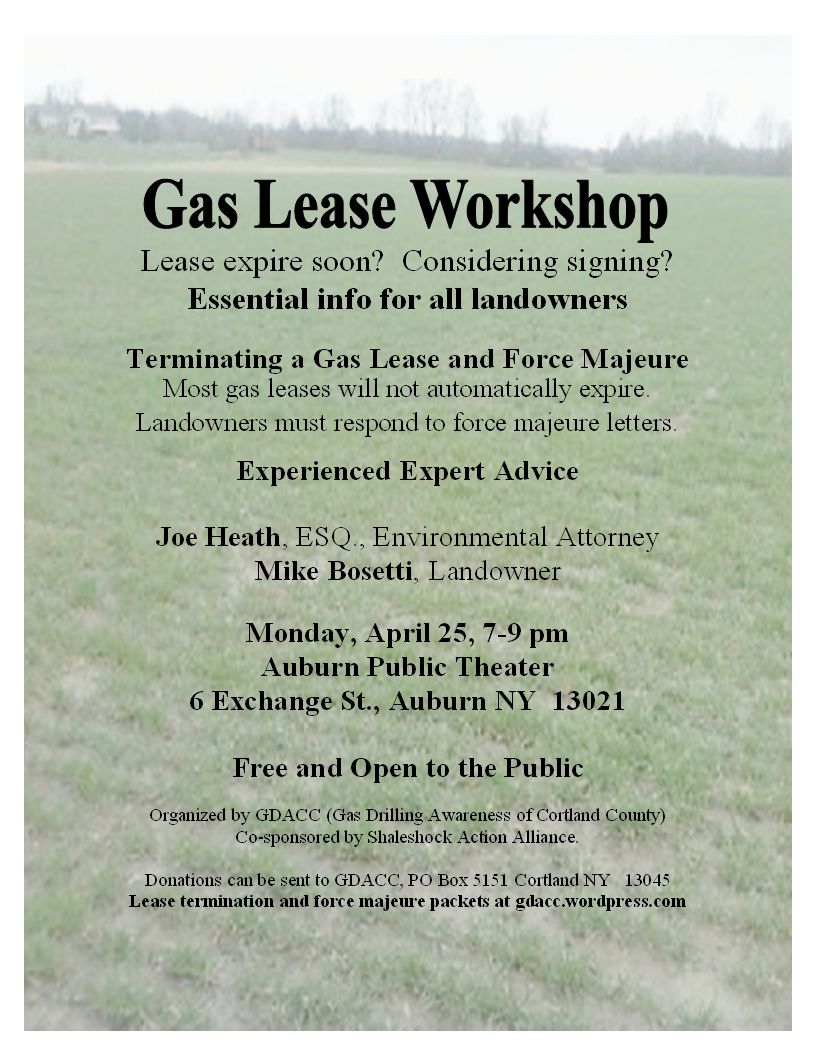
Gas Lease Workshop Apr. 25th Auburn Public Theatre

A legal plan to control drilling

A legal plan to control drilling.

A legal plan to control drilling
by David Slottje and Helen Holden Slottje

What comes to mind when you think about upstate New York? Rolling farmlands, fresh air, and the chirping of birds? Or heavy truck traffic at all hours of the day and night, the smell of chemicals in the air, distant views pockmarked with drilling rigs, and the stars blocked from sight by light pollution?


Many community groups and municipal leaders are becoming increasingly alarmed by the threats attendant to unconventional gas drilling. These communities are growing frustrated with what they perceive to be the unwillingness of state and federal politicians and agencies to act decisively.


Can anything be done at the local level to protect the health and welfare of our communities? The answer is yes, at least in New York.


We are lawyers with the Community Environmental Defense Council, Inc., a pro bono, public interest environmental law firm based in Ithaca. It is our opinion that a New York municipality has the legal authority and right to use land-use laws of general applicability (such as zoning laws) to prohibit what we have termed “high-impact industrial uses,” either in certain zoning districts or throughout an entire town.


Furthermore, we believe this authority and power legally may be exercised in a manner that, depending upon the municipality’s particular definition of “high-impact industrial uses,” will have the incidental effect of prohibiting (within the town) land uses such as unconventional gas drilling.


Some people have heard that municipalities are legally restricted from enacting laws to prohibit certain uses, such as “adult entertainment,” and so they wonder whether those same restrictions might also apply to banning industrial uses. They do not.

Those restrictions on “adult entertainment” are very limited and very specific in nature, and have to do with protection of constitutional rights, specifically First Amendment rights, including free speech.


There is no question that exclusion of industrial uses is a proper and legitimate use of land-use laws.


The United States Supreme Court addressed this question in a 1974 case known as Village of Belle Terre. In Belle Terre, the court stated that the town had wide latitude to use its zoning laws to protect the public welfare, and that the public welfare is spiritual as well as physical, aesthetic as well as monetary. The court specifically held that a town may use its police power “to lay out zones where the blessings of quiet seclusion and clean air make the area a sanctuary for people.”


And the New York Court of Appeals­—the highest court of New York State—came to the same conclusion in a 1996 case called Gernatt Asphalt Products. This was a situation in which a town had used its zoning power to ban mining as a permitted use, and the people who wanted to mine challenged the ban, saying that the ban involved unconstitutional exclusionary zoning.


Rejecting the challenge, the court said:

We have never held that the exclusionary zoning test, which is intended to prevent a municipality from improperly using the zoning power to keep people out, also applies to prevent the exclusion of industrial uses. […]

A municipality is not obligated to permit the exploitation of any and all natural resources within the town as a permitted use, if limiting that use is a reasonable exercise of its police power to prevent damage to the rights of others and to promote the interests of the community as a whole. (Emphasis added.)


So, there should be no doubt that a New York State municipality has the legal right to use land-use laws to ban industrial uses.

You may have heard the opinion that New York has preempted the right of municipalities to ban certain specifically articulated industrial uses —oil and gas drilling and solution mining—within their boundaries.


We believe that the state has not preempted such activities, so long as they happen to fall within the definition of “high-impact industrial uses” contained in a town’s properly enacted zoning law.


There is a state statute (the “drilling statute”) that precludes municipalities from regulating the oil, gas, and solution mining industries, but we believe “regulating” means regulating the operational processes
of the industry—that is, things such as how deep they can drill or mine, and imposition of bonding requirements. Municipalities may, in fact, prohibit such industries outright, either in certain zoning districts or throughout an entire town.


The drilling statute language regarding regulation is almost identical to the language regarding regulation that was previously used in the context of the mineral mining statute, and in that context the Court of Appeals made it crystal clear that the scope of preempted regulation meant regulation related to operational processes, and that municipalities absolutely could prohibit mining outright, whether in certain zoning districts or throughout an entire town.


Simply put, our recommendation to New York State municipalities seeking to preserve their character and avoid industrialization is to adopt a zoning law or amendment that specifically prohibits high-impact industrial uses within the municipality, and to utilize a definition of “high-impact industrial use” which encompasses unconventional gas drilling and any other uses determined to be inimical to the municipality’s desired character and goals.


We do not believe that our interpretation is particularly bold, or visionary, or out-of-the box. Embracing our approach does not involve attempting to create new law, or attempting to overturn any law, or even trying to distinguish a holding in an unfavorable judicial decision.


There are people out there who do not agree with our approach. Our view is that the vast majority of them are people who have a financial stake in seeing drilling go forward: drilling companies and their lawyers, landowners who favor drilling, and their lawyers—many of whom will receive substantial fees if drilling is allowed to proceed.


We would be happy to speak with the representatives of any municipality, or any community group, who wish to discuss the concepts we are recommending, the specifics of creating the type of law we are suggesting, or how to minimize political and legal “push-back” risks. We are pro bono attorneys, which means we do not charge for our time.


David Slottje is executive director and senior attorney, and Helen Holden Slottje is managing attorney, at the Community Environmental Defense Council, Inc. (CEDC). Both are members of the Club’s Atlantic Chapter. CEDC is a 501(c)(3) non-profit, pro bono, public interest environmental law firm. For more information about CEDC or to contact the authors, visit CEDC’s web site at http://www.cedclaw.org.

Copyright SierraClub 2009

County, drillers nearing accord on road use agreement – Bath, NY – The Courier

County, drillers nearing accord on road use agreement – Bath, NY – The Courier.

y Mary Perham

Posted Apr 14, 2011 @ 08:00 AM
Print Comment

The cost of road repairs in Steuben County could be the biggest stumbling block in future road use agreements with gas drillers.
The agreement now calls for drilling companies to pledge between $150,000 per mile and $300,000 per mile for to repair county roads damaged by construction or haulage during future drilling of the Marcellus Shale in Steuben.
Public Works Commissioner Vince Spagnoletti said the drillers’ routes could run 100-150 miles, meaning the gas companies would be required to pledge as much $45 million to ensure county roads will stay in good shape.
“They think it (costs) too much,” Spagnoletti told the county Legislature’s Public Works Committee. “But we think they can pay it.”
Spagnoletti said the amounts are in line with state Department of Transportation’s agreements with local contractors.
Spagnoletti said companies would need to set aside 0.5 percent of the total, or $225,000, before the proposed road use agreement could be signed.
The purpose of the road use agreement is to ensure the companies maintain and repair any county roads damaged by the expected heavy traffic caused by drilling.
The amounts are determined by the condition of the roads before any construction begins.
Legislators are concerned the cost of repairs would fall on taxpayers if the gas companies fail bring the roads back to their original condition.
Committee members also wanted to be sure the roads stay driveable throughout the driller’s use.
“These roads still need to passable day to day,” said Legislator Patrick McAllister, R-Wayland. “I mean, it could take a week, two weeks for them to fix the roads. We don’t want that.”
The proposed road use and repair agreement was modeled on an earlier county policy for wind farm developers, and is available for municipal use, too.
Officials have been working on the new road policy for several months, anticipating the time natural gas companies begin drilling Marcellus Shale deposits in Steuben.
There now is a statewide ban on natural gas drilling, which expires in 2.5 months.
Steuben’s draft agreement rates road conditions, and designates or restricts haul routes based on those conditions.
Road conditions also determine the bond Steuben will require firms to post to ensure the quality of the repair of each route.
Spagnoletti said the county also may require the gas firms rebuild some roads before use.  Roads in the southern portion of the county – where drilling is expected to begin – are built over clay and could become hazardous very quickly, he said.
Enforcement of the agreement also concerned committee members.
Spagnoletti said the county can’t stop hundreds of trucks meeting the legal weight limit.
However, the county can post a lower weight limit, and cut off all truck traffic, he said.
The state DEC also may include road use agreements as a part of the permits required for its environmental impact statement he said later.
County Administrator Mark Alger said the county expects to meet with town officials in May to discuss the road use agreement and make other recommendations about the impact of future drilling in Steuben.

Key points in the draft agreement include:
• Drilling companies must notify the county of their routes.
• Once the routes are approved, the roads will be surveyed at the driller’s expense.
• Based on the survey, bonds will be determined and in place before the companies use the roads.
• The roads must stay in good condition during use by the gas firms.
• Once the heavy traffic ends, the roads will be analyzed again at the driller’s expense, and restored to their original condition.
• Gravel roads are included in the draft and rated for use in town agreements.

Methane and the greenhouse-gas footprint of natural gas from shale formations

Methane and the greenhouse-gas footprint of natural gas from shale formations:  A letter

Robert W. Howarth, Renee Santoro and Anthony Ingraffea

SpringerLink – Climatic Change, Online First™.

Here’s the direct link TO THE SITE
LINK TO PDF OF STUDY
LINK TO SUPPLEMENTAL MATERIAL

FLOWBACK-TXOGAP-HealthReport-lowres.pdf (application/pdf Object)

FLOWBACK-TXOGAP-HealthReport-lowres.pdf   Natural Gas Flowback: How the Texas Natural Gas Boom Affects Health and Safety,  April 2011

A Year Later, The Prospect of Fracking Remains | hburgnews.com

A Year Later, The Prospect of Fracking Remains | hburgnews.com.

A Year Later, The Prospect of Fracking Remains

Jeremiah Knupp March 21st, 2011

This story was funded in part by hburgnews.com readers via Spot.Us. Thank you for your support of community-funded journalism.

Turn west off of VA 259 onto Bergton Road and you drive into the far northwestern corner of Rockingham County. The narrow paved road winds you into a land of sheep pastures and chicken houses, hunting cabins and homes, rolling hills and wooded ridges that rise into the mountain that creates a skyline marking the border with West Virginia. Whether that skyline will someday feature a natural gas derrick is a question that remains unanswered.

The intersection of Crab Run Road with Bergton Road is near the site of a proposed natural gas well in western Rockingham County. Photo by Holly Marcus for hburgnews.com


In early 2010, plans to drill a natural gas well in Bergton brought Rockingham County into the national debate over the use of horizontal drilling and hydraulic fracturing (known as hydrofracking), a process that pumps fluid (a mixture of water, sand and chemicals, several million gallons in total) into the ground at high pressure to fracture rock and release trapped gas for extraction through a well. The Marcellus Shale formation that travels through a region that extends from New York to Tennessee is estimated to contain a large gas reserve. Carrizo (Marcellus) LLC, a Houston-based energy company, applied for a special use permit with Rockingham County to drill on a lease it owns in Bergton.

While the industry claims the process is safe, others maintain that the damaging effects of hydrofracking include ground and surface water pollution and lowered air quality.  Equally debated is the economic gain a community can expect from natural gas drilling. To some it brings a boon of jobs, industry and tax revenue. For others, the potential costs to repair damage to the environment and transportation infrastructure caused by the process outweigh any benefits.

The permit will allow the company to drill an exploratory well and then mount a hydrofracking operation if the well proves viable. The request immediately brought a firestorm of objections from members of the local community who voiced their objections at the permit’s public hearing. The county’s Board of Supervisors tabled the request at their Feb. 24 meeting to do more research on the process.

In August, with their request still on the table Carrizo unexpectedly announced that it had stopped “actively pursuing” the permit (“Energy Company Backs Off Gas Permit,” Daily News-Record, Aug. 31). Now, a year after the prospect of gas drilling captured local headlines, Carrizo’s request remains on hold.

Carrizo maintains it has no plans to pursue the special use permit in the near future.

“There’s really no point,” said Carrizo’s director of investor relations, Richard Hunter. “As a company we have to decide how to best allocate our resources. We faced very aggressive local push-back, especially compared to the welcome we received in Pennsylvania and West Virginia.”

“There would need to be an attitude change in the local population,” Hunter added, when asked what it would take for Carrizo to renew its interest in Rockingham County. “Frankly, local residents should be flipping out. They should approach local legislators and let them know ‘I own a 7-11. I own a hotel. I own a bulldozer and we want this here.’ It’s a loss of opportunity for those people.”

A natural gas well site in Wetzel County, W.Va. Sand trucks and trailers are on the left, with the fracturing pumps clustered around the center. Photo used by permission of http://www.marcellus-shale.us.


Following the initial tabling, the members of the Board of Supervisors spoke to local geologists, conservation groups and those in the energy industry and took a trip to Wetzel County, W.Va. to see the hydrofracking process first hand. At least two remain unconvinced that the process is safe enough for Rockingham County or that there are enough controls in place to hold a company accountable for the damage that it may cause when operating a gas well.

“You have to respect people’s property rights, but you have to ask yourself ‘How much are we hurting for revenue?’ before you approve a permit like this without considering the safety issues,” said Pablo Cuevas, the supervisor who represents District 1 in Rockingham County, which includes the area where the proposed drilling was to take place. “We need energy. We need gas. We need oil. But you’re dealing with a company that is a group of investors. They hire other companies to do the drilling and do the trucking. You have five or six companies working under contract, so the energy company has very little to lose if something goes wrong. I would not approve a permit under the current circumstances.”

“You don’t trade clean water for dollars,” stated Fred Eberly, county supervisor from District 5. “How do you un-contaminate water once it’s been contaminated?”

Carrizo stated that it has no plans to change its drilling procedures.

“Our process has not changed,” Hunter said. “It was established many years ago and we started by drilling in densely populated areas of Fort Worth [Texas]. We can’t refine the process.”

Although Carrizo’s was the first (and currently the only) attempt to use hydrofracking in Virginia the state Department of Mines, Minerals and Energy (DMME) feels that the agency’s current standards are stringent enough to regulate hydrofracking.

A natural gas drilling site in West Virginia with a square impoundment dam used to store the fluid that returns to the surface after hydrofracking. Photo used by permission of http://www.marcellus-shale.us.


“We believe that the existing requirements in Virginia, which are as strict or stricter than any other state’s, are up to the task of addressing this kind of well drilling process,” said DMME spokesman Mike Abbott.

Abbott stated that if Carrizo renews its request, the permit that DMME was prepared to issue would still be valid if the conditions of the original application were still current.

“The agency found their application to be technically complete, but we chose not to issue the permit while the company was still pursuing the special use permit through the county,” he said.

“We’re giving them [Carrizo] a chance to prove to us that the process is safe and answer our questions; to show us the data that proves that this all works,” Eberly said. “The ball is in the court of the people who want to drill.”

Local opposition groups, like the Community Alliance for Preservation (CAP), have urged local residents to not let their guard down.

“Citizens can contact their supervisors and express their opinion and stay vigilant for new proposals,” said CAP spokesperson Kim Sandum, who noted that many people in the community believe that hydrofracking is “old news.” “People need to learn about the process and be educated so that you can discuss the issue in an intelligent way when they speak to their supervisor or their neighbors.”

While the prospect of natural gas drilling in Rockingham County hangs in the balance, the process is already taking place in West Virginia. A permit has been issued for a well in Hardy County, less than a mile from the Rockingham County border.

“We will be drilling near the border at some point, but not in 2011,” Hunter said. “We have a good-sized position in Hardy County, right on the other side. When we drill the wells the people in Rockingham County will be able to see the derricks.”

Looking east downstream from where Bennett Run and Crab Run converge at the intersection of Crab Run Road with Bergton Road. The property of the proposed drilling site lies just west of these water sources. Photo by Holly Marcus for hburgnews.com

National Forest lands, which make up 140,000 acres in Rockingham County, are also open to gas drilling in a process that does not require the county to approve a special use permit. According to officials with the George Washington National Forest there are no gas leases currently held on National Forest lands in Rockingham County, although there are some in nearby Highland County.

The administration of the George Washington National Forest is currently revising its Management Plan, a document that will determine which areas, if any, are available for gas leases and hydrofracking. A draft of the plan will be announced mid-April, followed by a public comment period before it is approved this fall.

In Rockingham County nearly 15,000 acres (about 2.5 percent of the county’s total) have been leased for natural gas by six different companies. While most of these leases are in the northwest corner of the county, leases have been sold within a quarter mile of the town of Broadway and within half a mile of the city of Harrisonburg. There are also nearly 1,500 acres leased in two large plots near US 33 on Shenandoah Mountain, in close proximity to Skidmore Fork Lake, Harrisonburg’s water reservoir.
 

Protesters target gas landowners’ meeting

Protesters target gas landowners’ meeting. Evening Sun. Apr. 11, 2011.


Kurkoski, Conover and  the coalition’s Vice President Bryant  LaTourette  reminded members to stick together and to attend their
town’s board meetings in order to oppose any zoning or road use laws that might impede industries’ interest in the group’s acreage.
Conover pointed to a map of acreage within the coalition and land already leased to natural gas companies. “Looking at the map of our
holdings and their’s (Norse Energy and other companies’), the majority of the county has resoundingly spoken in favor of gas drilling,” he said

Rally in Albany Draws Huge Media Attention

Re: Rally in Albany Draws Huge Media Attention MORE Link – 

ALBANY RALLY TO PROTECT NEW YORK FROM UNSAFE GAS DRILLING DRAWS HUGE MEDIA ATTENTION
Wes Gillingham at Albany Rally

Dear Friends,

With unprecedented, local and national coverage – including stories by The New York Times, The Wall Street Journal, Reuters, the Associated Press and papers from Texas to Canada – yesterday was a truly remarkable day for foes of fracking.

The rally gathered environmental justice and community groups and our organizers made sure our voice was heard. Catskill Mountainkeeper’s Wes Gillingham acted as Master of Ceremonies, introducing such speakers as acclaimed author Sandra Steingraber (Living Downstream), State Senator Liz Krueger, Assemblywoman Barbara Lifton, and ‘Gasland’ director Josh Fox.

Environmental groups from across New York mobilized their bases, spreading the word among members and organizing buses from every corner of the state. The result: over 450 New Yorkers lobbied their state representatives and many more turned out for a huge anti fracking rally in front of the capital. Event attendees not registered to lobby made themselves heard by protesting outside of the New York Department of Environmental Conservation building, as well as the Chesapeake Energy lobby offices – conveniently located directly next to the DEC.

The Rally/Lobby Day was an important step in our campaign to prevent unsafe gas drilling in New York State. To check out some of the news stories of yesterday’s event, please click on the links below.

Albany Times Union – “Drilling Foes Make Point”
http://www.timesunion.com/local/article/Drilling-foes-make-point-1332852.php

New York Times- “Wanted: Frack Busters (Costume Preferred)”
http://green.blogs.nytimes.com/2011/04/11/wanted-frack-busters-costume-preferred/
Associated Press – “Rally Against Fracking Draws Hundreds to Albany
http://www.daytondailynews.com/news/ohio-news/rally-against-fracking-draws-hundreds-to-albany-1133616.html

UPCOMING EVENT THIS THURSDAY NIGHT
PLEASE JOIN CATSKILL MOUNTAINKEEPER AND OUR PARTNERS
water-aid posterApril 14th, 7-9pm
The Great Hall, Cooper Union, 7 East 7th St.

For an evening of announcements, honors, videos and performances, featuring…

The Cooper Union 2011 Service to Sustainability Awards
Amy Goodman, Rebecca Wodder, Yoko Ono
Kevin Bone Inaugurates Awards, Josh Fox MCs program …
Artists Perform & Reverend Billy Sings Waterluja …
http://www.wateraid.org/cooper_events.html
SoHo Art Events for Legal Fund – Before/After …
http://www.wateraid.org/art_events.html
Celebrities and Community Leaders Speak …
Five Video Walls / Our Beautiful River…
Plus Major Announcements …

This event is free and open to the public
Hope to see you all.

http://www.WATERAID.org

g

The Gas Revolution

Amazingly, an era of energy abundance is upon us, unless politicians and environmentalists get their way.

Apr 18, 2011, Vol. 16, No. 30 • By STEVEN F. HAYWARD

Email

HideTo forward this article to a friend, please fill out the form below:

* Required Fields

Alerts

HideGet alerts when there is a new article that might interest you.

Fred Barnes
Bill Kristol
Scrapbook
Breaking Commentary

Please sign me up for The Weekly Standard weekly newsletter.

From the recent news reports you’d think shale gas and fracking had just been discovered, but neither is brand new. It has been known for decades that deep shale rock formations contain lots of natural gas, and oil drillers have employed fracking for years to enhance oil recovery. But fracking for shale gas was not economical until a second technology achieved major breakthroughs in the last decade and a half: directional drilling. It is possible today to drill several wells from a single platform in many different directions, often for several miles laterally, and navigational advances enable drillers to know their exact position down to a few inches from thousands of feet away. Combined with advances in underground geological surveying, directional drilling and fracking over the last decade have allowed us to tap into previously uneconomic shale gas deposits. At the present time shale gas accounts for about 20 percent of total U.S. gas production (up from 1 percent in 2000), but it is projected to account for nearly half of U.S. gas production by the year 2035.

One remarkable aspect of the shale gas revolution is that it was not the product of an energy policy edict from Washington, or the result of a bruising political battle to open up public lands and offshore waters for new exploration. Although the Halliburtons of the world are now big in the field, its pioneers were mostly smaller risk-taking entrepreneurs and technological innovators. George P. Mitchell, an independent producer based in Houston, is widely credited as being the prime mover in shale gas, pushing the idea against skeptics. The technology was mainly deployed on existing oil and gas leaseholds or on private land beyond the reach of bureaucrats (for the time being, anyway). That is why shale gas seemed to sneak up unannounced to the media and Beltway elites, even though people inside the gas industry realized several years ago what was rapidly taking place. Mitchell worked the Barnett shale formation near Dallas, but the biggest shale gas “play” is the Marcellus​—​a massive deep shale formation stretching from West Virginia through upstate New York.

Now that shale gas is front-page news, everyone wants a piece of the action. Environmentalists, who have supported natural gas as a “bridge fuel” to kill coal, are starting to turn against gas now that it looks more abundant. Regulators want to regulate it; state legislators want to tax it more. And politicians are eager to “help” the market decide how best to use this newfound bounty, which is music to the gas industry’s ears, as they fear a glut might collapse prices and do to their industry what the collapse in oil prices in 1986 did to the small producers in the oil patch. In other words, the one thing that might disrupt this amazing success story has arrived on the scene: politics.

The shale gas revolution presents two main issues. The first concerns fracking, which is currently unregulated or lightly regulated by state and local governments. Fracking is currently exempt from some sections of the Clean Water Act and the Safe Drinking Water Act, though it is subject to all of the wastewater and hazardous material rules and regulations. Fracking fluids, once they have done their work loosening the gas, contain some toxic chemicals (and can pick up low levels of radiation from deep underground). Environmentalists are raising a predictable hue and cry about threats to groundwater from well casing leaks or from water that returns to the surface. The environmental crusade against fracking has its own Inconvenient Truth-style documentary, Gasland, by Pennsylvania filmmaker Josh Fox, which was nominated for best documentary at the Academy Awards and aired on HBO.

Gasland features dramatic footage of gas-infused well water that can be ignited at a kitchen tap, though it is not established that this is the result of nearby shale gas drilling. Hitting pockets of gas has been a well-known phenomena in shallow water wells in parts of Pennsylvania for decades. Most shale gas fracking is conducted as far as 5,000 feet underground, thousands of feet below the aquifer and beneath impermeable rock layers that separate it from drinking water. Still, spills and leaking well casings near the surface have caused some localized water pollution problems, providing just enough traction for environmentalist complaints. The EPA has launched a major study of fracking that is expected to report findings in 2014, and New York’s outgoing governor David Paterson imposed a moratorium on new gas drilling last year in response to claims that fracking threatened groundwater, even though New York’s state geologist concluded fracking presented a low risk to the state’s groundwater.

Page 2 of 3