Actors Wade Into the Fracking Debate – NYTimes.com

Actors Wade Into the Fracking Debate – NYTimes.com.

June 9, 2011, 4:28 pm

Actors Wade Into the Fracking Debate


Green: Politics

Environmental groups seeking to mobilize opposition to the gas industry’s plan to drill extensively in the Marcellus Shale in upstate New York have pulled out the big guns: celebrities, of course.

In a new online video, a group of New York-based actors, including Ethan Hawke, Mark Ruffalo and Zoë Saldana, sing the praises of the state’s water while making tea, fly-fishing and, in the case of Mr. Hawke, taking a bath. Referring to allegations of water contamination and other environmental and economic problems in parts of the country where fracking is already taking place, the video warns viewers that their drinking water is at stake.

“My family moved to our quiet farming town on the Delaware River so we could enjoy a simple, healthy life outside of the bustling city,” Mr. Ruffalo said in a statement. “We want to enjoy that peace down the road, and know that the tap water we drink, and bathe our children in, is safe.”

The video, also featuring the actors Amy Ryan, Josh Charles and Nadia Dajani, is the latest salvo in an advertising campaign organized by a coalition of major environmental groups that are trying to bring attention to the risks of the controversial method of natural gas drilling known as hydrofracking. The effort comes as New York officials write drilling regulations that are intended to ensure the safety of water supplies and the environment.

Last April, the groups, including Riverkeeper, the Natural Resources Defense Council and Catskill Mountainkeeper, enlisted average citizens as “rangers” to help protect the safety of their water. asking them to don superhero costumes and have themselves photographed in front of a favorite body of water.

The gas industry is not amused. Jim Smith, a spokesman for the Independent Oil and Gas Association of New York, said that natural gas exploration in the watershed that supplies drinking water to most of New York State is highly unlikely in the first place, given the government restrictions that have already been imposed on companies, and that the groups are therefore exaggerating potential dangers.

“Basically, it means companies would have to jump too many hurdles to make drilling in the watershed viable,” he said.

More generally, the industry, which maintains a Web site on hydrofracking in the Marcellus Shale here, maintains that the hydrofracking technology has proven generally safe and provides not just an affordable source of energy but scores of jobs.

“Watching the video, I wondered how they heated the tub water,” Mr. Smith said drily. “If Ethan Hawke was able to stay so calm in that cold tub water, then he’s some actor.”

American Rivers CEO Is Nominated for Interior Assistant Secretary Post – NYTimes.com

American Rivers CEO Is Nominated for Interior Assistant Secretary Post – NYTimes.com.

American Rivers CEO Is Nominated for Interior Assistant Secretary Post

President Obama has nominated the leader of a conservation group to be the Interior Department’s next assistant secretary for fish, wildlife and parks, a position that oversees national parks and the Fish and Wildlife Service.

Rebecca Wodder, who since 1995 has served as CEO of American Rivers, a national river conservation group, was picked to replace Tom Strickland, who left Interior for the private sector in early January.

Wodder’s selection is seen as a nod to environmental groups and could draw opposition from some in the Senate over her group’s positions on hydroelectric power and river restoration, particularly in the West.

If confirmed, Wodder would replace Rachel Jacobson, Interior’s principal deputy solicitor, who is serving as acting assistant secretary in Strickland’s absence.

At American Rivers, Wodder helped dozens of communities restore river health through conservation projects including river trails, the removal of obsolete and dangerous dams, and the implementation of green infrastructure to safeguard clean water, Interior said.

“Rebecca’s extensive experience and notable accomplishments in natural resource management make her an outstanding choice for this key position on our departmental leadership team,” Interior Secretary Ken Salazar said in a statement. “Her lifelong work to conserve and restore America’s lands and waters will be invaluable in carrying out Interior’s strategic vision for our wildlife and park conservation programs and initiatives.”

From 1981 to 1994, Wodder worked for the Wilderness Society, a national environmental group dedicated to protecting public lands, where her roles included vice president for organizational development and vice president for membership, marketing and development.

Prior to working with the Wilderness Society, Wodder served as legislative assistant for environmental and energy issues to Sen. Gaylord Nelson (D-Wis.), who is known as the principal founder of Earth Day.

Wodder was named a “Top 25 Outstanding Conservationist” by Outdoor Life magazine in 2010, and was named Woman of the Year by the American Sportfishing Association in 1998.

At American Rivers, Wodder is credited with leading collaborative efforts among federal, state, tribal and local governments; business and industry; and grass-roots groups to reach agreements on rivers and freshwater resources.

But her group has taken controversial positions in advocating for the removal of dams on the Lower Snake River and criticizing an Obama administration salmon restoration plan (pdf) for the Columbia River that carries the support of states, tribes, the federal government and lawmakers from both sides of the aisle.

“This is a disappointing decision from the administration,” Wodder said of the Obama plan in May 2010 (Greenwire, May 21, 2010). “We can recover salmon and restore the Snake River in a way that works for local communities and the region’s economy, and we should embrace that path, not shy away from it.”

Wodder at the time said President Obama had taken no action to specifically address climate change in the document. She said the White House had “lowered the bar” for protection of species.

Difficult transition?

Her transition from an environmental group to the office of the Interior secretary won’t be easy, according to an Interior source who asked not to be identified by name because she is not authorized to speak to media on the matter.

“She was highly regarded at American Rivers, but the challenge is really about how well she makes that switch from the environmental world to the world of the executive,” the Interior source said. “It’s a different world.”

Some also question whether Wodder will be confirmed by a deeply partisan Senate where lawmakers have recently blocked Interior nominees to force the agency’s hand on energy development and draw negative attention to its conservation policies.

Confirmation of Dan Ashe, Obama’s nominee to lead FWS, is still held up by Utah Sen. Mike Lee (R), who demanded access to documents regarding the development of the Bureau of Land Management “wild lands” order, which Congress blocked as part of an April funding resolution.

Lee’s office is reviewing an initial installment of documents Interior provided late last week, a spokeswoman for the senator said.

Wodder could face similar challenges from Western senators whose states rely on hydroelectric dams to provide carbon-free electricity, water supplies for farming and flood control, among other things.

American Rivers argues that removing the lower four Snake River dams would be the “surest way to restore self-sustaining, harvestable wild salmon and steelhead populations to the lower Snake River and its tributaries.”

But it emphasizes that before the dams are removed, the area must find carbon-free energy to replace lost power, upgrade its railroads, highways and the Columbia River barge system and retrofit irrigation pumps.

American Rivers, which publishes a yearly report of the 10 most endangered rivers, last month named the Susquehanna River in New York, Pennsylvania and Maryland at the top of the list, citing a rush to drill and use hydraulic fracturing to access natural gas reserves, which it warned is a risk to clean water and public health.

The group also included the Hoback River in Wyoming and the Bristol Bay in Alaska, which are threatened by oil and gas drilling and hardrock mining, the group said.

“Is she going to be confirmed?” the Interior source speculated. “I think that’s an open question.”

Some observers have said they believe Ashe, if confirmed, would be the last Interior nominee to be confirmed during this session of Congress (E&E Daily, May 11).

A Nebraska native, Wodder holds a bachelor’s degree in biology and a bachelor’s in environmental studies from the University of Kansas. She also holds an master’s in landscape architecture and a master’s in water resources management from the University of Wisconsin, Madison.


Copyright 2011 E&E Publishing. All Rights Reserved.

For more news on energy and the environment, visit www.greenwire.com.
Greenwire is published by Environment & Energy Publishing. Read More »

Buy NY Times Gifts, Photos, Reprints, Collectibles and mor

Environmental Outlook: America’s Wilderness | The Diane Rehm Show from WAMU and NPR

Environmental Outlook: America’s Wilderness | The Diane Rehm Show from WAMU and NPR.

Ted Danson: “Oceana” | The Diane Rehm Show from WAMU and NPR

Ted Danson: “Oceana” | The Diane Rehm Show from WAMU and NPR.

ExxonMobil Continues Expansion in the Marcellus, Buys Two More PA Drillers for $1.69 Billion, Adds Another 317K Acres of Leases | Marcellus Drilling News

ExxonMobil Continues Expansion in the Marcellus, Buys Two More PA Drillers for $1.69 Billion, Adds Another 317K Acres of Leases | Marcellus Drilling News.

Finger Lakes Environment & Development Conf. July 21-22 Geneva

July 21-July 22, 2011 Hobart and William Smith Colleges, Geneva, NY
2011 Finger Lakes Environment and Development Conference:
Proactive Approaches to Managing Impacts of Marcellus Shale Development

Hosted by Hobart and William Smith Colleges

About the Conference
This 2-day conference will provide education, information resources, and practical knowledge regarding potential costs and benefits of shale gas development in NY, for the purpose of facilitating informed decision-making by individuals, non-profit organizations, municipalities, health professionals, planners and their counsel. Registration Fee includes meals, on campus parking and printed conference materials.

Keynote Speaker: John H. Quigley
Principal of John H. Quigley LLC, Strategic Advisor to Citizens for Pennsylvania’s Future (PennFuture), and former Acting Secretary of the Pennsylvania Department of Conservation and Natural Resources

Additional Speakers:
James Dunne Ph.D., Director of Property Tax Research, NYS Department of Taxation and Finance
Rachel Treichler, J.D.
Christopher Denton, J.D.
Richard Lippes, J.D. – Legal Advisor, Sierra Club Atlantic Chapter
Meghan Thoreau – Planner, Southern Tier Central Regional Planning and Development Board
Erica Levine Powers, Esq. (J.D., LL.M. Taxation); Adjunct Faculty, Planning Law and Environmental Law at University at Albany
Stuart Gruskin, J.D., former Executive Deputy Commissioner of the New York State Department of Environmental Conservation

Agenda Items:
Thursday, July 21
Introduction to Hydraulic Fracturing and Regulatory Background in NY State
-Implications of state and local tax structure for maximizing benefits of Marcellus Shale development

Economic Impacts of Unconventional Shale Gas Development
-Implications of state and local tax structure for maximizing benefits of Marcellus Shale development

Health Impacts of Hydrofracking

Shale Gas Development and Municipal/Regional Planning
-Protecting roads and Watersheds using home rule
-Municipal planning and preventing negative impacts of shale gas development

A Best Practices Approach to Managing Shale Gas Development

Friday, July 22
Proactive steps for landowners and their counsel

Primer on the revised Draft Supplementary Generic EIS/or what the EIS doesn’t regulate

Avoiding common pitfalls of the oil and gas lease

Local approaches to protecting watersheds, parks, and municipal interests

Discussion about response to DGEIS
-Protection of water sources (surface and ground)
-Protection of air quality
-Accident/spill reporting, response, and liability

Professional Credits
Conference coordinators are in the process of applying for approval for CLE credits for attorneys and CM credits for planners. Contact Sarah Meyer at smeyer@hws.edu to indicate interest and to obtain the status of credit availability and cost.

Overnight Accommodations
Limited campus housing is available to participants and can be added ($30 per person) to your registration fee at check out. Alternative overnight accommodations in Geneva, NY include the Hampton Inn, Ramada Inn, Belhurst Castle, Geneva On The Lake, Microtel Inn and Suites, Days Inn, and others.

Event Sponsors
Finger Lakes Institute
Hobart and William Smith Colleges
Finger Lakes-Lake Ontario Watershed Protection Alliance

REGISTER ONLINE!

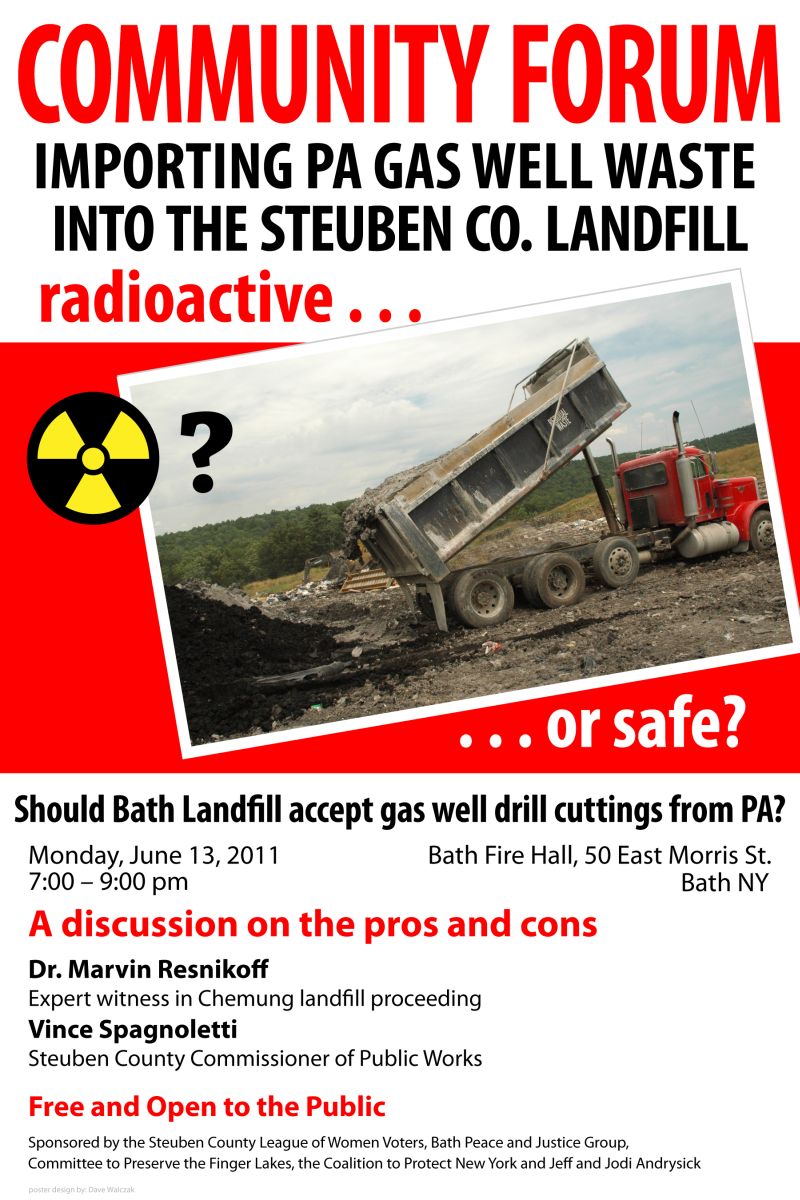
Steuben Co Landfill and Drill Cuttings–June 13, 2011

Controversial drilling technique prompts CA bill – BusinessWeek

Controversial drilling technique prompts CA bill – BusinessWeek.

Report: Lift of fracking ban would generate $11.4B for N.Y. by 2020 | The Ithaca Journal | theithacajournal.com

Report: Lift of fracking ban would generate $11.4B for N.Y. by 2020 | The Ithaca Journal | theithacajournal.com.

Report: Lift of fracking ban would generate $11.4B for N.Y. by 2020

1 Comments

ALBANY — New York could see $11.4 billion in economic activity by 2020 and up to 18,000 new jobs by 2015 if the state allows gas companies to drill into the massive Marcellus Shale formation, according to a report released Tuesday by a conservative think tank.

The report, paid for by the business-backed Manhattan Institute for Policy Research, found that state and local governments would gain $1.4 billion in tax revenues alone over the next nine years.

The study’s authors — who also penned a report in 2009 that was partially commissioned by the natural-gas industry and released through Pennsylvania State University — also found that the typical Marcellus Shale gas well reaps about $4 million in economic benefits, while the environmental impacts come to about $14,000 per well.

Their study is based on a prediction of 330 horizontal wells in New York, which primary author Timothy Considine said is a conservative estimate. The number could expand five-fold, he said, if gas companies decide to tap into the Utica Shale — a much larger formation that lies below the Marcellus.

Both formations lie below large portions of New York, with the Marcellus region taking up much of the Southern Tier and part of the Hudson Valley.

“It could be much larger than the numbers projected in my report,” said Considine, a professor at the University of Wyoming. “The $11.4 billion number is based on a fairly limited development scenario in the Southern Tier of New York, like Broome and Chemung counties.”

The figures include both direct and indirect streams of economic activity, such as the spin off to other manufacturing, construction and retail industries. Considine said the financial estimates are based on activity that has taken place in Bradford, Tioga and Susquehanna counties in Pennsylvania, where high-volume fracking has been permitted since 2008.

Natural gas advocates hailed the report, which they said validates what they’ve said since the technique was first put on hold in New York in July 2008 so the Department of Environmental Conservation could review its environmental impact. That study continues, with a second draft due by July and high-volume fracking still on hold until a final review is complete.

“This study quantifies in real and remarkable terms the economic promise of natural-gas development in upstate New York,” said Brad Gill, executive director of the Independent Oil & Gas Association of New York.

The report’s authors, however, have faced criticism for their past work on hydrofracking, including the Penn State report.

A dean at Penn State said that report — which predicted a windfall of economic activity resulting from natural gas in Pennsylvania and spoke out against a proposed severance tax — should have been “more scholarly and less advocacy-minded.”

An initial version also did not disclose that it was partially funded by a gas-industry trade organization, but was later updated to include a disclaimer. The New York report was funded solely by the Manhattan Institute, Considine said.

David Gahl, policy director for Environmental Advocates of New York, said it’s important to look at the report’s source of funding, which he characterized as coming from “pro-gas people.” It’s not a coincidence that the report is favorable toward the gas industry’s intentions, he suggested.

“Just like Pennsylvania’s lax history of regulatory oversight for dirty gas drilling called hydraulic fracturing … you get what you pay for,” Gahl said.

Considine, however, said the funding had no impact on the results of the study, and that he has plans to submit it to several peer-reviewed journals for publication.

“I don’t see how it could have,” Considine said. “The work stands on its own.”

The Manhattan Institute report does make some policy observations, finding that New York’s “current shale gas drilling moratorium imposes a significant and needless burden on the New York State economy.”

The authors also found the risk of significant environmental damage is very low, and “in no way call into question the soundness of” hydrofracking.

The study found that 152 violations — such as spills, cases of stray gas and blowouts — have led to the contamination of 9.3 million gallons of water in Pennsylvania. That number is low, the authors said, if you take into account the state’s annual household use of more than 300 billion gallons.

“Our study finds the net economic and environmental benefits from shale gas development to be considerable, suggesting that the current moratorium is far costlier than its proponents, or even its opponents, realize,” the report reads.”

Gahl, however, said the report underestimates the concerns about hydrofracking.

“The pro-gas people paid for a report that claims natural gas is a fairy godmother that will save New York’s economy and — poof! — makes very real concerns about health and safety disappear,” Gahl said.

Syracuse Big Splash June 12