Local businesses fighting LPG storage – YNN, Your News Now

Local businesses fighting LPG storage – YNN, Your News Now.

Local businesses fighting LPG storage

By: Bill Mich

Business owners around Seneca Lake thrive on the tourism that comes to the Finger Lakes Region. However, many believe the tourism business is in jeopardy with a proposal to store liquid petroleum gas underground in the region. As our Bill Mich tells us, some owners are now coming together to present a united front against the local gas storage.

BURDETT, N.Y. — It was standing room only at the Damiani Wine Cellars. The mission, to bring as many people together as possible to fight the proposed underground storage of liquid petroleum gas near Seneca Lake.”We are going up against a multi-billion dollar corporation that has very deep pockets and we need to show a united front and let them know that this is not right for this area,” said concerned local resident Joseph Campbell.

That corporation is Inergy, the energy storage company that wants to store over two million barrels of LPG in underground salt caverns. The company has presented their facts to the public and say their operation is safe and won’t bring any negative effects to the region. But some residents and business owners just aren’t buying it.

“The best laid plans of engineers go awry and that impacts all of us here,” said co-owner of Damiani Wine Cellars, Lou Damiani.

The potential for hazardous leaks, explosions, and constant noise and light pollution from the industry have local business owners worried about the area’s tourism.

“By some tourist magazines, the number one lake tourist spot in the world, in the world, and what do we want to do? We want to make it the industrial hub of north east gas distribution? That’s going to help us? I don’t think so,” Damiani said.

By presenting a united front, owners think they can make a difference. They have collected nearly 1,200 petition signatures and hired a lawyer to fight the storage company. Keeping things the way they are is the ultimate goal.

“It is a place that people enjoy because of it serenity and its pure waters and that’s what everybody wants to keep,” said Seneca Sailing Adventures Owner Terry Stewart.

The group will hold another public information meeting detailing their concerns of the proposed gas storage Wednesday night at the Glenora Wine Cellars.

State pension fund invests over $1 billion in gas companies | Star-Gazette | stargazette.com

State pension fund invests over $1 billion in gas companies | Star-Gazette | stargazette.com.

Written by
Jon Campbell
jcampbell1@gannett.com

Living Wage

Living Wage figures for Tompkins County as calculated by Alternatives Federal Credit Union.

Expenses 2009 2011

Living Wage $11.11 $11.67

Rent $763 $811

Food $203.25 $203.60

Transportation $167.52 $179.03

Communication $61.49 $59.99

Health Care $143.53 $173.08

Recreation $100 $101.62

Savings $59.81 $60.78

Miscellaneous $111.13 $110.46

ALBANY — The State Comptroller’s Office has invested hundreds of millions of dollars from the state pension fund in natural gas and hydraulic fracturing companies in recent years, a review of the fund’s most recent listings shows.

In all, the $140 billion fund had more than $1 billion invested in more than a dozen energy companies as of March 31, 2010, a review by Gannett’s Albany Bureau shows. That includes $72 million in natural-gas giant ChesapeakeEnergy Corporation and $145 million in Schlumberger Ltd, a company specializing in hydrofracking and oilfield services.

The issue of gas drilling and hydrofracking has divided the state, with some touting the economic and energy benefits associated with the fuel. Others say the extraction process — which involves the injection of millions of gallons of water and chemicals to fracture shale formations — is environmentally destructive and could lead to water contamination.

“The main objective is to make money, so that’s always a primary concern. But (Thomas DiNapoli) has always been very clear in his interest in safety and risk mitigation,” said Ola Fadahunsi, a spokesman for the Comptroller’s Office. “That’s the delicate balance that you always have to (achieve).”

Records show the fund’s investments in several gas companies have risen significantly since 2008, when many of those companies began expanding aggressively after technological advancements made the massive Marcellus formation more accessible. An additional $15 million went to Chesapeake and Houston-based Cabot Oil & Gas Corporation in that time frame, as well as $30 million to Southwestern Energy Company.

Some of the investments have led to big returns, including Schlumberger. The fund’s 4.2 million shares were worth $296 million as of 2010, after the fund bought $145 million worth of shares over the years.

Roger Downs, a conservation associate for the Sierra Club Atlantic Chapter, said the investments in fracking and gas companies deserve a second look, saying it could pose a conflict if the state moves ahead with drilling.

High-volume hydrofracking is prohibited in New York as the state reviews its permitting regulations. A second draft of the regulations will be released this summer.

“It’s something that I think we’d like the Comptroller’s Office to look at,” Downs said. “I think if the state is profiting from natural-gas development at the same time that they are looking at potentially new regulations for the industry, there is a bit of conflict of interest.”

A handful of the fund’s largest investments are in energy companies such as Royal Dutch Shell and ExxonMobil, which have built their fortune largely in oil but have in recent years acquired companies specializing in shale gas extraction. The fund has invested more than $374 million in Exxon, for example.

Some of the companies receiving pension-fund investments have come under fire for environmental mishaps. Cabot paid more than $400,000 in fines to the Pennsylvania Department of Environmental Protection and reached a $4.1 million settlement after faulty well construction led to methane seeping into a dozen water wells in Dimock Township, Pa.

Chesapeake made news last month when a blowout in Bradford County, Pa., led to a spill of thousands of gallons of chemical-laced water used in the hydrofracking process.

Both earlier this year and in 2010, DiNapoli was part of a group of investors to file a resolution with several companies involved with shale gas, including Chesapeake, Cabot and Hess. The group asked the companies to detail the environmental impact of their operations, as well as put forth potential policies to reduce emissions and environmental harm.

Most of the companies agreed with the request, while Carrizo Oil & Gas will put the resolution to a shareholder vote next month.

“The development of the Marcellus and other shale gas plays must be done the right way,” DiNapoli said at the time the resolution was filed. “As shareholders, we want these companies to assure us that they have a full and complete appreciation of the liability risk, and that they’re taking steps to mitigate those risks.”

Susan Lerner, executive director of government watchdog group Common Cause New York, agreed with DiNapoli’s action, saying it’s important for pension fund managers to stay on top of the corporations they invest in.

“One of the risks for a company that is involved in mineral extraction is that something goes wrong and the company is held liable, and then the shareholder value decreases,” Lerner said. “If the pension funds are shareholders, then they should behave like capitalists and demand that their investment be protected in whatever way is appropriate.”

Assemblywoman Barbara Lifton, D-Ithaca, has been one of the fiercest critics of hydrofracking in the Legislature, but said she trusts the work of the Comptroller’s Office.

“I assume they look at these decisions strictly as investments and keep the politics out of it,” Lifton said.

While the companies’ practices continue to come under intense scrutiny from environmental groups, telling the comptroller not to invest in an industry would be setting a dangerous precedent, said Sen. Thomas Libous, R-Binghamton.

“This issue has come up on a number of occasions, and not just as it pertains to fracking, but as it pertains to a whole host of things over the years,” Libous said. “If the comptroller started separating things out into what people agreed or disagreed with, there would be nothing to invest in.”

Energy Management Resources Reports on the Volatility of Natural Gas Prices

Energy Management Resources Reports on the Volatility of Natural Gas Prices.

Energy Management Resources Reports on the Volatility of Natural Gas Prices

Shale continues to take center stage, albeit with mixed opinions, which is adding volatility to the direction of natural gas prices.

Quote startThe new drilling technologies that have proved so successful for natural gas may now provide an impact on the world oil supplyQuote end

(PRWEB) May 03, 2011

EMR – Based on last months New York Mercantile Exchange (NYMEX), Natural Gas prices are holding between $4.20 to $4.30 per MMBtu. Many factors come into play with when pricing commodities on NYMEX; however, all eyes continue to focus on the game changer – Shale Gas. Energy Management Resources is seeing a lot of clients re-analyze their hedging strategies as a result.

Shale continues to take center stage, albeit with mixed opinions, as compared to previous robust projections. These mixed opinions are adding some volatility to the direction of natural gas prices. Yet, it looks like North American producers are scaling back due to economics.

Here are the some facts regarding the economics of shale gas:

  •     There are 2,300 drilled but yet to be completed wells in the Haynesville, Marcellus, Eagle Ford and Barnett plays alone. As a result, producers have an inventory position whose cost structure will continue to put price caps on future price increases.
  •     There are potential environmental hazards that can be associated with the process of drilling for shale gas. Consequently, larger investments may be needed to deal with any new regulatory oversight and unanticipated regulations.
  •     Storage and pipeline capacity limits are being tested, as U.S. dry natural gas production is expected to grow by about 5.4 Bcf/d through 2015 from the 2010 average.

What some know about this game-changer is that the new drilling technologies that have proved so successful for natural gas may now provide an impact on the world oil supply. Oil brings much higher returns than gas, so many investors have already begun to pressure Boards of Directors about their investments. While debt rollovers, new equity offerings, and asset lease sales have financed the shale gas boom, disappointing cash flows are leading some investors to jump off the bandwagon. A thousand cubic feet (Mcf) of U.S. natural gas once sold for a tenth of the price of a barrel of oil, but now that spread has widened tremendously – One (1) Mcf of gas now sells for a twentieth, or less, of the price of a barrel of oil. Major shale producers see today’s gas prices making the economics of shale gas, as well as conventional gas, increasingly unprofitable. Weak cash flows have spurred investor concerns that these companies may no longer be able to meet wellhead break-even costs at those prices.

  •     Chesapeake Energy Corporation announced they had decided to sell all of its Fayetteville Shale assets and its equity investments in Frac Tech Holdings, LLC and Chaparral Energy, Inc.
  •     Chesapeake also announced ramped up investments at the Niobrara oil/shale formation, primarily an oil play, situated in northeastern Colorado and parts of Wyoming, Nebraska, and Kansas.
  •     Voyager Oil & Gas has made similar investment decisions. It will reduce production in its Bakken shale formation and refocus on its Niobrara fields.
  •     In response to deteriorating, if not negative profit margins, other shale gas producers are suddenly redeploying their rigs to drill for more lucrative oil. That includes the likes of Petrohawk Energy Corporation, EOG Resources, Forest Oil Corporation, and Quicksilver Resources.

Low natural gas prices are the result of many factors and the technology behind shale gas is seen as the central game changer, as it may assume a similar role in oil exploration. Although the potential environmental impacts of producing shale gas are being questioned, shale gas producers are redeploying their drilling dollars to oil targets searching for higher returns. According to Baker Hughes last week, the number of natural gas rigs operating in the US fell for a fifth consecutive week to a ten-month low. By shifting from gas to oil, the technology has lifted hopes of the first significant rise of onshore U.S. oil production in decades. In five to eight years, the technology could add a million barrels of oil a day to U.S. supplies.

Analysts stress the importance of this switch in exploration activity. Moving from shale gas to oil won’t be without consequences for future gas supply, as the effect of more rigs drilling for oil will have an impact gas prices. The oil exploration industry has already moved to riskier finds, such as Alberta tar sands and deep-water drilling. There probably isn’t a whole lot of “easy oil” left to find. Thus, the oil industry thinks it can benefit from the shale gas technology developed by its siblings in the natural gas sector.

About Energy Management Resources:
Energy Management Resources (EMR) helps energy intensive industrial and commercial companies across North America optimize their energy requirements. The costs, risks and regulatory issues associated with high demand energy consumption are complex. We take the complexity out of the equation to reduce your operating expense and manage your company’s risk.

###

Businesses and Towns Taking On Fracking | WBNG-TV: News, Sports and Weather Binghamton, New York | Local

Businesses and Towns Taking On Fracking | WBNG-TV: News, Sports and Weather Binghamton, New York | Local.

Businesses and Towns Taking On Fracking

By Brennan Smith
Bio

March 28, 2011 Updated Mar 28, 2011 at 11:36 PM EDTTown of Middlefield, NY (WBNG Binghamton) As state lawmakers try do decide what they want to do with hydraulic fracturing, some towns are taking the matter into their own hands.

The town of Otsego and Middlefield are discouraging drilling on their land.

One area business is working to ban fracking.

Brewery Ommegang operates in the Town of Middlefield.

It goes through one million gallons of water per year to make its beer.

Water, it believes, could become polluted if hydraulic fracturing were allowed in the town.

“Beer is water and any threat to our water quality is a threat to our business,” said Brewmaster Phil Leinhar.

The Brewery says it is urging its local government to take action against hydro-fracking.

It is also taking a stand with 250 other businesses in a coalition.

“This isn’t just the usual liberal, left-wing greeny thing. It’s people across the entire spectrum. We’re concerned about this as a business,” says Larry Bennett who does Press Relations for the brewery.

Environmental effects isn’t the business’s only concern.

The nearby Cooperstown Chamber of Commerce says its members rely heavily on tourism.

It released a statement against fracking after surveying its members.

Eighty-seven percent of its members who responded agree with the move.

The chamber believes the drilling industry would change the region and discourage travel.

“I think the area sees half a million visitors per year. This year, we’ll get forty-thousand coming to this brewery right here and that makes it important to us to have a pristine environment, not just the water.”

The Brewery says it doesn’t want New York Sate to be the testing ground for natural gas drilling.

It wants the DEC to continue to research the procedure before it approves it.

Bennett says he will be meeting with the DEC and state leaders tomorrow.

He will be sharing his own research with them and finding out where they stand on the issue.

The Towns of Otsego and Middlefield are looking into either rezoning or crafting bans to prevent drilling.

The Marcellus Effect: An Economic Perspective

The Marcellus Effect: An Economic Perspective.

Tuesday, April 26, 2011

An Economic Perspective

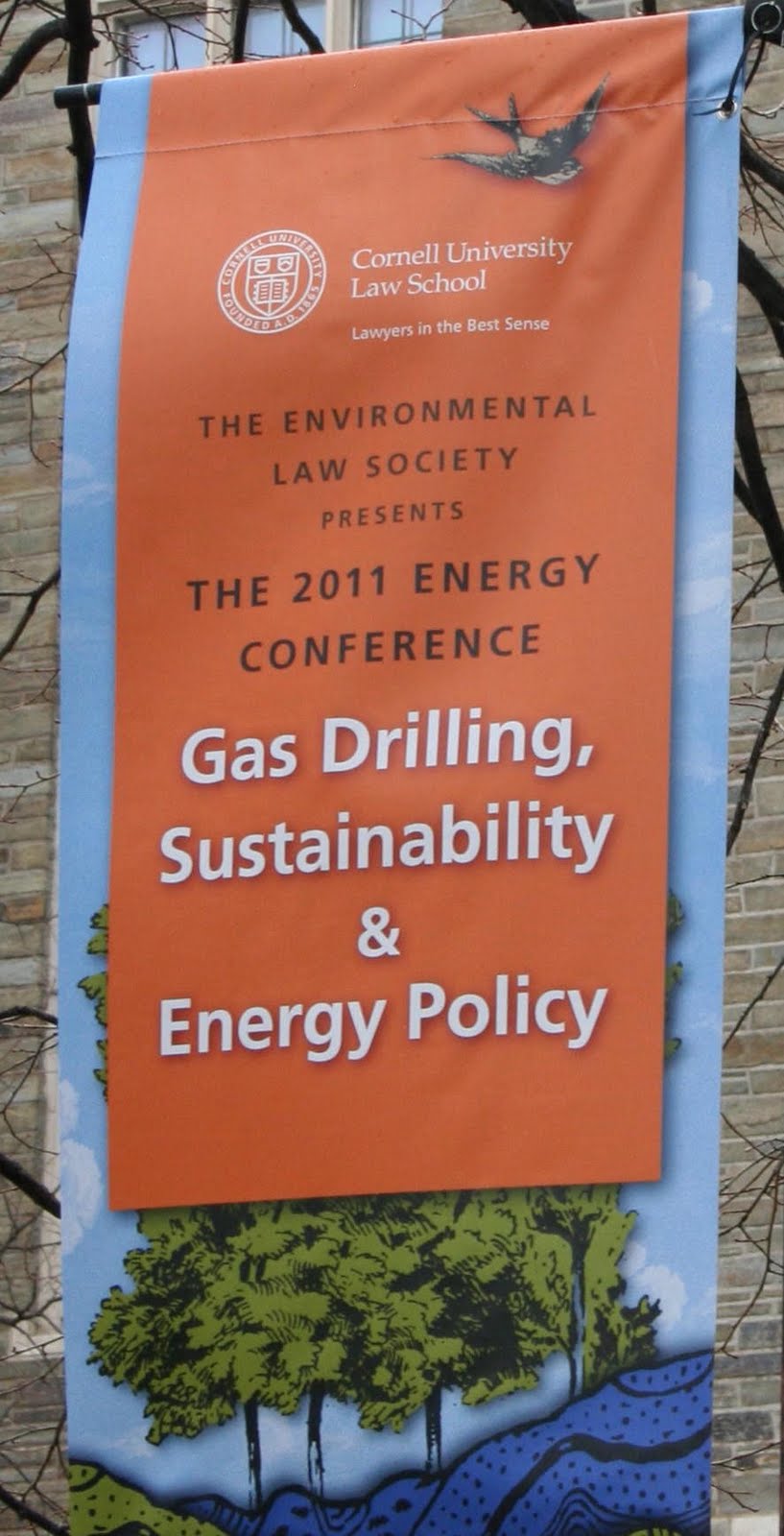
During the April 1-2 Environmental Law Conference up at Cornell, professor of city and regional planning Susan Christopherson provided some economic perspective to the Marcellus Shale discussion. “Drilling affects everything in a community,” she said, listing topics from traffic to housing to community health.
“There are so many uncertainties,” Christopherson said. “We don’t know what all the risks are, or who will bear them.” What we do know is that the roads will be heavily impacted by the increased traffic.
Shale drilling is driven by the market. The industry is debt-driven and looking for commercially viable wells and that will determine where they drill and how long they remain in a locality. Like the financial services, shale drilling is “a speculative bubble,” Christopherson said, “but one with serious environmental consequences.”
Drilling impacts are driven by the pace and scale of development. “We should plan for a short-term intensive boom/bust cycle, as well as the impact of building an infrastructure to get their [gas] product to market,” Christopherson said. She said municipal and state officials need to think beyond the well pad and consider cumulative impacts of industrialized drilling activity.
“There will be increased public safety costs,” Christopherson said, pointing to the correlation between the need for more police and shale gas drilling. Other community impacts include increased costs for health and education services, and increased demand on public administrative services such as permitting and zoning officers, and an increased need for environmental remediation and monitoring.
Communities that don’t experience drilling may still feel the impacts. Ithaca will see increased truck traffic, and Watkins Glen is already seeing development of an industrial site for storing liquefied gas and petroleum products. There will be more, she said: pipelines, man camps, water withdrawal sites, compressor stations, truck depots, rail spurs and “trucks, trucks, trucks!”
The big question: are we prepared for the bust? “It will surely come,” Christopherson warned, “because once the gas is gone, it is gone.” And the rural areas will be the ones hardest hit by the boom/bust cycle. The increased housing costs will push out traditional residents; the demand for truck drivers will push the cost of milk production higher as farmers compete with gas companies for drivers.
Resource extraction works against diversity in local economies, driving out small businesses that do not cater to the gas industry. Tourism, in particular, depends on availability of lodging and restaurants. There will be increased economic inequality, Christopherson said.
But communities can take steps to minimize these cumulative impacts. The most important thing, Christopherson said, is to slow the pace of development. That will allow communities to absorb and spread out the impacts. Communities also need to cooperate with each other. Christopherson also challenged the state to take the lead by establishing policy that regulates and monitors the gas industry. The state needs more transparency, too, regarding where drilling happens and when and where spills and incidents occur.

Tourism vs Energy Extraction

www.catskillcitizens.org

“Slam Bam, Thank You Ma’am”

Shale Gas Drilling Will Come and Go Without Regard to the Protection of our Precious State

The Facts:

• The tourism industry is critical to the long-term health and diversity of New York’s economy; it is sustainable, steady, and long-term.

• Shale gas drilling may bring a short-term boom, which will be followed by a long-term bust, with the substantial risk of contaminated water, an industrialized landscape, infrastructure destruction, and failing health.

• Gas drilling in the Marcellus Shale will gut the tourism industry in treasured areas, including the Catskills, the Finger Lakes, and surrounding areas.

• Water contamination may destroy our world-renowned trout streams — no more anglers.

• Water and land pollution may dramatically reduce our wild game populations – no more hunters.

• An industrialized landscape will destroy natural beauty – no more bird watchers, autumn leaf peepers, cross country skiers, hikers, kayakers, antique shoppers, second home market.

• Water and land contamination may destroy our organic farms, our vineyards and our new growth industry, agri-tourism.

• New York State estimates that every $1 generated directly by tourism indirectly generates $7 for the State’s economy; while the minimal analysis in the draft SGEIS estimates that every $1 generated directly by the Oil & Gas industry generates only $1.40 for the economy.

• Tourism creates more jobs than gas drilling; tourism is a more labor intensive industry, compared to the Oil &Gas industry, which is about 10 times more capital intensive than the average American industry. Moreover, tourism creates more local jobs, while oil and gas relies on a small, transitory workforce from out-of-state. In particular, the tourism industry is critical to the Catskills, generating 15% of total employment.

• Respected research points to the fact that fossil fuel extraction destroys economic diversity and increases long term poverty rates.

Don’t let Gas Drilling Destroy A Critical Industry

Catskill Citizens for Safe Energy Loves New York and Values our Touri