‪HRW trip to Pa to see Hydrofracking – entire interview 7 18 11‬‏ – YouTube

‪HRW trip to Pa to see Hydrofracking – entire interview 7 18 11‬‏ – YouTube.  Hydro Relief Web

On July 16th 2011, a group of people from Oneida County, New York drove to Bradford County, Pennsylvania to see the process of Hydrofracking for themselves. The trip was organized by Hydro Relief Web
Three of the people who attended (Toshia Hance Bonnie Jones Reynolds and Carleton Corey) were later interviewed by Reporter/Anchor Gary Liberatore from WKTV news Channel 2. This video is the extended form of that interview.

Reporting that Tonawanda resident that the local newspaper has told her not to write anymore letters to the editor about hydrofracking because the paper will not print them.

Shale Force–Syracuse New Times July 20, 2011

Shale Force.

Shale Force

By Ed Griffin-Nolan  

Bill Fischer moved to Central New York last year to get away from the noise and the risks of hydrofracking near his home in Pennsylvania. He has a simple message for people in Central New York about natural gas drilling in the Marcellus Shale: “It’s coming, whether you like it or not, so you better be ready.


Relocated here from northern Pennsylvania, Bill Fischer considers himself a fugitive from hydrofrackingBy Ed Griffin-Nolan

Bill Fischer moved to Central New York last year to get away from the noise and the risks of hydrofracking near his home in Pennsylvania. He has a simple message for people in Central New York about natural gas drilling in the Marcellus Shale: “It’s coming, whether you like it or not, so you better be ready.”

In the basement of the house in DeWitt that Fischer and his wife, Debbie, just bought hangs a framed picture of the home they left behind in rural northeast Pennsylvania. Seen in the aerial photograph the house sits on the edge of a lake that measures 92 acres surrounded by lush forest. Silver Lake, near Brackney, Pa., 14 miles of back roads south of Binghamton, was home to the Fischers for 13 years, until the advent of hydrofracking convinced them it was time to leave.

Fischer is a 64-year-old former New York state trooper who has the mind of a detective and speaks with the authority of a judge.

Since 1980, when a tangle with a suspect led to his early retirement with a disability, he has run his own private investigative firm, William Fischer Forensic Consulting, specializing in the reconstruction of crime scenes. He enlisted in the Marines during Vietnam, serving his time mostly in the Mediterranean.

Sitting on the three-season porch of his new home on a cul de sac just a few blocks from the spot where East Genesee Street crosses under Interstate 481, his aging golden retriever Nellie at his feet, Fischer describes the idyllic scene he left behind just south of the New York-Pennsylvania line. At regular intervals he interrupts himself to talk of his recent passion: long, early summer bike rides through southern Onondaga County. Recounting mornings spent cycling through the hills of Jamesville and Pompey and past the dairy farms of Fabius, Fischer sounds like a man who has discovered a new love late in life. But when he talks about the place he left behind, a wistful sadness emerges in his voice.

“We lived on State Route 167, 100 feet from the road, and 500 feet from the lake,” he says. “It was a quiet country road. I could sit on my porch and watch five eagles fishing the lake.”

Last November, all that changed as Williams Oil Company set up shop to drill for natural gas. Like much of New York’s Southern Tier and a large swath of Pennsylvania, Silver Lake sits atop a rock formation so packed with fossilized vaporized energy that it is frequently referred to as the Saudi Arabia of natural gas. The race to get the gas out of the ground and into a pipeline changed Bill Fischer’s life forever.

“Sixty trucks an hour came by the house, 10 hours a day, for three weeks. Every time they came to the top of the hill they downshifted, sending up a puff of diesel that cooled and then settled back down right in my front yard. That was just to put in the pad. The pad was a mile and a half from the house, directly across from Salt Springs State Park. They planned to place 10 wells on the pad.”

That subterranean rock formation—the Marcellus Shale—is what we share with the people of Susquehanna County, Pa., the place Fischer left behind. The shale is either a blessing or a curse, depending on who you speak with. For Fischer, it depends on how we handle it and, he reminds us, it’s not going away any time soon.

The gas entombed by the Marcellus Shale sits thousands of feet below the earth and the only technology yet discovered that can exhume it—high volume hydraulic fracturing (fracking for short)—brings with it heavy baggage. Fracking involves shooting millions of gallons of pressurized water and sand, laced with chemicals, into the formation. While fracking breaks up the shale and forces the gas up, questions of where all the water will come from, how it will be altered by its use in the process, and what will be done with it afterward remain unanswered. And that’s just for starters.

The Marcellus Shale has the potential to power the Northeast for a generation or more, and to turn the area’s last unspoiled landscapes into industrial wasteland. Royalties from gas drilling can fund our schools and social services and erase our crushing deficits, while creating water and air pollution from which we might never recover. It can divide neighbor from neighbor, upstate from downstate, while bringing an upstate revival that will allow aging families to remain in their homes and even bring young people back to the region. You pick.

At the Crossroads

These and many other concerns are addressed in a massive document that you can read online at http://www.dec.ny.gov/energy/75370. html (Please don’t print it out unless you really hate trees). It’s the New York state Department of Environmental Conservation’s answer to the Tolkien trilogy, entitled the Preliminary Revised Draft of the Supplemental Generic Environmental Impact Statement (GEIS).

The report suggests how New York state proposes to govern fracking in the Marcellus Shale, and it tweaks the earlier draft GEIS first released in 2009, responding to the more than 13,000 comments made on that tome. The new report is open for public comment from now through September.

Pressure from legislators has led to a moratorium on fracking that is set to expire this month, and politicians in both Central New York and New York City have persuaded the DEC to declare both the Skaneateles and the Catskill watersheds, which feed water to the Salt City and the Big Apple, respectively, offlimits. The federal Environmental Protection Agency is also conducting a review of the impact of fracking nationwide, and there is pressure in Albany to extend the moratorium until the EPA releases its findings, probably not for at least another year.

Public sentiment runs high against the procedure, even as local landowners continue to sign leases giving companies the right to drill on their land.

Bill Fischer, the bike-riding former cop, comes to us with his simple, fatalistic message. “They’re not gonna stop this industry,” he concedes. “In our area the grass-roots was building up, but the industry was rolling over everybody. There’s just too much money in it.”

In his case the gas company was allowed to drill in spite of his exhaustive organizing efforts. Fischer had banded together with neighbors to form a Silver Lake Watershed Legal Defense Fund. They petitioned the Pennsylvania Department of Environmental Protection (DEP) to declare their watershed “exceptional” and entitled to special protection.

“They designated 52 acres along the Silver Creek as ‘exceptional quality,’ which means no surface water contamination would be allowed,” says Fischer. “We thought that ruled out hydrofracking because of the possibility of leaks contaminating the surface water—but there’s no enforcement.” They went to the Public Utility Commission and won a ruling denying Laser Marcellus Gathering Company, a gas company, the use of eminent domain to take control of land to build a pipeline, only to see the commission reverse the recommendation.

“We saw the handwriting on the wall,” he continues. “It was a risk to stay. Long before this my wife and I understood, based on policies coming out of Harrisburg, that industrial development was going to be allowed, and this {their home in Silver Lake} would no longer be the place we thought it would be. We put the house up for sale and found a buyer in three days.

“Anyone who says, ‘no way, no how, not here’ is not being realistic. It’s not about stopping it; it’s about guiding it in a responsible way. This will necessarily go through in both northern Pennsylvania and southern New York state. The difference will be the amount of profit that will go from the public to foreign corporations.

“Do we develop this for the benefit of the public or for a few people? This is a public resource: The public is entitled to the profits. Here’s a state that’s going bankrupt, and you’ve got a huge amount of wealth that’s being taken to Texas {where many of the drilling companies are located} for the asking. Rather than close schools and programs,” he offers, “use the tax revenue from this industry to revive the state.”

In His Opinion

So how do you make it work for the people? Fischer rattles off policy options covering everything from the macroeconomic level down to engineering basics.

• “Every time they put a hole in the ground in the Marcellus Shale they’re making money,” he says, referring to the oil companies. “There’s so much gas that there’s almost no risk, and the certainty of gas sucks capital out of the market for all renewable energy sources.”

• “Why risk your capital investing in solar or wind when there’s so much money to be made drilling for gas in the Marcellus Shale? The only thing that can change that is government policy.”

• “There are things that New York state can do. The gas industry uses public air, water and roads. You can say, ‘This is a public resource and it is to be used for public wealth, to be shared.’ Like they do in Saudi Arabia, like they did in Alaska. This is seen by some as too socialistic. So if you don’t like that, change the permitting process.”

• “Instead of setting a permit price by the depth of the well, put those permits up for auction. Let the market determine the value. And only issue the number of permits that you can supervise. How many wells can you supervise for three shifts a day, seven days a week? Gas companies drill 24/7; we can’t have inspectors who go home at 5 p.m.”

In addition, Fischer suggests that a meter be placed on every well to measure the amount of flowback fluid coming back up from the shale. Right now he worries that the lack of measurement of returning fluid gives unscrupulous companies an incentive to dump their toxic wastewater. If it were metered, the company would have to account for the disposal of each and every gallon. In addition, he suggests, add a chemical tag to each well so that any wastewater found dumped illegally could be traced back to the well operator. Better yet, he says, have the state take charge of all wastewater and process it—for a hefty fee.

While Fischer came here to get away from the hydrofracking controversy and to be closer to family—three of his four children live locally, as do two grandchildren—the struggle for the heart of gasland seems determined to follow him. At a community forum in Fabius in May he was introduced as a “refugee from hydrofracking”; more recently he was part of a delegation visiting state Sen. David Valesky (D-Oneida) to talk on the issue.

“The decision to sell our house wasn’t to come up here. Once we decided to move, this was the logical place to come. There were a lot of tears shed over this, and a lot of secondguessing. I will be second-guessing myself until I die.”

As for Central New York, he says that they are here for good. “We love it here. We’re staying.”

Gas companies, beware. There’s a cop on your tail.


Religious leaders enter debate over hydraulic fracturing | syracuse.com

Religious leaders enter debate over hydraulic fracturing | syracuse.com.

Victory | Services–Security for the Oil/Gas Industry

Victory | Services.--Keep Disrupters Away!

Cornell Expert Says Hydrofacking Already Affecting New York State

(((THIS INFORMATION DISTRIBUTED ON BEHALF OF THE TOMPKINS COUNTY COUNCIL OF GOVERNMENTS)))
(Released June 23, 2011 at 8:03 PM)
 

Cornell Expert Says Hydrofacking Already Affecting New York State

 
Reflecting on lessons learned and questions yet to be answered about the hydrofracking and the economy, a Cornell expert today told members of the Tompkins County Council of Governments (TCCOG) that New York State is already being affected by such shale gas drilling, even though wells are not yet permitted here.
 
Economic Geographer Susan Christopherson, of Cornell’s Department of City and Regional Planning, has been studying the economic effects of hydrofracking, looking at the experience in nearby Pennsylvania and effects in New York.  Since there is “no border fence between New York and Pennsylvania,” she said, drilling produces a regional industrial effect, and cautioned there will be “important impacts to Tompkins County”—from such aspects as heavy truck traffic, water resources, and waste disposal— even if a single well is not drilled here.  She maintained State officials are showing “willful ignorance and disinterest” in failing to  address those issues and, because of that, the state is unprepared.
 
Based on her own research and review of other studies, Christopherson reported findings including the following:
  • The Elmira area is already feeling pressure on its housing stock and is experiencing some increase in sales tax revenue.
  • In Pennsylvania, jobs are being created, but impact is inflated since measures are based on new hires, not permanent jobs, with only 70% going to in-state residents.  She predicted employment growth here would be “modest,” with several hundred of the best jobs created for functions such as well monitoring when drilling is in process, but a significant decline once it’s completed.
  • Other industries will be affected, with tourism and the dairy industry most affected in PA.
Among questions that remain to be answered, according to Christopherson:
  • How long the drilling phase will last.  Where, when, and how many wells are drilled, she said, will be affected by natural gas prices, currently too low to make much drilling economically viable—the more wells that are drilled, and the faster they’re drilled, the greater the impact.
  • How the federal government’s recent approval of export of natural gas will affect gas prices.
  • Information on who owns land currently in PA and where proceeds from royalty payments are spent.
Christopherson said a New York State severance tax could help support costs related to shale gas drilling, and that such taxes exist in most states where such extraction takes place.  She said the level of such taxes varies widely state-to-state, as does the extent to which that tax is distributed to municipalities.  She assessed the 3% severance tax being proposed by some in New York State, however, as inadequate to meet the need.
 
Media contact:  TCCOG Co-Chair:  Ithaca Town Supervisor Herb Engman, 607-273-1721.
 
 
——
Marcia E. Lynch
Public Information Officer
Tompkins County
125 E. Court Street
Ithaca, NY  14850

COLUMN-Shale revolution hits snag along the Delaware: Kimmerle | Energy & Oil | Reuters

COLUMN-Shale revolution hits snag along the Delaware: Kimmerle | Energy & Oil | Reuters.

COLUMN-Shale revolution hits snag along the Delaware: Kimmerle

Fri Jun 10, 2011 3:10pm GMT

— Chris Kimmerle is a Reuters market analyst. The views expressed are his own —

By Chris Kimmerle

NEW YORK, June 10 (Reuters) – Shale gas and hydraulic fracturing have transformed the U.S. gas market in less than five years and are now central to the administration’s strategy for reducing emissions, boosting energy security and improving the balance of payments by cutting reliance on imported oil.

But the transformative potential of these technologies is threatened by rapidly escalating political opposition to the environmental impact of drilling and potential chemical contamination from fracking fluids.

The flash point centers on the giant Marcellus Shale in the Northeastern United States, which covers portions of West Virginia, Pennsylvania, Maryland, Ohio and New York. (here)

Development is pitting the gas industry and communities anxious to benefit from jobs and the income from royalties and leases against environmental groups and residents concerned about increased traffic and the risks to the environment from the disposal of a cocktail of chemicals injected into gas wells as part of the fracking process.

DELAWARE RIVER BASIN COMMISSION

While the relatively poor state of West Virginia has welcomed shale development as a way to supplement income and jobs from its troubled coal industry, opposition has mounted in other states.

The New York City Department of Environmental Protection called for a prohibition on drilling within the watershed of the city’s reservoir system in December 2009, and the governor of Pennsylvania banned new wells on state forest lands in 2010.

Last month, the speaker of the New York State Assembly announced the Environmental Conservation Committee had reported out legislation to suspend the issuance of new drilling permits for hydraulic fracturing in the state until June 2012.

But one of the most serious public challenges to drilling in the Marcellus has come from grass roots opposition to regulations being proposed by the Delaware River Basin Commission (DRBC).

The commission regulates water use and quality along the Delaware River under a 1961 compact among the states of Delaware, New Jersey, New York and Pennsylvania and the Federal Government. Its commissioners are the governors of the four riparian states as well as division engineer for the North East Division of the U.S. Army Corps of Engineers. (here)

In May 2009, the commission notified the natural gas industry that new Marcellus wells cannot be drilled within the river’s drainage area without first applying for and obtaining its approval. At the same time the commission released a set of proposed development rules as part of its water quality regulations.

The regulations are intended to protect the river’s water resources and apply to all gas-development activities including withdrawing water from the river system and the disposal of wastewater (including fracking fluids) from fracking projects.

The public comment period on the proposed regulations, which closed on April 15, drew a heavy response with approximately 58,000 public submissions received, of which more than 36,000 were hostile to the further expansion of Marcellus drilling.

TRANSFORMATIONAL TECHNOLOGY

The combination of shale gas discoveries and the hydraulic fracturing process, which makes it possible to exploit them, has probably been the most important new development in the oil and gas industry in last decade.

The revolution began with exploitation of the Barnett Shale under the Texas city of Fort Worth in the late 1990s. It has since spread to the Greater Green River Basin in Wyoming, the Uinta-Picenance Basin in Colorado and Utah, the Haynesville Shale stretching across the Texas-Louisiana border, the Woodford Shale in Oklahoma, and the Fayetteville Shale in Arkansas. (here)

Production from unconventional shale reservoirs has leapt from 0.39 trillion cubic feet in 2000 to 1.3 trillion in 2007, 3.1 trillion in 2009 and 4.87 trillion in 2010, according to the Energy Information Administration. It now accounts for 23 percent of all gas production in the United States.

Burgeoning shale production has transformed the outlook for the U.S. gas market. In 2005, the Hirsch Report for the U.S. Department of Energy forecast “Gas production in the United States now appears to be in permanent decline” and a period of rising gas prices.

Gas companies built a raft of regasification terminals to import LNG to alleviate predicted shortfalls in domestic production. Now surging output has caused prices to fall sharply and the gas companies are applying for permits to reverse the LNG terminals and use them to export domestic production.

Shale technology is now being deployed around the world and has effectively doubled the global resource base for natural gas. As a result, the International Energy Agency expects gas will play a much greater role in the global energy mix in future, according to a recent report in which it asked “Are we entering a golden age of gas?”

But that technological revolution has now run into an unexpected problem: mounting concerns about the content and disposal of fluids used.

CHEMICAL COCKTAIL

Key to winning natural gas from low permeable shale is hydraulic fracturing, a process that involves the injection of typically 1-4 million gallons of water at high pressure into a well in order to break the rock and allow gas to follow.

The water is combined with sand, chemicals, and gels to lubricate the process and help keep the rock open after it is broken. During the fracking process the fluid is returned to the surface for recirculation and ultimate disposal.

Between 2005 and 2009, the oil and gas industry introduced 780 million gallons of fracking fluid into U.S. wells, according to a staff report issued by the Democratic minority on the Energy and Commerce Committee of the House of Representatives.

According to the report, the fracking fluids used contained a total 750 chemicals and other components. The most widely used chemical, as measured by frequency of use, was methanol – designated by the Environmental Protection Agency as a hazardous air pollutant and candidate for inclusion on the list of regulated substances under the U.S. Safe Water Drinking Act.

Other widely used chemicals included benzene, lead, isopropyl alcohol, 2-butoxyethanol (also used as a paint solvent and in cleaning products) and ethylene glycol (also used in automotive antifreeze).

The report identified 29 chemicals used in fracking that are known or possible carcinogens and regulated under the Safe Water Drinking Act or listed as hazardous pollutants under the Clean Air Act.

It also identified 94 million gallons of fracking fluid that contained at least one chemical or component that its manufacturer deemed proprietary or a trade secret and is not available for public scrutiny.

POLITICAL CONTEXT

The unconventional gas revolution was born in the belt of midcontinental and western states stretching up to Wyoming where there was a favorable political, business and regulatory environment for energy producers. Shale production was welcomed as creating jobs and generating state and local tax revenues.

The political context in the Northeast is very different. The region has a broader economic base so it is less dependent on the energy sector for jobs and tax revenue. It also has poisonous legacy of 250 years of heavy industrial development along some of its rivers, including abandoned oil wells, acid drainage from abandoned coal mines, underground fires in the anthracite field and industrial pollution.

In New York state, the upper Hudson River is contaminated with PCBs (a known carcinogen) and the Monongahela River in western Pennsylvania and West Virginia remains scarred by the legacy of steelmaking and bituminous coal extraction industries.

Unsurprisingly, these states are more divided about shale development. The Delaware is part of the country’s Wild and Scenic Rivers System and provides drinking water for over 15 million people including the New York and Philadelphia metropolitan regions.

Coming from the more benign climate in the south, southwest, and west the industry appears to have been blindsided by the extent of local opposition. In a belated attempt to reverse industry groups have saturated local television and radio with advertisements extolling the virtues of oil and gas.

Even if the commission gives its approval, the lack of an environmental impact assessment is likely to form the basis for a court challenge. Litigation may delay implementation for 2-3 years, and open up fracking practices to greater scrutiny. (Editing by John Kemp and Marguerita Choy)

Bainbridge Residents Weigh In On Natural Gas Pipeline | WBNG-TV: News, Sports and Weather Binghamton, New York | Local

Bainbridge Residents Weigh In On Natural Gas Pipeline | WBNG-TV: News, Sports and Weather Binghamton, New York | Local.


Bainbridge Residents Weigh In On Natural Gas Pipeline

By Jenna Hanchard

June 14, 2011 Updated Jun 14, 2011 at 11:05 PM EDT

Bainbridge, NY (WBNG Binghamton) More than 100 people crowd into the Bainbrige Town hall to weigh in on a proposed natural gas pipeline.

The Leatherstocking Gas Company wants to build a pipeline that would run through Sidney, Coventry and Bainbridge.

The company is based in Sidney and wants to obtain public utility status.

The Village of Sidney has already signed off on the plan, but it has yet to go to a vote in Coventry or in Bainbridge.

Many who spoke up in support of the pipeline say the plan would create jobs and economic opportunities for the area.

Those against the plan fear the possibility of the company using eminent domain to build the lines and that constructing this pipeline will pressure lawmakers to give hydrofracking the go ahead.

“I’d like to see natural gas available as a competition to the oil. Oil is driving us out of our home. My heating bill next year is probably going to be like five thousand dollars, ” says Jay Campbell.

“Its problematic because its an underhanded attempt to invest millions of dollars and then say to our state assembly and state senate ‘we’ve put this in we’ve made this investment, you have to okay fracking,” says Patrick McElligott.

Both the town and the company reiterate that Leatherstocking does not have the right to use land belonging to residents for this project.

The town of Bainbridge will revisit the company’s plan at its next meeting to determine how it will move forward.

Regulations force trucks to add dozens of miles to routes – News – The Times-Tribune

Regulations force trucks to add dozens of miles to routes – News – The Times-Tribune.


Regulations force trucks to add dozens of miles to routes


Article Tools

| Font size: [A] [A] [A]

Our Social Networks

Facebook Twitter

Facebook


Photo: N/A, License: N/A

Route

LEMON TWP.

Craig Keller’s agitation surfaced as he discussed regulations restricting heavy-truck traffic from his quarry to the nearby Nicholson Twp. Building.

“They are between four and five miles, if we go this way,” Mr. Keller said, pointing east and indicating a direct route on rural roads. “For us to get there legally, its over 30 miles, if we do what the state wants us to do.”

Mr. Keller’s business, Keller Crushing and Screening Co., a quarry and stone distributor located nine miles north of Tunkhannock, is among dozens of companies confronting the burden of stepped-up state enforcement of a 10-ton limit on hundreds of miles of secondary regional highways. His company’s six dump trucks weigh 14 tons without any cargo, and if his haulers follow state-sanctioned routes from his Wyoming County quarry to the Nicholson Twp. building, they would drive south on Route 29 into Tunkhannock, east on Route 6 to Factoryville and north on Route 11 to Nicholson.

“Truthfully, we’re running illegally,” Mr. Keller said, referring to travel on 10-ton-limit roads. “I don’t like it, but I have to stay in business.”

Companies hauling large loads to remote locations find themselves hemmed in, driving extra distances and forgoing direct, country-road routes to comply with weight restrictions putting more than 1,500 miles of roads off-limits for heavy truck traffic in northern Lackawanna, northern Luzerne, Susquehanna, Wayne and Wyoming counties. Violations can lead to substantial fines.

“We are running in areas where we don’t even belong because we can’t go on that 10-ton-limit road,” said Adam Diaz, a Kingsley businessman who runs a stone company, a lumber mill, gas-industry services and drilling-site disposal operations. “It’s more of a risk and more of a liability for me because I’m sending my trucks farther. There’s more chance of an accident, a breakdown, wear and tear.

“It’s a cost of business that we didn’t have two years ago.”

The state Department of Transportation last summer expanded the posting and enforcement of 10-ton limits on mostly four-digit secondary highways in southwestern and Northeast Pennsylvania after excessive damage from heavy vehicles associated with Marcellus Shale natural gas development. The state ordered gas companies to post bonds covering roads they use regularly to service drilling sites. The goal was to make companies financially responsible for repairing road damage from heavy truck traffic.

The bonds cost $12,500 per mile for paved roads and require companies entering a compact to assume responsibility for additional maintenance from truck damage.

When stricter regulations and enforcement started in August, posted-road mileage in Susquehanna County alone quintupled from 97 miles to more than 552 miles.

“We run all these roads. It’s our lifeline,” said David Keller, Craig’s brother and vice president of the family business.

“If you go from Tunkhannock to Montrose (on Route 29) in a dump truck, you can’t legally turn off that road, with the 10-ton limit,” Craig Keller said. “We supply a lot of rock for the road repairs, but we can’t use the roads to get there.”

PennDOT issues travel permits to regional companies, giving them technical clearance to use secondary roads for local deliveries. But a recently discontinued regional PennDOT notification about the permits process includes a warning: “State police do not recognize this as a legal document.”

“If you are a local business, there is an exemption built in,” said James May, spokesman for the PennDOT district office in Dunmore. “It really should not be a whole lot more inconvenient.”

Thirty state police enforcement teams monitor truck traffic statewide for violations, including regional units based in Dunmore, Blooming Grove and Towanda, said Lt. Ray Cook, director of the state police commercial vehicle safety division.

“We actively enforce violations of special hauling permits or, in many cases, trucks operating in excess of 10-ton limits without a permit,” Lt. Cook said. “When it comes to weight violations, the permit becomes completely invalid.”

In November, a truck owned by Kingsley-based Masters Concrete Products was stopped, inspected and issued a $15,000 citation for a weight violation, company President Richard W. Masters said.

The company fought the citation in magisterial court and the fine was dismissed, but the experience was alarming, Mr. Masters said.

“It’s hanging over our heads all the time. We’re holding our breath,” he said. “If we have to go around these roads, there’s no point in staying in business. We could not afford to do it.

“It’s ridiculous that we have to put up with this stuff,” he said.

PennDOT permits allow local companies to use posted roads for local deliveries, Lt. Cook said, but they do not excuse violations for weight or safety issues.

“We certainly don’t want to stymie the growth of the (gas) industry in the state, but at the same time, we want them to operate in accordance with the law,” he said.

State Rep. Sandra Major, R-111, Bridgewater Twp., has fielded a flood of complaints about the restrictions.

“It has a huge impact. Where they might take a shortcut using a four-digit road, now because they are posted, they can’t do that,” Ms. Major said. “The local folks who have been using these roads for generations are getting caught up in this issue.”

The restrictions not only add greater traveling distances, higher fuel and vehicle maintenance expenses, they deter commerce, Mr. Keller said.

His local business has declined by 50 percent over the last year, though increased work at gas-drilling sites has made up for the loss.

“A lot of our customers are afraid to come in here because of the 10-ton roads,” he said.

Because of travel restrictions and near-record diesel fuel prices that are up 33 percent from last June, businesses are increasing prices and fees to offset higher expenses.

Mr. Keller has boosted stone prices by 20 percent this year, but Mr. Diaz said higher charges barely offset his soaring operational costs.

“We are going to get nickeled and dimed so bad that eventually, you are not going to be able to pass it on,” he said.

Inspections can tie up trucks for hours, delaying deliveries and adding more expenses.

“We had one of our trucks stopped three times in one day – by the same officers,” Mr. Keller said.

“Some people have been pulled over for anywhere from an hour to three or four hours,” Ms. Major said. “There are costs. That’s a driver not getting a product to where it needs to be delivered.”

Gas-drilling companies can afford to bond highways they need to ensure their availability and supplies, but the prospect is beyond reach for most small businesses.

“How to do you take a 10-mile stretch and put up a $125,000 road bond and make your payroll?” Mr. Diaz asked. “They are making people run illegally, because they can’t afford this.”

Contact the writer: jhaggerty@timesshamrock.com

Read more: http://thetimes-tribune.com/news/regulations-force-trucks-to-add-dozens-of-miles-to-routes-1.1160805#ixzz1P5zggoys

Methodists call for new drilling moratorium – News – The Times-Tribune

Methodists call for new drilling moratorium – News – The Times-Tribune.

Methodists call for new drilling moratorium


GRANTHAM – United Methodists representing 950 churches across central and Northeast Pennsylvania passed a resolution calling for a temporary halt in gas well drilling in the Marcellus Shale as well as an impact tax on those places where drilling already has taken hold.

The issue dominated about an hour of discussion Thursday at the Susquehanna Annual Conference meeting, which runs through today at Messiah College near Harrisburg.

Karen Weiss, a lay member from St. Paul’s Church in State College, who is also an environmental engineer, said she had a hand in being part of a design team for a pair of wastewater treatment plants that took fracked water.

She said she was surprised that what chemical compounds some companies said they used in fracking often understated what was actually used.

“We were discovering that the water at the end of the treatment plant’s recycling process wasn’t as clean as it should have been because other things had been added we weren’t prepared for,” Ms. Weiss said. “That’s just not acceptable.”

The Rev. Wayne Bender of Shope’s Church in Hummels­town said he was disappointed that the Susquehanna Conference was not addressing what he considered more important issues that the Marcellus Shale activity had wrought on the region – particularly an influx of new workers coming into the region and what he called the “new homelessness” created because rents were being driven up in certain communities.

But, Joan Carey, a lay member from Clarks Summit, said she has a doctorate in biology, and “the bottom line was that if we don’t have clean water, we’re done.”

During the four-day conference attended by as many as 1,500 United Methodists about evenly divided between clergy and laity, the body also supported mental health ministries, envisioned an AIDS-free world by 2020 and openly discussed sexual ethics and reinforced the church’s mechanisms for accountability.

Celebrations also occurred in honor of retiring clergy and in memory of those deceased.

Bishop Jane Middleton presided over the body, and in her opening remarks Wednesday said those gathered needed “to stand in the water and choose life.”

She said individuals needed to be willing to give up anything that is not essential to their survival and challenged the conference to give up everything that is not essential to its mission “so we may go where God leads.”

On Friday, the body voted to cut back on its number of geographical districts from 11 to seven effective July 1, 2012, and reallocate resources that could better be directed at training and deploying transformational leaders.

The body also elected seven laity and seven clergy to represent the Susquehanna Conference at next year’s quadrennial meeting of the worldwide United Methodist Church, which would be meeting next spring in Tampa, Fla. Among the clergy elected was Scranton District Superintendent the Rev. Beth Jones.

The Susquehanna Conference includes 160 United Methodist churches in Northeast Pennsylvania that until a year ago were in the former Wyoming conference.

Contact the writer: bbaker@wcexaminer.com

The Marcellus Effect: Frack Democracy! Full Speed Ahead

The Marcellus Effect: Frack Democracy! Full Speed Ahead.

Friday, June 10, 2011

Frack Democracy! Full Speed Ahead

Town of Caroline, Tompkins County NY
Drive south of Ithaca just a few miles and you come to the Town of Caroline. It’s a lovely mix of rolling hills, farms and several small communities. People move here to raise their vegetables and children in a quiet rural environment. They stay because of the community.
But that sense of community may be fracturing. About 55% of the land in the Town of Caroline is leased to gas companies and some residents worry that a minority will rake in economic benefits at the expense of the majority. They are concerned that industrialized drilling could contaminate their water, pollute their air, affect soil and food production, drastically change land use and damage publicly-funded infrastructure.
So over the past few weeks a few of these folks have been walking through their neighborhoods carrying a petition. It’s a simple petition, only 55 words long: We, the undersigned residents of the Town of Caroline, urge the Town Board to ban gas extraction using high-volume, slickwater, hydraulic fracturing in the Town of Caroline. The methods used and the intensity of industrial development threaten our clean air, clean water, soil, rural landscapes, and health, as well as our social and economic well-being.
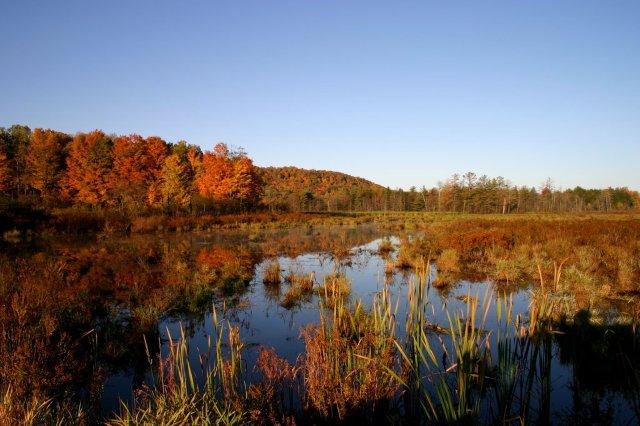
Caroline in the fall
More than 900 Caroline residents have already signed the petition – more than three times as many signatures as any other petition drive in the Town has ever gathered, says Bill Podulka. He coordinates the local activist group ROUSE (Residents Opposing Unsafe Shale-Gas Extraction) which is spearheading the petition.
“Momentum to ban gas drilling by local rule has been building across Tompkins County,” says Podulka. “This week the city of Oneonta voted to ban all forms of gas drilling within city limits, and Buffalo has already enacted a similar ban.” Even closer to home both Dryden and Ulysses boards are exploring legal options to draft a fracking ban. 
And that has some Caroline town officials running scared. Two town council members have decided to take preemptive action – they’ve submitted a resolution that would preclude the board from taking any action to consider drafting a local ban.
“Before the petition is presented and before necessary legal research is done,” says Podulka.
Council members Linda Adams and Peter Hoyt co-authored the legislation, and Toby McDonald supports it. Should gas wells be drilled in town, all stand to benefit: Hoyt and McDonald have leased their property to gas companies, and Adams directs the Tompkins Landowner’s Coalition, a group whose sole purpose is to help landowners obtain the best lease possible.
Adams and Hoyt don’t see a problem with their proposed law. They contend that local drilling bans are not permitted because New York State statute preempts local regulation of natural resource mining activities.
But many legal experts dispute this interpretation of the statute. They say that although local regulation of the day-to-day operations of resource extraction is indeed prohibited, there is ample case law to show that outright banning, which falls under local land use determination, is permissible.
Residents are outraged.  “Given that these elected officials all have ties to gas leasing, their action strikes me as a brazen abuse of power to benefit their own self-interests,” says Irene Weiser.
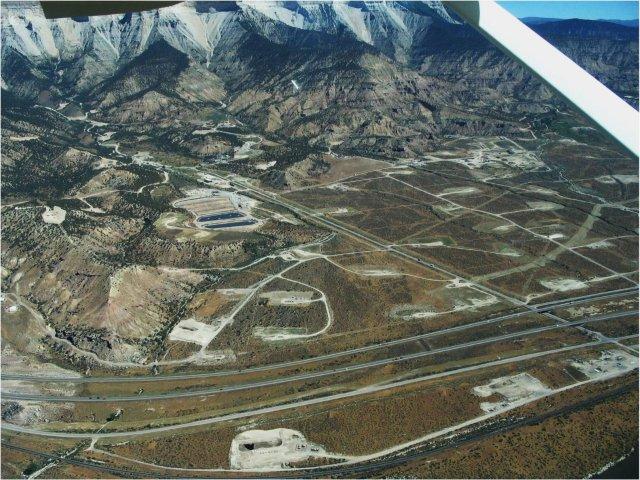
Aerial view of drilling in Colorado
Another explained that this resolution, if passed, “… would severely limit the town’s options in the face of massive industrialized hydraulic fracturing. If this type of industry is encouraged in the rural corners of Caroline,” he says, “the quiet, sweet rolling hills of green with thrushes, peepers, crickets and wild flowers could quickly be replaced with thousands of thundering trucks and hundreds of massively noisy industrial drilling rigs that will destroy the countryside for years to come — all for the short term financial benefit of only a few. These drilling rigs are massive and industrial; this is not your grand-dad’s little gas well sitting quietly out on the back forty.”
Earlier today town supervisor Don Barber commented on the attempt to short-circuit the democratic process. The resolution may be an attempt to stop debate about a frack ban. “But the town board will have that debate,” Barber said. “ The town needs to hear from all its residents before taking a position.”
The Caroline Town Board will hold its public business meeting on Tuesday, June 14, at 7 pm.  Public comments regarding the proposed resolution will begin at 8:15 pm, after the Board considers other matters.


Text Of The Proposed Resolution
Resolution Clarifying the Town of Caroline’s Role Regarding Gas Development Based on Current Environmental Conservation Law
Whereas Ecl 23-0303, section 2 states,  “The provisions of this article shall supersede all  local  laws or ordinances  relating  to  the  regulation of  the oil, gas and solution  mining industries; but shall not supersede local government jurisdiction over local roads or the rights  of  local  governments  under  the  real property tax law”; and
Whereas it is the opinion of our municipal attorney that the State clearly, with intent and purpose, set this scope; therefore be it
Resolved that the Town will not attempt to either encourage or limit gas drilling in the Town of Caroline; and further
Resolved that the Town will exercise its fiduciary responsibility to protect its investments in local roads, primarily through road use agreements; and further
Resolved that the Town through its authority under the Stormwater Law will protect local water supplies from any damaging effects of surface runoff due to gas drilling or any other large scale industrial activity.