Gas company sues Morgantown over drilling ban  – State News – Charleston Daily Mail – West Virginia News and Sports –

Gas company sues Morgantown over drilling ban  – State News – Charleston Daily Mail – West Virginia News and Sports –.


Looks like the pre-existing leases in the City of Morgantown will pose
the greatest problem for them, since “State law [in West Virginia]
gives cities the rights to exercise some authority up to a mile
outside of city limits.” I wonder if the City of Morgantown was due
notification by any of the regulatory agencies? Forewarned is
forearmed, indeed!

Dryden Town Meeting 6/15/11 Video

Video of Dryden Town Meeting 6/15/11

wherein the town board voted unanimously to advance a zoning amendment to BAN drilling to public hearing on July 20

Caroline Council Tables Resolution

The Marcellus Effect: Caroline Council Tables Resolution.

Video by Cris McConkey.  CC Attribution/Non-commercial. Playlist duration ~ 3-1/2 hrs: Rally; Privilege of the Floor and Reading of Resolutions; Presentations; Public Hearing; Vote on the resolutions.  Downloads.

SUMMARY BY SANDY PODULKA
Brooktondale Community Center, June 14, 2011

Two hundred or more people attended a Caroline Town Board meeting about a resolution to prohibit the Town from taking any action to enact a ban on hydraulic fracturing. Two of the three proponents of this resolution (Toby McDonald and Pete Hoyt) have gas leases and a third (Linda Adams) is the head of the Tompkins County Landowners Coalition. Of the 40 people who spoke, 35 were against the ban and 5 were for it. Since the resolution was apparently in response to the news that local citizens had gathered more than 900 signatures on a petition asking the Town Board to ban high-volume hydraulic fracturing in the Town, many people stated their anger that the board was trying to stifle democracy. Many pointed out the conflict of interest issue, as well, and some asked board members with conflicts to recuse themselves from any vote on this issue. Another theme was the preservation of Caroline as a safe, tranquil community. People asked the Town Attorney, Guy Krogh, and Town Board not to put the avoidance of a lawsuit higher than protecting residents. Guy Krogh indicated that a ban might be possible if crafted carefully and thoughtfully after much analysis of state law. Most of the speakers did a very good job of voicing the concerns of Caroline residents who were dismayed that this resolution popped up on June 7. Local attorney David Slottje, of the Community Environmental Defense Council, spoke eloquently and passionately against the resolution. It was tabled at about 10:45 PM.


PRIVILEDGE OF THE FLOOR and READING OF RESOLUTIONS

Supervisor Barber opens Priviledge of the Floor; Comment on resolution before board in support of New York State Senata and Assembly bills S.3472 and A.3245 “home rule” 0m0s
Comment regarding statement made by town’s attorney at the April 12th board meeting in regard to Adams’ and Hoyt’s resolution. 2m36s
Response by Councillor Hoyt and reading of pertinent parts of the minutes which were not approved in a timely fashion to notify the public. 4m41s
Reading of resolution is support of 90-day public comment period after DEC promulgates new rules upon completion of its review of the SGEIS follwed by discussion and vote. 8m8s
Introductory remarks regarding Public Hearing 12m24s
Reading of resoution “Clarifying the town’s role regarding gas development based on current Environmental Conservation Law” 18m02s
Reading of Resolution in support of A.3245 / S.3472 19m15s

PRESENTATIONS

Linda Adams, Town Councillor 0m0s
Bill Podulka, Resident and Chair, Residents Opposed to Unsafe Shale-Gas Extraction (ROUSE) 3m51s
David Slottje, Attorney with Community Environmental Defense Council 12m49s
Guy Krogh, Attorney for Town of Caroline 26m18s
PUBLIC COMMENT

1-9 Public addresses Caroline Town Board

1 Pat Brhel 1m47s
2 Sandy Podulka 4m25s
3 Jim Raponi 7m40s
4 Ann Boehm 9m52s
5 Bendidt Pauli 13m44s
6 Anna Gibson 18m31s
7 Elisa Evett 19m56s
7a Councillor Linda Adams 23m57s
8 Karen L. Allaben 26m06s
9 Rita Rosenberg 28m20s

10-18 Public addresses Caroline Town Board

10 Kim Knight 0m0s
11 Irene Weiser 2m12s
12 Todd Schmit 7m02s
13 Tony Tavelli 9m32s
14 Bruce Murray 14m33s
15 Rebecca Dewit 17m05s
16 Michele Brown 20m42s
17 David Kauber 22m20s representing Steve Kress & Elissa Wolfson
18 Nelly Farnum, former Town Councillor 25m36s

19-27 Public addesses Caroline Town Board

19 Jonathan Comstock 0m0s
20 Bert Cooley 3m37s
21 Mary Alyce Kabler 10m52s
22 Leanne Avery 14m25s
23 James Burlitch 17m46s
24 Elliot Swarthout 20m01s
25 John Reed 21m30s
26 Frank Verret 22m14s
27 John Confer 26m16s

28-39 Public addresses Caroline Board

28 Sue PK 0m0s incomplete
29 Milt Taam 1m51s
30 Cyrus Umrigar 5m12s
31 Glen Robertson 9m13s
32 Picilla Timberlake 10m28s
33 Aaron Snow 13m12s
34 Bob Andeson 14m55s incomplete
35 Barbara Lynch 15m34s
36 Ellen Harrison 16m57s
37 Phillip Shapiro 20m20s
38 Bill Crispell 22m31s
39 Beth Hollier 25m09s

Public Discussion on Resolutions and Vote by Board duration: 18m57s


Tompkins town drilling regulations | The Ithaca Journal | theithacajournal.com


Tompkins town drilling regulations | The Ithaca Journal | theithacajournal.com.

Tompkins town drilling regulations


Town drilling regulations

Here’s a look at the actions related to gas exploration adopted and under review by Tompkins County towns.

Ithaca: Adopted Road Excavation Law; Studying Road Use Preservation Law; Considering Critical Environmental Areas Legislation; Considering a zoning law to ban gas drilling in the town.

Dryden: Added industrial noise ordinance to new zoning code: Considering a zoning law to ban gas drilling in the tow:; Considered Critical Environmental Areas Legislation; Considering a zoning law to ban gas drilling in the town: Considering Aquifer Protection Ordinance; Contract with engineering firm to conduct Road Use Assessments for possible Road Use Preservation Law.

Lansing: Conducting Road Assessments with highway staff for Road Use Preservation Law.

Ulysses: Considering a zoning law to ban gas drilling in the town: Created a Citizen’s Advisory Board on Gas Drilling: Contract with engineering firm to conduct Road Use Assessments for possible Road Use Preservation Law: Funding stream monitoring by the Community Science Institute for water quality data: Passed legislation prohibiting town water from being used for gas drilling purposes.

Enfield: Adopted Road Excavation Law: Conducting citizen survey on attitudes toward gas drilling: Considering contract with engineering firm to conduct Road Use Assessments for possible Road Use Preservation Law.

Groton: The town is considering a road use assessment, and citizens are forming a landowners’ consortium to negotiate with drilling companies regarding leasing.

Newfield: Adopted Road Excavation Law: Contract with engineering firm to conduct Road Use Assessments for possible Road Use Preservation Law;

Danby: Adopted Stormwater Management Law: Adopted Road Excavation Law: Contract with engineering firm to conduct Road Use Assessments for possible Road Use Preservation Law: Working with first-responders to prepare for gas drilling accidents/emergencies: Researching possible noise/light protection ordinances: Considering Critical Environmental Areas Legislation: Citizens preparing petition for gas drilling ban.

Caroline: Adopted Road Excavation Law: Considering conducting Road Use Assessments for Road Use Preservation Law.

Two Caroline Town Board members, Linda Adams and Peter Hoyt have placed a resolution on the agenda of the June 14 board meeting that would prevent the town from taking any action to prohibit high-volume hydraulic fracturing.

The Marcellus Effect: Frack Democracy! Full Speed Ahead

The Marcellus Effect: Frack Democracy! Full Speed Ahead.

Friday, June 10, 2011

Frack Democracy! Full Speed Ahead

Town of Caroline, Tompkins County NY
Drive south of Ithaca just a few miles and you come to the Town of Caroline. It’s a lovely mix of rolling hills, farms and several small communities. People move here to raise their vegetables and children in a quiet rural environment. They stay because of the community.
But that sense of community may be fracturing. About 55% of the land in the Town of Caroline is leased to gas companies and some residents worry that a minority will rake in economic benefits at the expense of the majority. They are concerned that industrialized drilling could contaminate their water, pollute their air, affect soil and food production, drastically change land use and damage publicly-funded infrastructure.
So over the past few weeks a few of these folks have been walking through their neighborhoods carrying a petition. It’s a simple petition, only 55 words long: We, the undersigned residents of the Town of Caroline, urge the Town Board to ban gas extraction using high-volume, slickwater, hydraulic fracturing in the Town of Caroline. The methods used and the intensity of industrial development threaten our clean air, clean water, soil, rural landscapes, and health, as well as our social and economic well-being.
Caroline in the fall
More than 900 Caroline residents have already signed the petition – more than three times as many signatures as any other petition drive in the Town has ever gathered, says Bill Podulka. He coordinates the local activist group ROUSE (Residents Opposing Unsafe Shale-Gas Extraction) which is spearheading the petition.
“Momentum to ban gas drilling by local rule has been building across Tompkins County,” says Podulka. “This week the city of Oneonta voted to ban all forms of gas drilling within city limits, and Buffalo has already enacted a similar ban.” Even closer to home both Dryden and Ulysses boards are exploring legal options to draft a fracking ban. 
And that has some Caroline town officials running scared. Two town council members have decided to take preemptive action – they’ve submitted a resolution that would preclude the board from taking any action to consider drafting a local ban.
“Before the petition is presented and before necessary legal research is done,” says Podulka.
Council members Linda Adams and Peter Hoyt co-authored the legislation, and Toby McDonald supports it. Should gas wells be drilled in town, all stand to benefit: Hoyt and McDonald have leased their property to gas companies, and Adams directs the Tompkins Landowner’s Coalition, a group whose sole purpose is to help landowners obtain the best lease possible.
Adams and Hoyt don’t see a problem with their proposed law. They contend that local drilling bans are not permitted because New York State statute preempts local regulation of natural resource mining activities.
But many legal experts dispute this interpretation of the statute. They say that although local regulation of the day-to-day operations of resource extraction is indeed prohibited, there is ample case law to show that outright banning, which falls under local land use determination, is permissible.
Residents are outraged.  “Given that these elected officials all have ties to gas leasing, their action strikes me as a brazen abuse of power to benefit their own self-interests,” says Irene Weiser.
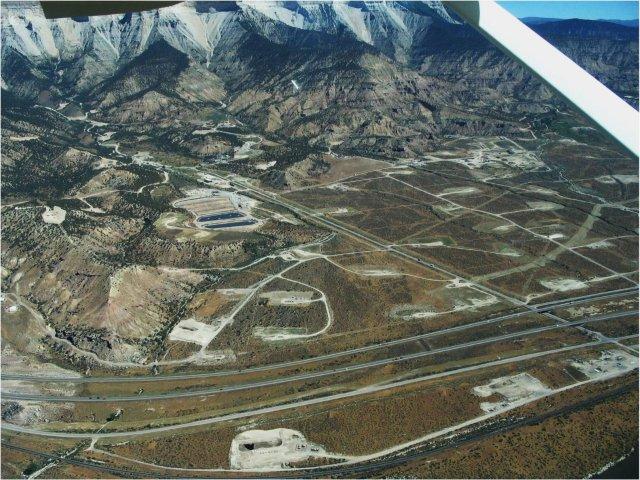
Aerial view of drilling in Colorado
Another explained that this resolution, if passed, “… would severely limit the town’s options in the face of massive industrialized hydraulic fracturing. If this type of industry is encouraged in the rural corners of Caroline,” he says, “the quiet, sweet rolling hills of green with thrushes, peepers, crickets and wild flowers could quickly be replaced with thousands of thundering trucks and hundreds of massively noisy industrial drilling rigs that will destroy the countryside for years to come — all for the short term financial benefit of only a few. These drilling rigs are massive and industrial; this is not your grand-dad’s little gas well sitting quietly out on the back forty.”
Earlier today town supervisor Don Barber commented on the attempt to short-circuit the democratic process. The resolution may be an attempt to stop debate about a frack ban. “But the town board will have that debate,” Barber said. “ The town needs to hear from all its residents before taking a position.”
The Caroline Town Board will hold its public business meeting on Tuesday, June 14, at 7 pm.  Public comments regarding the proposed resolution will begin at 8:15 pm, after the Board considers other matters.


Text Of The Proposed Resolution
Resolution Clarifying the Town of Caroline’s Role Regarding Gas Development Based on Current Environmental Conservation Law
Whereas Ecl 23-0303, section 2 states,  “The provisions of this article shall supersede all  local  laws or ordinances  relating  to  the  regulation of  the oil, gas and solution  mining industries; but shall not supersede local government jurisdiction over local roads or the rights  of  local  governments  under  the  real property tax law”; and
Whereas it is the opinion of our municipal attorney that the State clearly, with intent and purpose, set this scope; therefore be it
Resolved that the Town will not attempt to either encourage or limit gas drilling in the Town of Caroline; and further
Resolved that the Town will exercise its fiduciary responsibility to protect its investments in local roads, primarily through road use agreements; and further
Resolved that the Town through its authority under the Stormwater Law will protect local water supplies from any damaging effects of surface runoff due to gas drilling or any other large scale industrial activity.

Oneonta Common Council bans gas drilling » Local News » The Daily Star, Oneonta, NY –

Oneonta Common Council bans gas drilling » Local News » The Daily Star, Oneonta, NY  June 8, 2011


June 8, 2011

Oneonta Common Council bans gas drilling


By Jake Palmateer Staff Writer


ONEONTA _ The Common Council voted Tuesday to ban all forms of natural gas drilling in city limits.

One alderman said he will work to see the city takes even more steps.

The vote was not unanimous. With Third Ward Alderman Erik Miller absent, Seventh Ward Alderman Liz Shannon abstained.

After the meeting, she said she supports the concept of banning natural gas drilling, but said the draft ordinance was poorly written.

Several members of the public spoke out in favor of the measure, including Colleen Blacklock, who submitted a petition with 1,888 signatures.

The measure makes it unlawful for any person or corporation to drill for natural gas within the city. Under the proposed ordinance, violators are subject to a maximum fine of $250 for each day a violation occurs.

“I am fully supportive of the ordinance,” Eighth Ward Alderman Kevin Hodne said.

Hodne said hydraulic fracturing would be an economic disaster for the area because the high concentration of drilling rigs and equipment would affect tourism and the service industry.

“I think we are taking a good stand here,” he said.

No one spoke against it.

In response to call for further action from Hartwick College professor Mark Davies, Fourth Ward Alderman Mike Lynch, who worked with Alderman Miller on the draft, said he would be looking at additional steps the city may take. These include regulating the staging areas used to store chemicals used in the hydraulic fracturing process or equipment used in the drilling.

The Common Council also voted unanimously to approve an amendment to the zoning code overhaul they passed May 17.

An area near Silver Creek that under the draft zoning code was zoned for apartment complexes, was changed to a more restrictive zone.

A mayor’s public hearing on the amendment was set for June 21. Mayor Dick Miller said the zoning code overhaul passed May 17 will get his signature.

“I will be signing the new zoning code,” Miller said. “I suspect that comes as no surprise to anyone.”


French Lean Toward Ban of a Controversial Gas Extraction Technique – NYTimes.com

French Lean Toward Ban of a Controversial Gas Extraction Technique – NYTimes.com.

French Lean Toward Ban of a Controversial Gas Extraction Technique

PARIS — French lawmakers opened debate on Tuesday on proposals to ban a method for extracting oil and gas deposits from shale because of environmental concerns, throwing up the first serious stumbling block to firms that want to use the practice.

Green

A blog about energy and the environment.

Looking with alarm at the experience in the United States, where shale gas is booming, even members of President Nicolas Sarkozy’s governing conservative party have come out against the practice, known as hydraulic fracturing, in which water, sand and chemicals are pumped deep underground under high pressure to free scattered pockets of oil and gas from dense rock formations.

Hydraulic fracturing, or fracking, “is not something we want to use in France,” Nathalie Kosciusko-Morizet, the environment minister, said on RMC Radio.

“Shale gas is the same as any other gas,” said Ms. Kosciusko-Morizet, who in February announced a halt in all exploration, pending the results of a study. “What poses a problem is the technology used. Today there aren’t 30 technologies, there’s only one for extracting shale gas — hydraulic fracturing.”

Even without the final study, which is expected in June, deputies in the National Assembly are expected to pass a ban on Wednesday. The legislation will then be sent to the Senate.

Proponents of so-called unconventional gas and oil argue that exploiting European shale deposits would reduce the Continent’s dependence on imports. Shale-based fuels have only begun to appear on the regional energy agenda but may become increasingly visible in the second half of 2011, when Poland assumes the rotating presidency of the European Union. The Poles, leery of their reliance on Russia for their gas, have embraced the search for shale gas.

Fracking has been employed in the United States since the 1990s to tap beds of shale that energy producers had previously considered almost useless. Production from those wells now contributes nearly a quarter of the United States gas supply, driving down prices for consumers. But criticism of the practice has been growing even as it spreads.

A critical documentary on the practice, “Gasland,” was nominated this year for an Oscar, and a spill in Pennsylvania by Chesapeake Energy that polluted a waterway with fracking chemicals seemed to confirm some people’s worst fears.

A ban would affect companies, including Hess Oil France, which has teamed up with the French unit of Toreador Resources to explore in the Paris area; Vermilion Energy, a Canadian company; Schuepbach Energy, a Texas company that is allied with Gaz de France; and Total, the largest French oil company.

Europe is at least a decade behind the United States in exploring its shale resources, and no one is even certain how much oil and gas there is, much less how much can be recovered profitably.

“Our position hasn’t changed,” Total said in a statement. “We think it would be wrong for the country to close the dossier on shale gas without even knowing if there is any.”

Hess Oil France, which has a license for exploring for oil in the Paris basin, had been only about two days from beginning test-drilling in February when the government announced the halt, Mark R. Katrosh, the chief executive, said in an interview.

Mr. Katrosh, who noted that low levels of oil production had been taking place for decades in the Paris region, cited estimates that France held as many as 100 billion barrels of shale oil, of which perhaps 10 billion were recoverable.

Regarding the potential size of the resource, Mr. Katrosh said, “we’re all talking hypothetically right now. The country needs to debate and decide whether they see value in understanding what the potential resource is, and if they do, we’re one of the companies that’s willing to make the investment to better understand this and demonstrate that we can operate safely and respectfully of the environment.”

Industry officials remain optimistic that with public education and political will, economic logic will eventually carry the day. They acknowledge that Europe needs to modernize its regulatory system to adapt to the technology, and they say they expect to have to adapt to much stricter regulation than is the norm in the United States.

For the several hundred fracking opponents outside the National Assembly on Tuesday morning, no compromise is possible.

“For now, we oppose all drilling,” said Liliane Devillers, president of Collectif Carmen, an organization that she said was an umbrella group representing 16 “mostly apolitical” environmental associations from the Picardie region northeast of Paris.

“No one has shown us that it can be done safely, and all the information we have suggests there is a big risk for the groundwater from toxic chemicals.”

French Lean Toward Ban of a Controversial Gas Extraction Technique – NYTimes.com

French Lean Toward Ban of a Controversial Gas Extraction Technique – NYTimes.com.

French Lean Toward Ban of a Controversial Gas Extraction Technique

PARIS — French lawmakers opened debate on Tuesday on proposals to ban a method for extracting oil and gas deposits from shale because of environmental concerns, throwing up the first serious stumbling block to firms that want to use the practice.

Green

A blog about energy and the environment.

Looking with alarm at the experience in the United States, where shale gas is booming, even members of President Nicolas Sarkozy’s governing conservative party have come out against the practice, known as hydraulic fracturing, in which water, sand and chemicals are pumped deep underground under high pressure to free scattered pockets of oil and gas from dense rock formations.

Hydraulic fracturing, or fracking, “is not something we want to use in France,” Nathalie Kosciusko-Morizet, the environment minister, said on RMC Radio.

“Shale gas is the same as any other gas,” said Ms. Kosciusko-Morizet, who in February announced a halt in all exploration, pending the results of a study. “What poses a problem is the technology used. Today there aren’t 30 technologies, there’s only one for extracting shale gas — hydraulic fracturing.”

Even without the final study, which is expected in June, deputies in the National Assembly are expected to pass a ban on Wednesday. The legislation will then be sent to the Senate.

Proponents of so-called unconventional gas and oil argue that exploiting European shale deposits would reduce the Continent’s dependence on imports. Shale-based fuels have only begun to appear on the regional energy agenda but may become increasingly visible in the second half of 2011, when Poland assumes the rotating presidency of the European Union. The Poles, leery of their reliance on Russia for their gas, have embraced the search for shale gas.

Fracking has been employed in the United States since the 1990s to tap beds of shale that energy producers had previously considered almost useless. Production from those wells now contributes nearly a quarter of the United States gas supply, driving down prices for consumers. But criticism of the practice has been growing even as it spreads.

A critical documentary on the practice, “Gasland,” was nominated this year for an Oscar, and a spill in Pennsylvania by Chesapeake Energy that polluted a waterway with fracking chemicals seemed to confirm some people’s worst fears.

A ban would affect companies, including Hess Oil France, which has teamed up with the French unit of Toreador Resources to explore in the Paris area; Vermilion Energy, a Canadian company; Schuepbach Energy, a Texas company that is allied with Gaz de France; and Total, the largest French oil company.

Bans and Moratoria on Hydrofracking 4/25/11 Unofficial list

MORATORIA, BANS, RESOLUTIONS

New York, Pennsylvania, New Jersey, and Maryland Municipalities and A

Sampling of Key Organizations Opposed to Hydrofrack Drilling

New York State:

* Two legislative bills on hydrofrack drilling are being

considered by New York State. The Assembly bill calls for a 5 year

moratorium while the Senate bill calls for an outright ban.

* NYS Executive Order calling for a drilling moratorium by former

Governor Paterson has been affirmed by Governor Cuomo.

* Yates County resolution unanimously passed calls for similar

protection treatment of their watershed as that in NYC and Syracuse

watersheds.

* The Town of Jerusalem (Yates) at the February public hearing

enacted a moratorium ordinance for their entire township.

* The Town of Milo is drawing up a moratorium statement for board

action.

* Dewitt, Tully, Marcellus and Skaneateles have enacted moratoria

laws.

* Highland, (Sullivan Co) is developing a moratorium statement.

* Buffalo has banned hydrofrack drilling and wastewater disposal in

their city.

* Lumberland (Sullivan Co) is considering a moratorium statement.

* Town of Ulysses is establishing “industrial zones” attempting to

restrict the negative impact of drilling in their water supply.

* Tompkins County has enacted a ban on fracking on county land.

* Broome County: Ban on hydrofracking on county lands. Waste

restrictions for fracking cuttings and flow back water established.

* Ontario County and Onondaga Counties have enacted bans on

fracking on county owned land.

* Ulster County has banned hydrofrack drilling on county owned

lands.

* Gorham in Ontario County enacted a moratorium ordinance.

* The towns that ring Cooperstown’s reservoir, Otsego Lake —

Middlefield, Otsego, Butternuts, Cherry Valley and Springfield — are

moving to ban or restrict natural gas drilling and high-volume

hydraulic fracturing.

* The Medical Society of the State of New York has gone on record

supporting a moratorium on gas drilling using high volume hydraulic

fracturing.

* Cooperstown’s Chamber of Commerce has issued a position

statement supporting a total ban on fracking due to the impact it will

make on their watershed, farming and tourism.

* A group of residents have launched a petition drive designed to

ban the use of high-volume, slickwater hydraulic fracturing in the

Town of Caroline, Tompkins County.

* New York City has called on the US Congress to remove hydrofrack

drilling’s exemption from the Safe Water Drinking Act.

* The Otsego County Planning Board approved changes to

Middlefield’s master plan and zoning law that would specifically

prohibit heavy industry, including gas and oil drilling.

* The Board of Trustees of Bassett Medical Center, based in

Cooperstown, New York, views the issue of hydrofracking as a public

health issue of the highest priority and resolves that the

hydrofracking method of gas drilling constitutes an unacceptable

threat to the health of patients, and should be prohibited until such

time as it is proven to be safe.

* A consortium of interested citizens is planning for a unified

moratorium and eventual ban of hydrofrack drilling in the entire Keuka

Lake watershed region.

* Lebanon town board members adopted a memorializing resolution

that calls on the New York State Legislature and Governor Andrew Cuomo

to repeal and reform compulsory integration laws in the State of New

York that currently govern natural gas development.

* A petition drive has resulted in the Dryden Town Board

unanimously passing a resolution to move forward with an ordinance to

ban fracking.

Pennsylvania:

* Pittsburgh bans hydraulic fracturing in their city.

* Luzerne County Lehman Township, ordinance calling for “home rule” and a ban on drilling within their surrounding township area.

* Cresson has enacted legislation banning fracking.

* Washington Township has banned fracking.

* Philadelphia, Pennsylvania City Council unanimously passed the pro-moratorium Resolution on Marcellus Shale Drilling Environmental and Economic Impacts.

* Philadelphia refuses to purchase Marcellus Shale gas as the dumping of flow back waters is polluting their water supply.

New Jersey:

* The New Jersey Senate Environment Committee unanimously passed a bill to ban hydrofrack drilling in the state. The legislators now need to reconcile the Assembly’s Environment Committee’s moratorium

bill with the Senate’s Ban Bill. It will be going to the floor in the

coming months.

Maryland:

* The first community in Maryland, Mountain Lake Park, adopted an ordinance banning corporations from natural gas drilling.

NY, PA, NJ and DE – Delaware River Basin Commission has a moratorium on gas drilling in place in the Watershed located in these 4 states since May 2010 that is running concurrent with the development of natural gas development regulations.

Compiled by Joe Hoff, Chairman KCAH As of April 20, 2011

Shale gas drilling likely to be banned in France | EurActiv

Shale gas drilling likely to be banned in France | EurActiv.

Shale gas drilling likely to be banned in France
Published: 12 April 2011

The French government has backed a draft bill that would ban shale gas
drilling in the country, citing fears that the extraction method is a
risk to water quality. However, for other countries like Poland, shale
gas has become a national priority to win independence from Russian
imports. EurActiv France reports.

MPs from the ruling centre-right UMP party tabled the bill in the
National Assembly using an accelerated procedure. As a result, it will
only be examined in a single reading in the Assembly and the Senate.

If adopted, the text would suspend drilling permits granted in March
2010 to Total, GDF Suez, and Schuepbach Energy by former Environment
Minister Jean-Louis Borloo.

A shale gas drilling ban is also supported by the opposition Socialist
Party, which presented its own alternative text with the same aim.

In March, the French government had prolonged a moratorium on shale
gas drilling until June.

This had followed protests opposing the drilling method, notably in
the village of Villeneuve-de-Berg in southern France, with over 20,000
people voicing their opposition chanting “No gazaran!” Shale gas
drilling near the town had been planned for the end of 2011.

Scientists relieved, oil business fears red tape

After the announcement of the suspension of drilling, researchers at
the hydro-science centre at the University of Montpellier said they
were reassured. In the event of shale gas drilling, Montpellier’s
region “and all the water reserves close to the drilling area would
have been seriously threatened,” said researcher Françoise Elbaz.

“There is always a technological risk. In going back up, the drill can
release toxic gases such as the radioelements naturally contained in
the rocks,” she said. “And the authorities would have to cut off the
water supply.”

No such drilling has yet taken place in France, but researchers cite
the example of the city of Pittsburgh in the United States. Elbaz says
that following the use of chemicals to fracture the rock and ensure
permeability, the waters of the city have reached a salinity level
inappropriate for consumption.

During a presentation of his company’s annual results last February,
the director-general of Total, Christophe Margerie, said he was
“annoyed by the noise” surrounding shale gas. He expressed frustration
with excessive concern about the safety of drilling, saying “it’s good
to talk about the problems this can pose – if one day there are some –
but today, there are none”.

Margerie also raised fears that red tape could hinder production.
“[If] we need to ask the authorisation to one day ask for
authorisation, we’re going to start falling into useless paperwork,”
he said.

EU to assess shale gas potential in Europe

If the law is passed, the French debate on shale gas should be closed,
but the discussion continues at the European level.

Last February, European leaders agreed that “Europe’s potential for
sustainable extraction and use of conventional and unconventional
(e.g. shale gas, oil shale) fossil fuel resources should be assessed”.

A report by the consultancy firm McKinsey – commissioned by major gas
giants Gazprom, Centrica and others – claimed that shale gas could
meet the continent’s energy needs for 30 years.

Cuadrilla Resources, a British energy company, has begun exploratory
drilling near Blackpool, Lancashire. Drilling of shale gas is already
taking place near Gdansk, Poland.

For certain European countries, Poland in the lead, the drilling of
shale gas is seen as an alternative to Russian gas, which would allow
for greater energy independence.